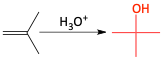
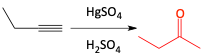
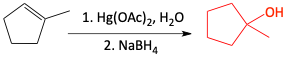
11.9 Markovnikov hydration of alkyne
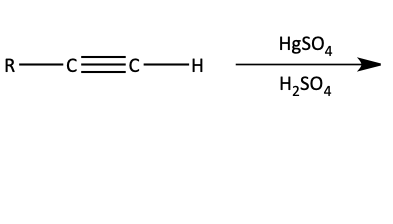
Alkynes, with their two pi-bonds, can also react in an oxymercuration-demercuration reaction. The reaction is very similar to that for an alkene with a twist at the end. Instead of mercuric acetate, the oxymercuration of alkynes usually involves mercuric sulfate and aqueous sulfuric acid. Like with alkenes, this results in the addition of water across a pi-bond resulting in a Markovnikov alcohol. Only one pi-bond of the triple bond reacted, so alkene remains. This vinyl alcohol is called an enol (pronounced “een-awl”). The “enol” name comes from this compound being an alkene (ene) and an alcohol (ol).
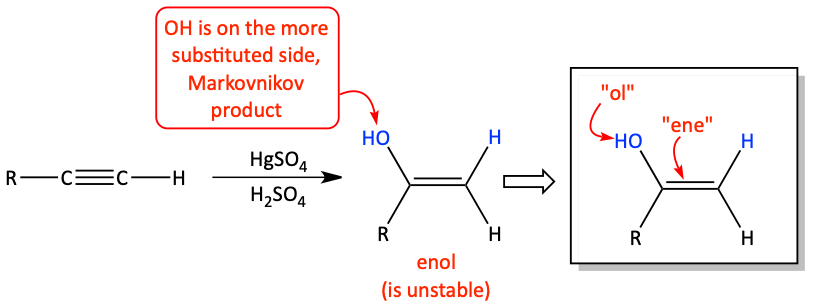
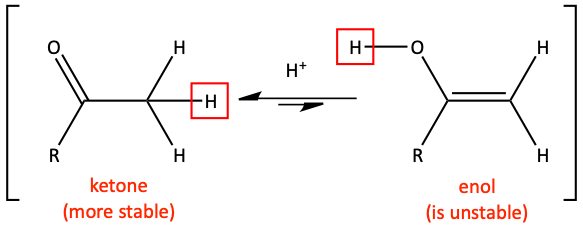
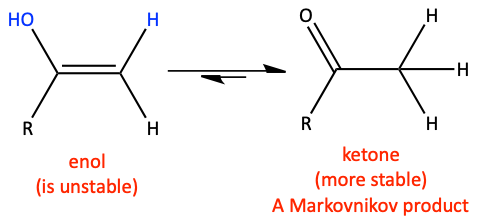
Enols tend to be unstable. Enols are in equilibrium with their isomer, the ketone. These isomers differ only in the location of one proton and a double bond. Such isomers are called tautomers (pronounced “taw-toe-mers”). The ketone and enol are called keto-enol tautomers. The transformation of one into another is called a keto-enol tautomerization. The process itself is called keto-enol tautomerism. In the equilibrium of the two, the keto form predominates. Take careful notice of the transformation. The hydrogen atom moves from the alcohol of the enol to the alpha carbon. The pi-bond of the alkene of the enol moves to make a carbonyl (a ketone).
Overall Reaction
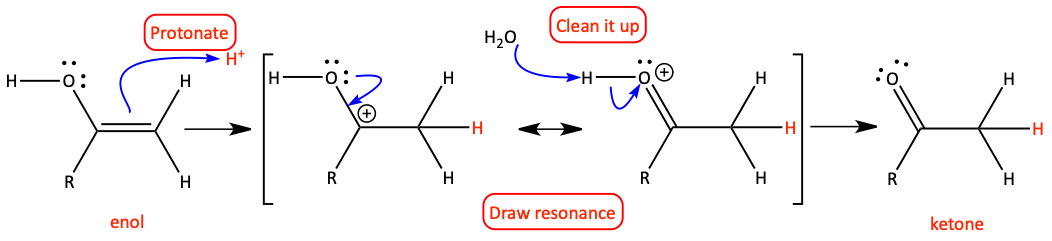
The tautomerization is acid-catalyzed since sulfuric acid is used in the reaction. H+ is available because of the acid. To write the mechanism of the acid-catalyzed keto-enol tautomerization, protonate the enol at the alpha-carbon, draw resonance forms, and clean it up to make a ketone.
3. Draw the products of the following reactions.
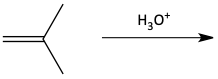
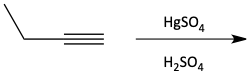
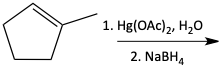
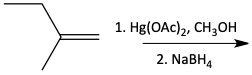
3.