11.14 Cyclopropanation
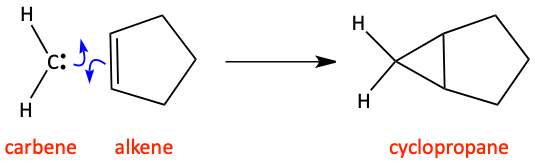
A carbene is a neutral reactive intermediate of a divalent carbon atom with a lone pair of electrons. The lone pair of electrons makes a carbene a nucleophile. Carbenes are also electrophilic because they contain an empty p-orbital. Carbenes are used to make cyclopropane rings. There are a couple of ways to generate carbenes.
11.14.1 Alpha elimination making dihalocarbenes
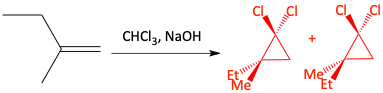
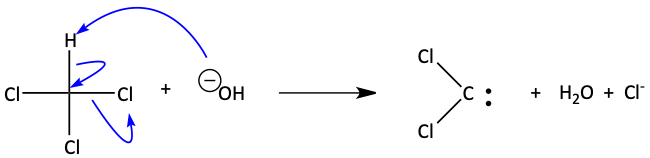
If a proton (hydrogen atom) and a good leaving group are on the same carbon atom, alpha elimination can occur. Alpha elimination is when two groups are removed from the same carbon atom. In this case, a good base like hydroxide is used to deprotonate the carbon while simultaneously, the leaving group leaves. This generates a carbene.
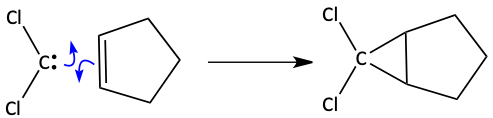
The carbene can react with an alkene to form a cyclopropane ring.
11.14.2 Diazomethane
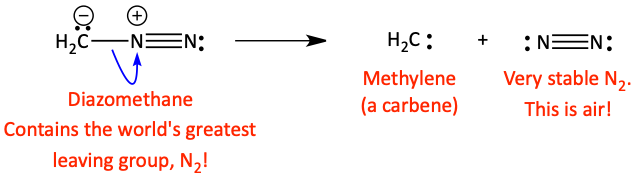
To make the simplest of the carbenes, methylene (:CH2), diazomethane can be used. Azo means “containing nitrogen. Diazomethane has two nitrogen atoms on one carbon. These two nitrogen atoms make up the world’s greatest leaving group, nitrogen gas, N2. The nitrogen gas leaving group is very stable and simply bubbles away as air.
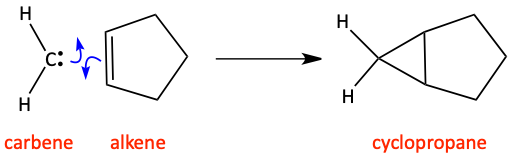
The methylene carbene can then react with an alkene to form a cyclopropane.
Although very effective, diazomethane is not necessarily the best way to make cyclopropane rings. Diazomethane is quite reactive. It can explode if heated above 100°C. A blast shield should be used when it is used in reactions. Diazomethane also has an acute toxicity and should be handled with care. Also, diazomethane is so reactive that an unwanted side reaction can also occur. The methylene carbene might insert between carbon-carbon bonds or between carbon-hydrogen bonds.
Unwanted side reactions
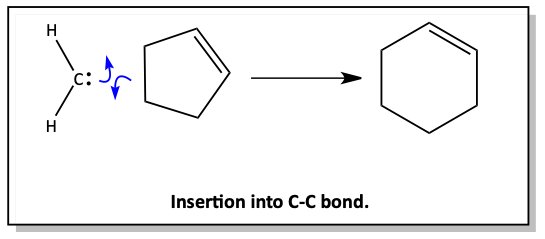
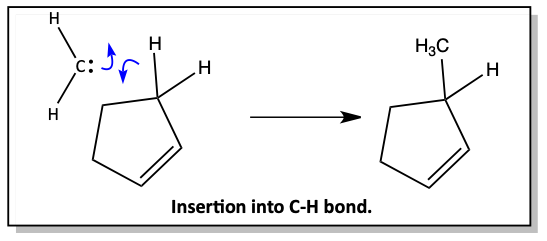
Because of these unwanted side-reactions when diazomethane was used, a gentler method was developed to synthesize cyclopropane rings. This method is the Simmons-Smith reaction. It uses what is called the Simmons-Smith reagent, which is a carbenoid. A carbenoid is like a carbene, but not exactly the same thing.
11.14.3 Simmons-Smith Reaction
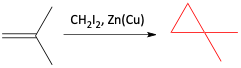
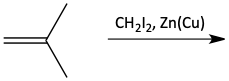
In this reaction, diiodomethane is reacted with zinc-copper couple. This makes a carbene-like species called a carbenoid. This carbenoid can be thought of as :CH2, methylene, but it is not as reactive as the methylene carbene made from diazomethane. The advantage is the unwanted side reactions do not occur, only the cyclopropanation.

7. Draw the products of the following reactions.
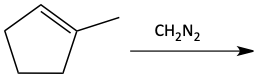
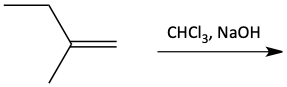
7.