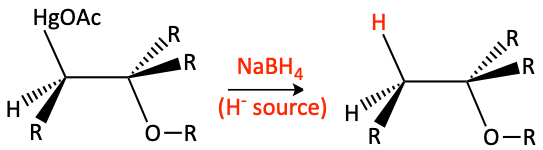
11.8 Oxymercuration/Demercuration -with alcohol -a Triangle Reaction
11.8.1 Oxymercuration in alcohol
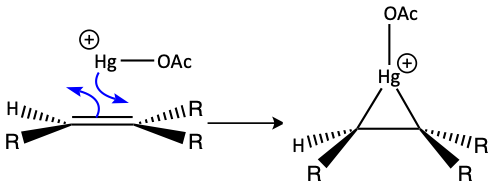
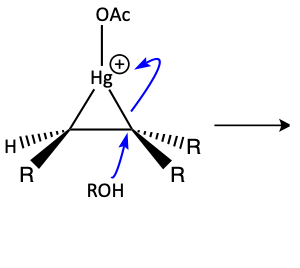
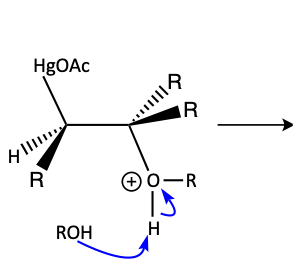
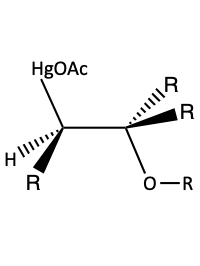
Once again, mercuric acetate is used to make the triangular mercurium ion. If water is not used as our solvent, it cannot react as the nucleophile. If alcohol is used as the solvent, the lone pair of electrons on the alcohol can act as a weak nucleophile and attack the mercurium. Again, it attacks the carbon atom of the mercurium triangle with the greatest partially positive charge. The electron bond goes up onto the mercury cation to make a good, neutral mercury leaving group. The protonated –OR group is deprotonated with another molecule of solvent to make a mercury-ether containing compound. Many different Markovnikov ethers can be made depending on the alcohol used as the solvent. R = CH3 for methanol, R = CH2CH3 for ethanol, etc.
11.8.2 Demercuration
Sodium borohydride (NaBH4) is once again used to replace HgOAc with H- making a Markovnikov ether.