11.7 Oxymercuration/Demercuration -with water -A triangle reaction
A good, gentle way to make Markovnikov alcohols is oxymercuration in water followed by demercuration. This is an example of what I call a Triangle Reaction. If you have not yet read about Triangle reactions and the analogy we use for them, go do that first here.
11.7.1 Oxymercuration in water
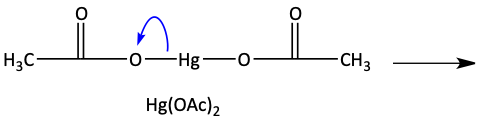
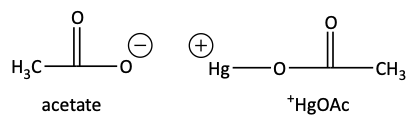
To perform the oxymercuration, mercuric acetate, Hg(OAc)2, is used. There are two common oxidation states of mercury, 1+ and 2+. Mercuric refers to the higher oxidation state, Hg2+. Acetate (OAc) is CH3CO2-. There needs to be two of these acetates with -1 charge to balance the 2+ charge of the mercury. The key first step in the oxymercuration of an alkene is the breaking apart of the mercuric acetate to form the electrophilic +HgOAc.
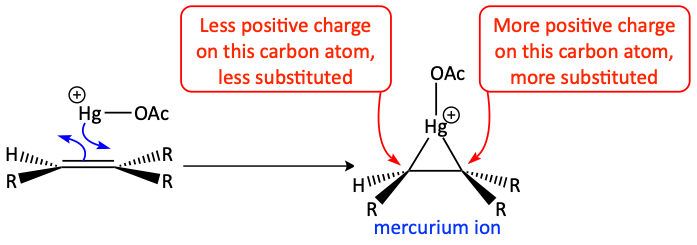
The negative pi-electrons of the alkene eagerly attack the positively charged, electrophilic +HgOAc. The pi-electrons attack to form the triangular mercurium ion. The two electrons from the pi bond go towards the Hg+, and two electrons return towards the pi bond. This causes the oxidation state of the mercury not to change so it remains Hg+. These triangles are formed when very large, soft atoms like mercury are used in the electrophile. The mercury atom is so large, it takes both carbon atoms to hold up. The victim in our triangle analogy is now holding a “+” over his head indicating he has money.
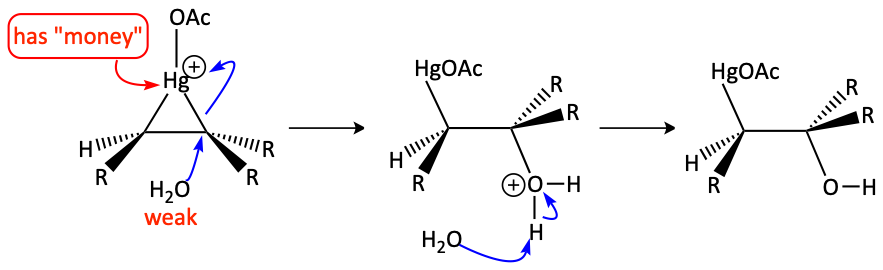
When the reaction is run in water, a weak nucleophile is present. Water is a stable, happy molecule. It will not attack a triangle compound unless it is coaxed in by money in some bags. In this case, the positive charge is shared over the two carbon atoms of the triangle. The more substituted carbon atom (on the right) carries a greater partial positive charge. Water then attacks the carbon atom with the greatest partial positive charge. In our criminal/victim analogy, the right carbon atom of the triangle is holding more bags and the + money is kept on the right carbon atom of the triangle under the bags. From what direction will the water attack the triangle? The large HgOAc blocks the topside of the mercurium ion triangle from attack, so the water must attack from the backside. It attacks, and the electrons go up onto the positive mercury. The neutral mercury acetate that is formed is a good leaving group—even though it is still attached to the left triangle carbon of our molecule. Finally, another water molecule cleans up the protonated alcohol to give us a mercury-alcohol compound.
11.7.2 Demercuration
The final step is demercuration, where HgOAc is replaced with H. Sodium borohydride (NaBH4) is a source of hydride (H-). This H- directly replaces the HgOAc. Don’t worry about the mechanism of this step. The mechanism will only confuse you at this state, so this is one of those instances where you should simply memorize this.
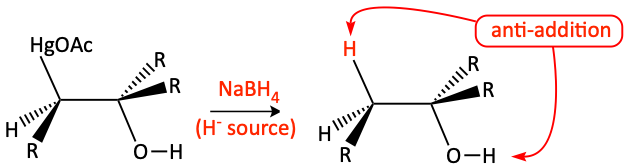
The benefits of oxymercuration and demercuration are: 1) a regular carbocation is not formed, so there is no chance for rearrangements. 2) the reaction is gentler than using sulfuric acid. 3) the reaction tends to go in high yield. Are there any drawbacks to the oxymercuration/demercuration reaction? You may have already guessed it. Any time a reaction uses mercury, we need to be careful. Mercuric acetate and our mercury-containing products are toxic. We need to be very careful using them and be careful that we properly dispose of our waste.