11.23 Acetylide formation
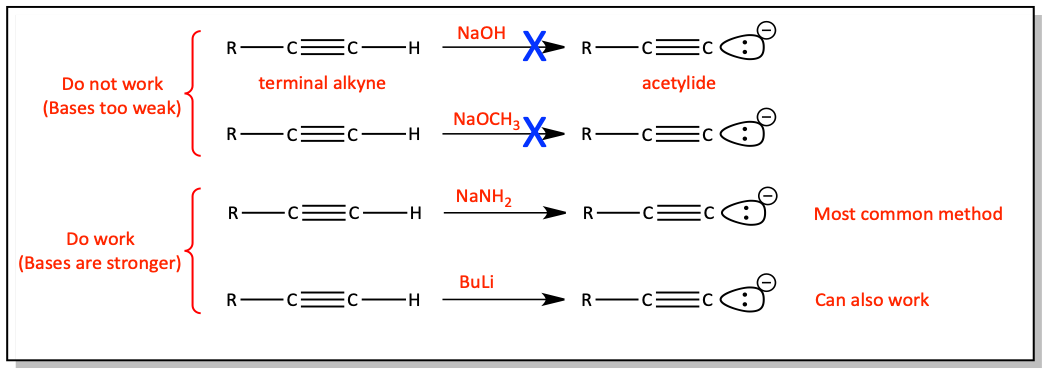
Terminal alkynes are slightly acidic. This is because the proton is on an sp hybridized carbon atom. Once deprotonated, this carbon atom will hold its negative lone pair of electrons in an sp hybrid orbital that is 50% s-character. These negative electrons will be held close to the carbon atom’s positive nucleus. You can review this in the acid/base discussion here. The resulting anionic alkyne is called an acetylide.

Terminal alkynes are only slightly acidic, though. A fairly strong base is required to deprotonate it. Negative oxygen bases like hydroxide, HO-, or alkoxide, RO-, simply do not work. Stronger bases are required. Reactive bases with negative nitrogen atoms or negative carbon atoms are needed to deprotonate terminal alkynes.
Sometimes, the acetylide ion will be drawn with its counterion. It may be drawn in the following ways.

