11.19 Further oxidation with KMnO4
11.19.1 Of alkenes
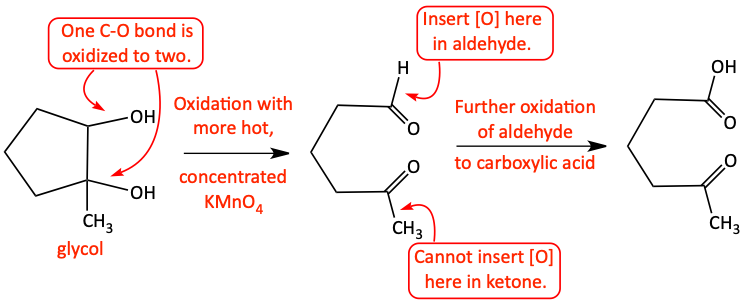
If the alkene reaction with potassium permanganate is not conducted under dilute and cold conditions but is instead run under more basic conditions and warm and concentrated conditions, further oxidation can occur. When the glycol is further oxidized, the carbon-carbon sigma bond of the glycol is broken and the single carbon-oxygen bonds of the glycol turn into carbon-oxygen double bonds (an oxidation). KMnO4 is a pretty strong oxidizer. If an aldehyde is first made by this oxidation, it is further oxidized to a carboxylic acid.

and the further oxidation of the glycol with hot, concentrated KMnO4.
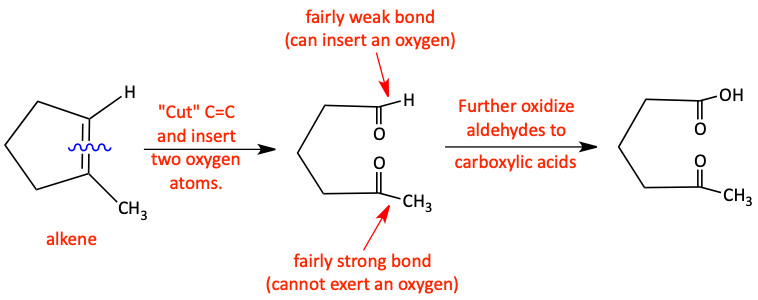
Overall, this reaction can be thought of as chopping the alkene in half and inserting two oxygen atoms. If the result is a ketone, nothing more happens to that carbon atom. If the result is an aldehyde, further oxidation to a carboxylic acid occurs.
11.19.2 Of alkynes
When KMnO4 reacts with an alkyne under more aggressive conditions, in the presence of hydroxide base and heat, the α-diketone is produced like under less aggressive neutral conditions, but it is then further, fully oxidized. The C-C bond between the two carbonyl groups is cleaved followed by further oxidation resulting in two carboxylic acids. With three C-O bonds, the carboxylic acid is fully oxidized and cannot be oxidized further.
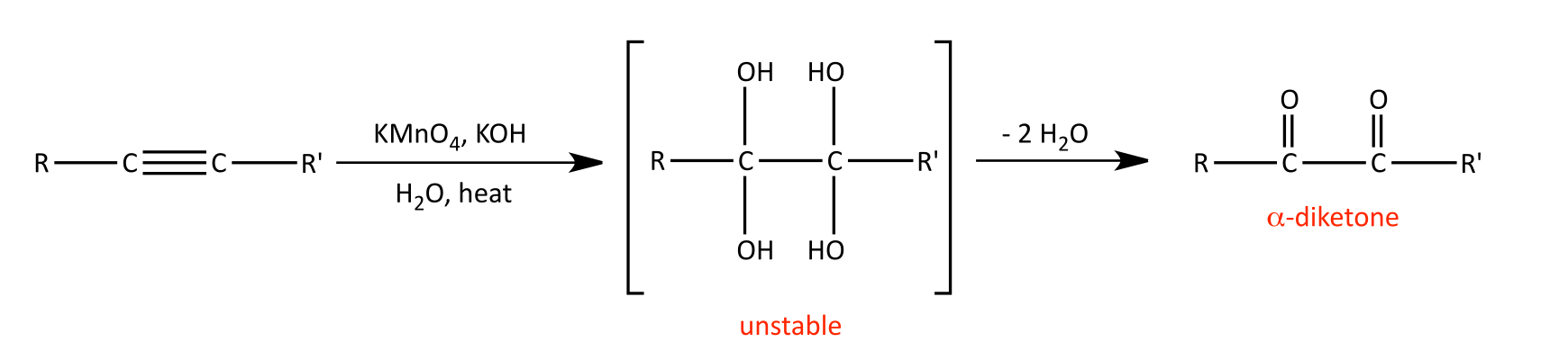
and the further oxidation of the α-diketone with hot, concentrated KMnO4.
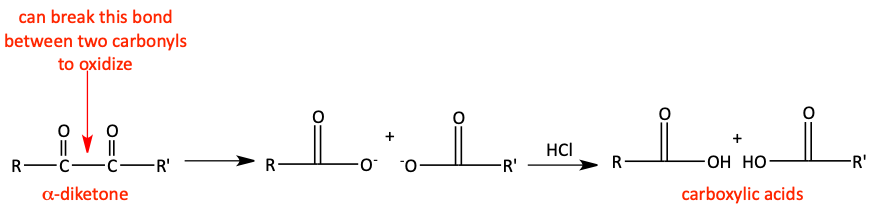
Overall, the cleavage can be thought of as. . .
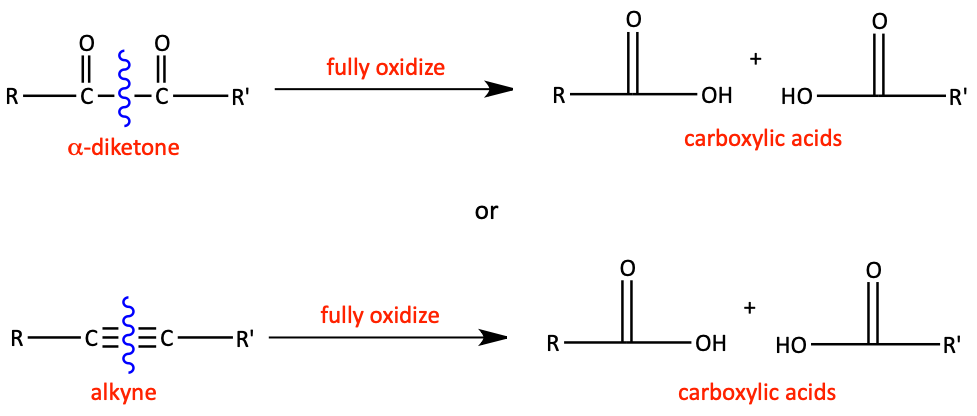
Notice that in this oxidation, three carbon-carbon bonds of the alkyne turn into three carbon-oxygen bonds of the carboxylic acid.