4.3 Resonance Rules
There are a few rules for us to consider when we find resonance forms.
1. Don’t start any arrows at single bonds. Your molecule will fall apart if you move single bond electrons. That’s bad.
2. One atom cannot contain more than eight electrons. If you end up with five bonds around a carbon atom, you’ve made a mistake.
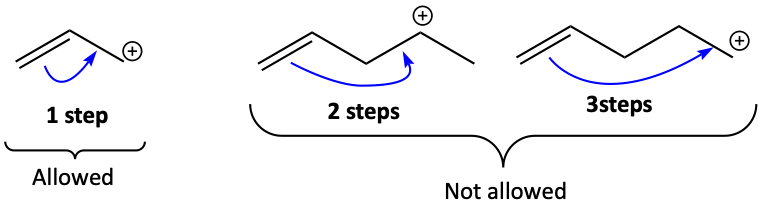
3. Electrons cannot move more than one full step.
4. If we have the option, it is better to move the negative electrons towards positive charges (cations) or on to electronegative elements.
5. The molecular structure must remain intact. Atoms are not allowed to be rearranged or moved. Only electrons may be moved around.
6. The sum of the charges on resonance structures must be the same.
4.3.1 Pi electrons towards cations.
Let’s try to find valid resonance forms of the following carbocation.
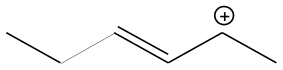
As we are learning how to do this, it is helpful to draw in all hydrogen atoms. This is sometimes called Grossman’s rule. It is named after chemistry professor Bob Grossman at the University of Kentucky. It can trip us up if we forget how many hydrogen atoms are on each carbon atom. That is easy to mess up for beginning organic chemistry students. Sometimes even experienced organic chemists make this mistake! Grossman’s rule can help us out. So, let’s rewrite the compound with the hydrogen atoms attached.
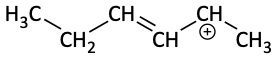
Let’s begin looking for a good resonance form. We’ll look at some possible ways electrons could be moved on this compound. We’ll work through several bad attempts until we come to the correct one.
Attempt 1

This is a violation of rule 1. If we move these electrons, we could break our molecule apart. Yikes! A good way to avoid this problem is to ALWAYS start our arrows at pi electrons (from a double or triple bond) or from lone pairs of electrons. In attempt 2, we’ll start our arrow at the double bond (pi bond). We’ll move two of those electrons around.
Attempt 2

This is a violation of rule 5. We rearranged the atomic structure when we were not allowed to change the molecular structure or the arrangement of the atoms. We cannot rearrange the atoms. Notice that there were two hydrogen atoms on the second carbon, but there is only one after the electrons move. There was only one hydrogen atom on the fourth carbon, but there are two after the electrons move.
Attempt 3

Attempt 3 is a ½ step movement of electrons. This is a legitimate way to move electrons. The problem with it is that we get a new resonance structure that has three charges drawn on it. This makes this resonance structure fairly unstable and not very useful. This attempt does follow all of the rules, but it simply takes more experience for us to learn that it is not very useful.
Attempt 4

Attempt 4 is a ½ step movement of electrons, but we simply moved the electrons the other way as compared to attempt 3. Again, it is a legitimate way to move electrons, but not very useful because it makes a triply charged, unstable, resonance structure.
Attempt 5

Attempt 5 is a full step movement of the pi electrons. This movement of the electrons violates rule 2. We have too many electrons around an atom. The carbon atom has the most unfortunate situation of having five bonds! It is also a violation of rule 6. The left resonance form has a +1 charge. The right resonance form has a +2 charge.
Attempt 6

This is a full step movement of pi electrons towards a positive carbocation. A few things should be noted. It is preferred to have negative electrons flow towards a positive site. The atomic structure has not changed from one resonance form to the other. No atoms have more than an octet around them. This is because the positively charged carbon atom only started with six electrons (3 bonds) around it. When the pi electrons moved towards it, it made an octet. The bottom line is a pi bond can move one full step towards a carbocation to make a resonance structure. If the pi bond is further removed from the cation more than one full step, they cannot be pushed towards the cation.
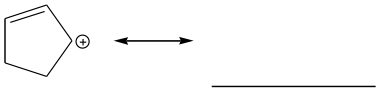
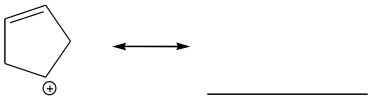
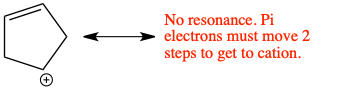
3. One of the following cyclopentene cations has a valid resonance structure and the other does not. For the one that has a valid resonance structure, draw the curved arrow needed and the resonance form. For the one that does not have a resonance form, explain why. It may be helpful to use Grossman’s rule.
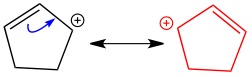
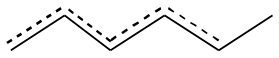
4. Draw in the appropriate resonance structures and curved arrow for the following. Pay careful attention to where the positive charge is located in the resonance structures. Grossman’s rule can help you out.

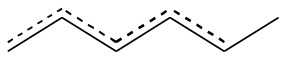
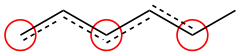
Circle the three atoms on the resonance hybrid of this molecule that have a partial positive charge. You can tell by noticing which atoms in part a have a positive charge drawn on them.

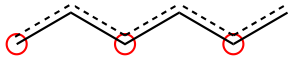
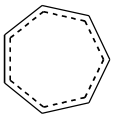
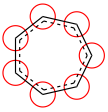
5. The cycloheptatrienyl cation has seven valid resonance structures. Draw in each resonance structure and the appropriate arrows showing how each resonance structure if made. The first arrow has been drawn for you.
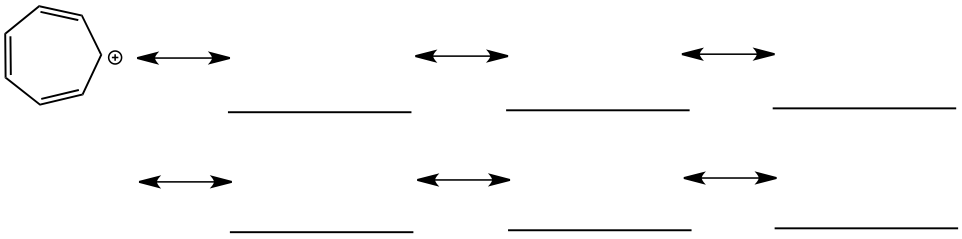
Circle the atoms on the cycloheptatrienyl cation hybrid that have a partial positive charge.

Let’s return to our original example and take a closer look at how we would find this new resonance structure. Until we become experts, and even then, it is wise to draw in hydrogen atoms near all of our reactive sites so we don’t lose track of them
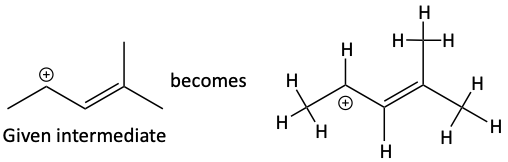
Notice that the carbocation only has one hydrogen atom attached to it. All of the other carbon atoms need four bonds. The carbocation, being positively charged, can be stabilized if some negatively charged electrons can be “pushed” towards it. In our example, we have a pi bond located right next door with plenty of juicy, negative electrons. We can push them over one full step towards the carbocation.
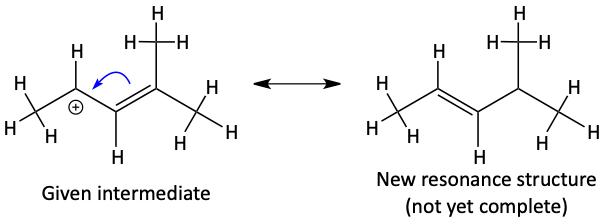
To finish, we need to evaluate our new resonance structure and make sure all of our formal charges are correct. Since our given intermediate has an overall +1 formal charge, we need to have a +1 formal charge in our new resonance structure (rule 6). After a quick analysis, we find that one of the carbon atoms only has three bonds; it must be our carbocation.
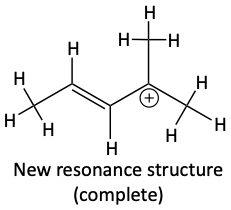
This is a correct resonance structure. Let’s look at some things beginning students try to do that are not correct.
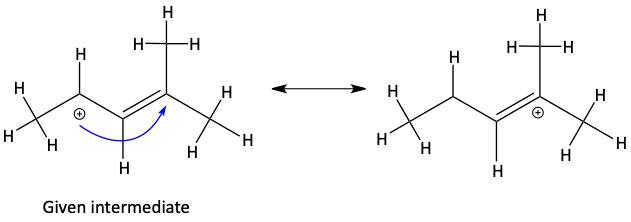
Why this is incorrect. Arrows always show the movement of electrons, not positive charges. Never do this. Even if we broke the rules and moved the positive charge, our new resonance form does not make sense. The carbocation should be on a carbon atom with three bonds, not the one with four bonds.
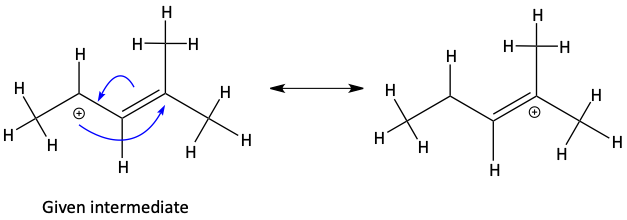
Why this is incorrect. These two arrows give a resonance structure that looks right, but again, arrows always show the movement of electrons, not positive charges. Never do this. Many novice organic chemistry students draw too many arrows for no reason. Do not draw more than one arrow to make a resonance form unless you need to. If an atom gets more than an octet of electrons because a first arrow has moved two electrons onto it, then a second arrow should be drawn to remove electrons. For example, if an atom will have ten electrons, then some electrons need to be immediately removed in order to maintain an octet.
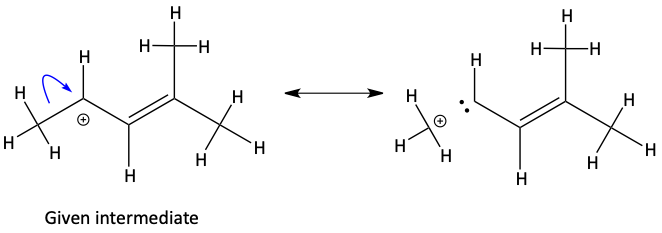
Why this is incorrect. Looking at the resonance structure made from this movement of electrons makes it obvious what the problem is. Resonance structures must keep the same basic atomic structure and only differ by the location of pi and nonbonding electrons. If an arrow starts at a sigma bond, it breaks apart the structure. Never do this.
4.3.2 Pi electrons towards electronegative atoms
We’ve focused on pi electrons moving towards positive cations, but cations are not the only things that pull negative electrons towards them. Electrons are also drawn towards electronegative atoms. Pi electrons can move ½ step onto an electronegative atom if the pi electrons are located adjacent to an electronegative atom like oxygen or nitrogen.
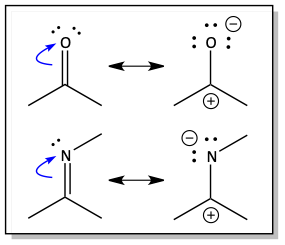
When pi electrons move onto an electronegative atom, we get a resonance structure with a charge separation. We get a positive atom and a negative atom. The electronegative oxygen or nitrogen atom becomes the negative one.
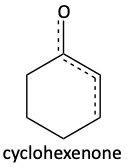
6. In the following reaction, hydroxide is going to react with cyclohexenone. The question is, where? Hydroxide has a negative charge. Since opposites attract, the most positive atoms on cyclohexenone will be where hydroxide attacks. There are two atoms on cyclohexenone which carry a partial positive charge. Let’s try to find them.
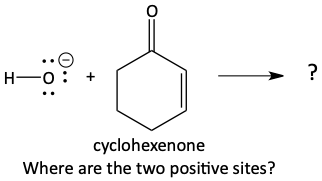
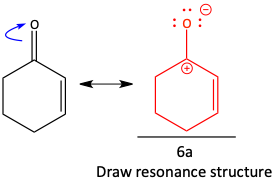
Let’s work through it together. First, we notice the electronegative oxygen atom with a pi bond attached. We can move the pi bond ½ step onto the oxygen atom to find one of the partially positive atoms.
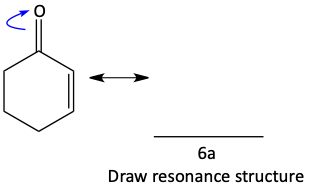
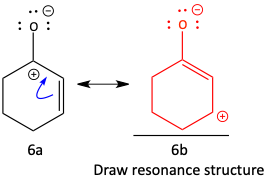
This resonance structure has a pi bond adjacent to a positively charged carbon atom (carbocation). Move some pi electrons one full step towards the carbocation.
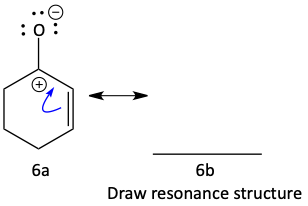
Now, since we have two resonance structures with positively charged atoms, we have insight into the reactivity of cyclohexenone.
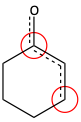
c) Circle the two atoms on cyclohexenone hybrid that have a partially positive charge.
c)
7. a) Find resonance forms to help find the three atoms on the following compound that have a partially positive charge. Draw in all appropriate arrows and resonance forms.

b) Circle the three atoms that are partially positive.
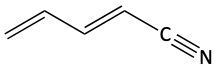

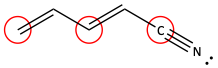
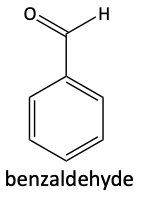
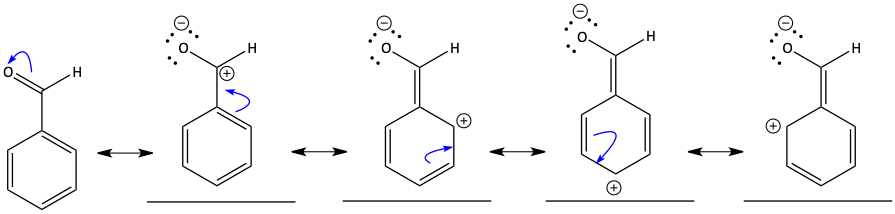
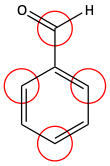
8. Four atoms of benzaldehyde have a partial positive charge. Draw resonance forms to find them all.

Circle the four atoms on benzaldehyde that have a partial positive charge.
Lone pairs moving towards pi bonds
Pi bonds are not the only electrons that can be moved to make resonance forms. A lone pair of electrons (especially at a position with a formal negative charge) is a great place to start pushing electrons. They can be pushed ½ step IF AND ONLY IF a situation does not occur where an atom ends up with greater than eight electrons on it (an octet). An atom can temporarily have more than eight electrons around it, IF DURING THE SAME STEP, electrons are removed from the back side of said atom to correct the problem of having too many electrons. Let’s take a closer look to see what I mean. Consider the following anion.
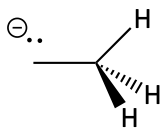
If I push the lone pair from the negative site ½ step, we run into a bad situation.
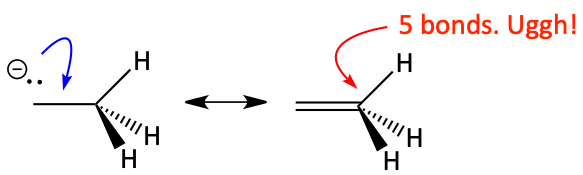
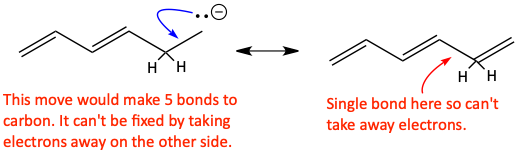
We have a carbon atom with five bonds! That’s bad unless we can fix the situation by moving some electrons away from it. But, in this example, the problem cannot be fixed because all of the bonds on the backside of this carbon are all single bonds and cannot be moved away.
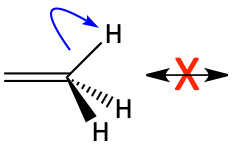
We cannot start arrows at single bonds to make resonance forms because our molecule will fall apart. How about the following carbanion?
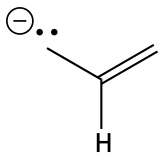
We move the lone pair of electrons from the negative site ½ step and see what we get.
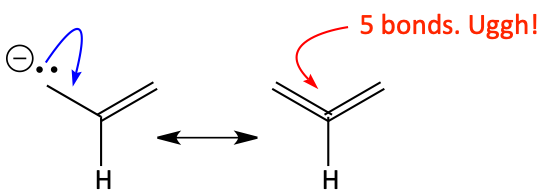
Again, we get the bad situation of having 5 bonds around a carbon. We have more than eight electrons around the carbon and have broken the octet rule. But, don’t panic just yet. We’ll be OK if we can move electrons away from this overloaded carbon atom. In this case, we have a pi bond that can be pushed away ½ step onto another carbon atom to remove some electrons. We’re saved!
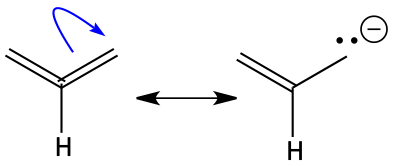
Normally, organic chemists do not draw the bad looking structure with five bonds around the carbon. We know that it is not a good structure, so we don’t want to pretend that it is valid in the least. So, we typically draw both arrows on one structure like this.
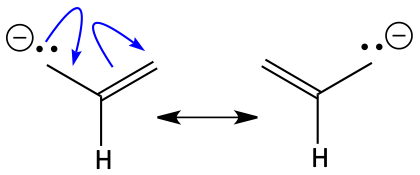
9. Finish the movement of the electrons on this structure and draw the resonance structure made
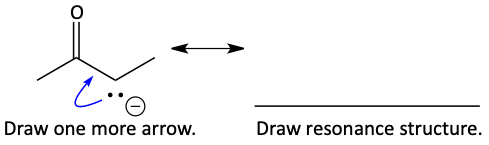
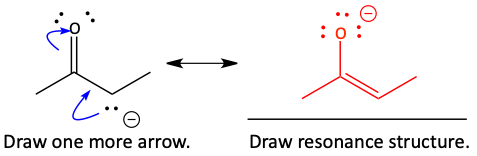
This a very good resonance structure because electrons end up on an electronegative oxygen atom!
10. Nitropropane has one other good resonance structure. Draw it.
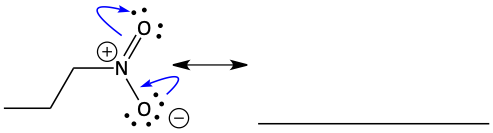
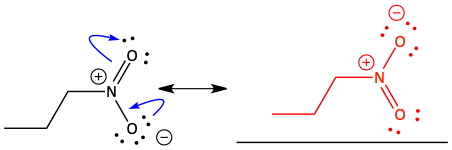
Since the two oxygen atoms share 1 negative charge, the resonance hybrid (or the true structure of the molecule) has ½ of a negative charge on each oxygen atom.
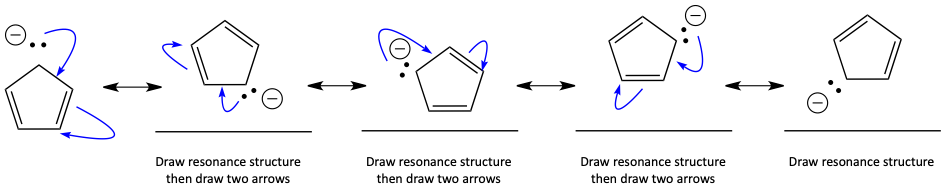
11. The cyclopentadienyl anion has five valid resonance structures. Draw them and the appropriate arrows.

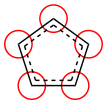
Circle the atoms on the cyclopentadienyl anion that have a partial negative charge.

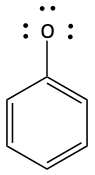
12. The phenoxide anion has four atoms with a partial negative charge on them. One is the oxygen atom which is clearly delineated in the given structure. Draw three other resonance forms to find the other three negatively charged atoms.
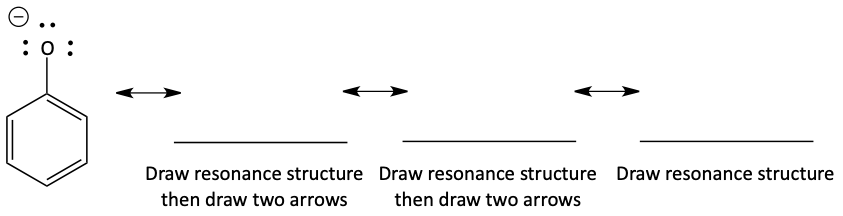
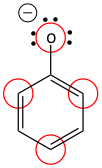
Circle the atoms on the phenoxide anion that have a partial negative charge.
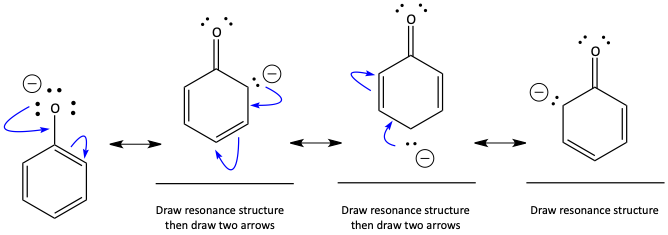
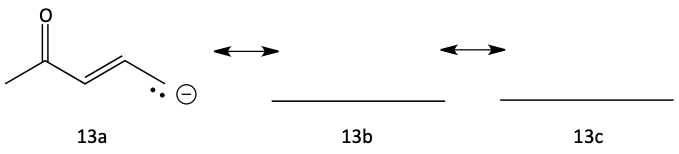
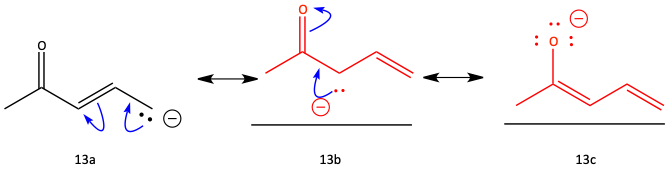
13. Draw in the two resonance forms as well as all appropriate arrows to show the movement of electrons in the following.
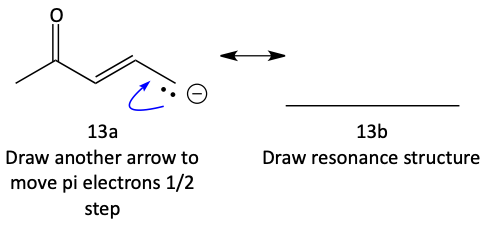
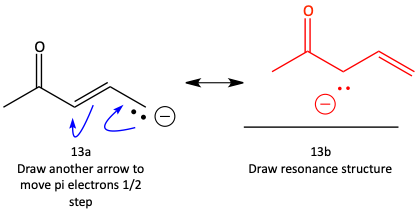
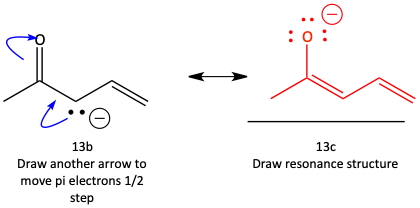
In this new resonance structure, we can push the carbanion electrons towards the carbonyl C=O. Draw in the second arrow needed and then the resonance structure made.
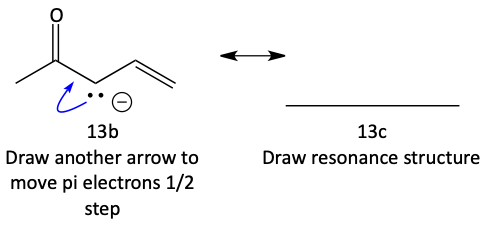
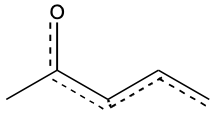
We can put it all together and get the following.
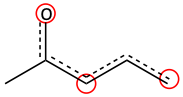
Circle the three atoms that are partially negative.
14. The following movement of electrons is not allowed in order to make a new resonance form. Why?
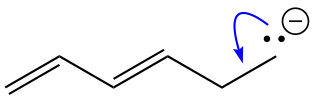
15. The following compound does have two valid resonance forms. Draw them and appropriate arrows.

Circle the three atoms that are partially negative.