4.1 Introduction
Organic chemists have agreed to show the movement of electrons by using arrows. A regular, two-headed arrow, <->, shows the movement of two negative electrons. Did you get that? That last sentence may be one of the most important statements in organic chemistry. Arrows show the movement of negative electrons. Arrows DO NOT show the movement of positive charges, atoms, or anything else you can think of. Arrows in organic reaction mechanisms show the movement of negative electrons. Students who fail to learn this are almost never successful in organic chemistry. If you don’t learn to focus on the movement of these electrons, organic chemistry will remain a mystery. It is my belief that successful organic chemistry students learn to think in terms of arrows. Since opposite charges attract each other, we would expect the following reaction of hydroxide with a positive cation intermediate to proceed as follows.
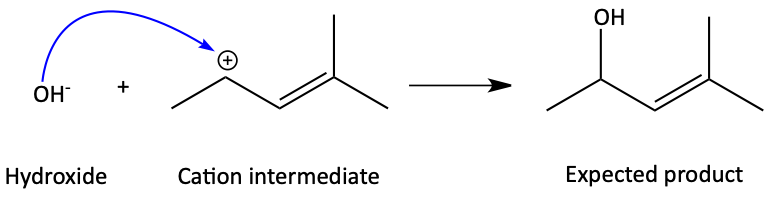
This is, in fact, one of the products we find. Surprisingly, we also find the following product is made.
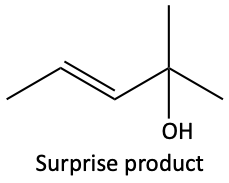
By analyzing this surprising product that is made, we can think backward and figure out what unknown cationic or positively charged intermediate could have been attacked by the hydroxide.
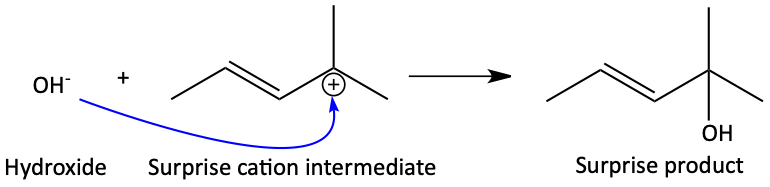
Let’s compare these two cationic intermediates we must have had in order to give us these two products.
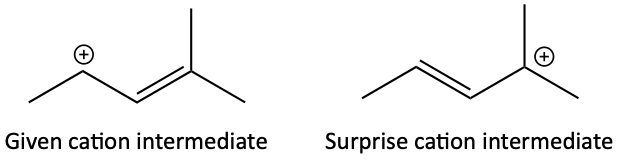
These two cation intermediates are called resonance structures of each other. Neither one actually exists, but they are convenient representations of the true intermediate. They are useful to us because it makes it much easier for us to explain why a reaction proceeds the way it does. The symbol we use to signify that two structures are resonance structures of each other is a two-headed arrow, <->. Sometimes, brackets are put around the two structures to identify them as resonance structures.
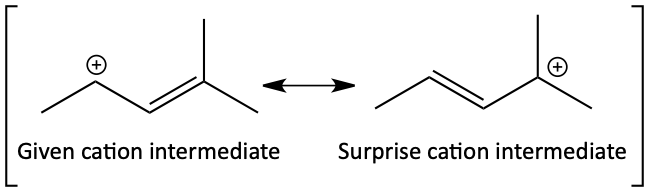
Well, which is it? Is the intermediate the given one, the surprise one, both, or neither? Some people even mistakenly think that these two resonance structures are flipping back and forth from one form to the other. This is not true. The resonance hybrid, the “true” form of the intermediate, is a combination of these two resonance structures. It really looks more like the following.
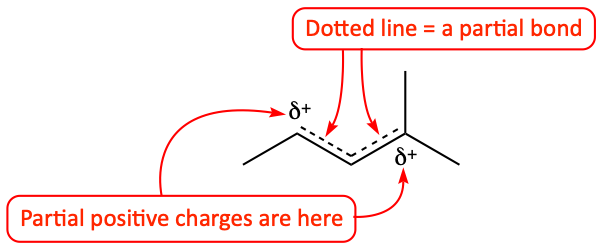
The two electrons of the pi bond are shared between second and third bond. A solid line drawn between two atoms represents one full, two-electron, bond. A dotted line drawn between two atoms represents a partial bond. So, instead of a double bond at each site, there is really more like 1½ bonds. The one positive charge is shared between the second and fourth carbon atoms. So, instead of having a full positive charge, each of those two atoms carries about ½ of the positive charge. It can get a little confusing. So, in order to simplify our thinking, organic chemists prefer to write the two, distinct, resonance structures. These two resonance structures are very similar to each other. Notice that the atomic framework in both structures is exactly the same. The only difference between them is the location of the pi bond and the location of the positive charge. If we are given one structure, we can find, or predict, other resonance structures by moving pi electrons around.
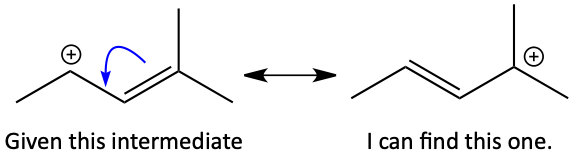
Notice, only two pi electrons were moved. The arrow shows the movement of these two electrons, NOT the positive charge. We’ll spend quite a bit of time learning how to find good, valid resonance forms of various structures. Let’s take a break from this example to discuss resonance structures in more detail. We’ll return and finish up this example later.
4.2 Half steps or full steps
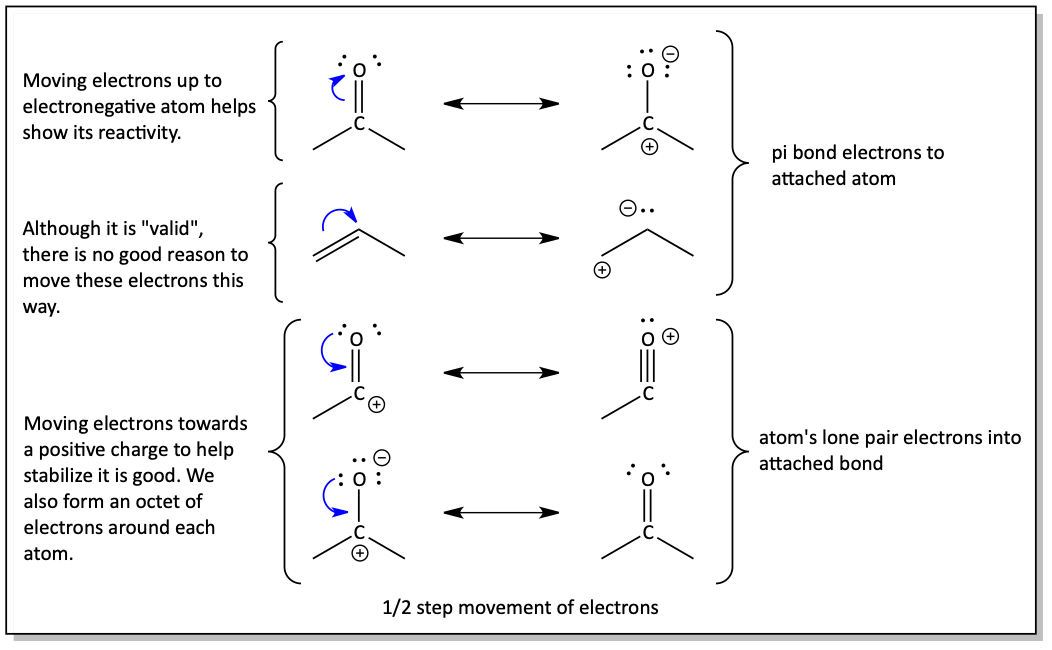
Whenever resonance structures are drawn, there are two ways to move electrons. Electrons can move from an atom to an adjoining bond, from a bond to an adjoining atom, or from a bond to a neighboring bond. That may sound a little confusing if you read it too fast. To put it more simply, I use the terminology that electrons can move one full step or ½ step. You won’t find these terms in any other organic text, but I think it makes our discussion of resonance forms more convenient. Electrons move ½ step if they move from a pi bond to an attached atom or if a set of lone pair electrons moves from an atom to an attached bond. Study some examples of valid ½ steps below.
A full step of moving the electrons is moving from a pi bond to a neighboring bond, skipping over the atom between the two bonds.
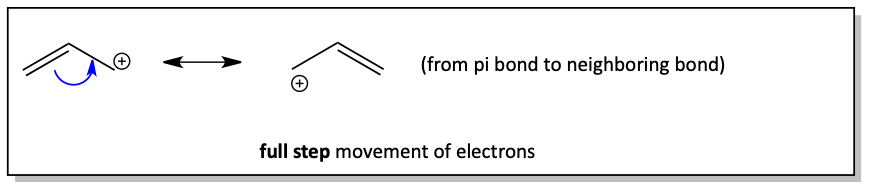
The reason I call the above pi bond to neighboring bond movement of electrons a “full step” is that it really is the sum of two ½ steps.
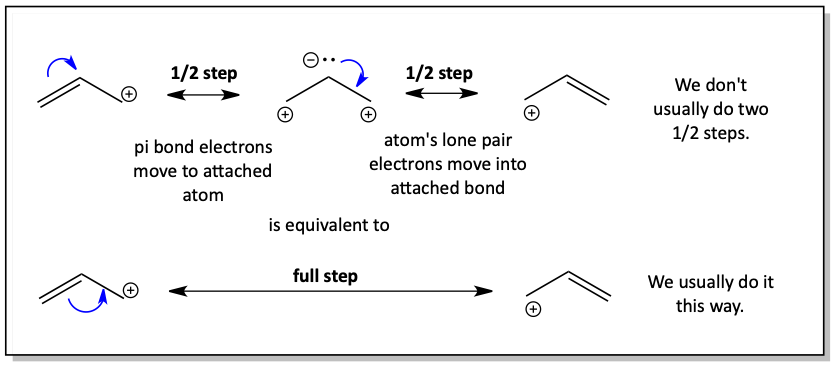
Electrons may be moved ½ step or one full step, but they may never be moved farther than one step. This means that electrons are not allowed to move 1½ steps, 2 steps, or more.
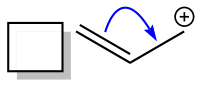
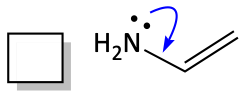
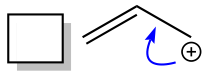
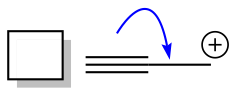
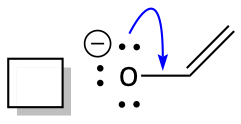
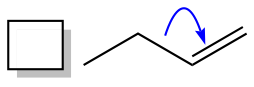
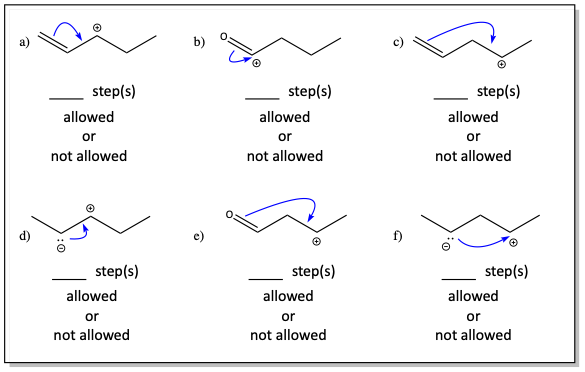
1. Each of these problems has an arrow indicating the movement of electrons. Write how many “steps” each movement would be. Then, indicate if the movement is allowed or not allowed by circling the appropriate word.
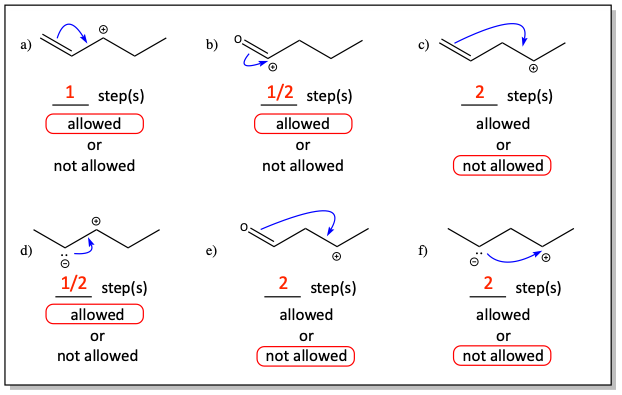
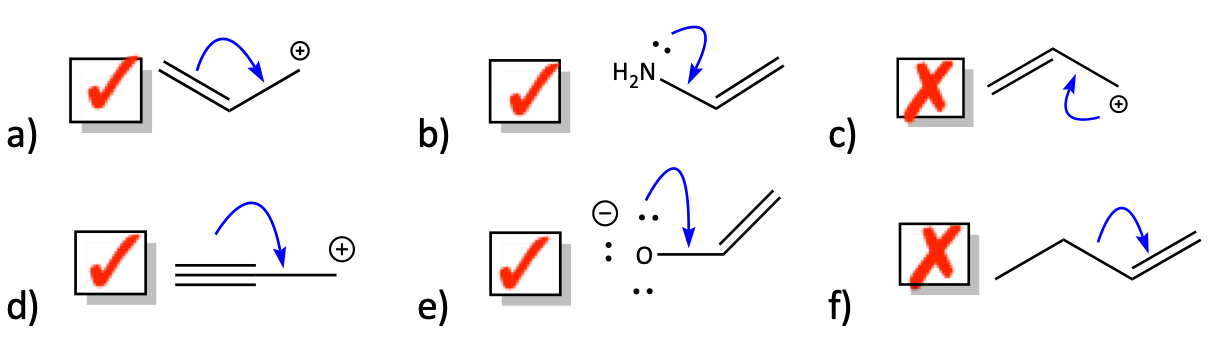
Let’s further investigate how we find good, valid resonance structures. The most important thing is to not forget our mechanism arrow training. It is important to still think in terms of arrows moving electrons. For resonance structures, our arrows will move electrons from one spot to another within the same molecule. We will do this by moving the electrons ½ step or one full step at a time. Since we are moving electrons, our arrows will always start at a pi bond (in a double or triple bond) or a lone pair of electrons. We can only move these electrons certain places.
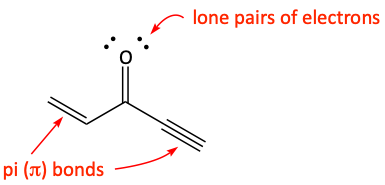
2. For the following structures, put a check in the box if the curved arrow STARTS at a valid location (lone pair of electrons or a pi bond). Put an X in the box if curved arrow STARTS at an incorrect location.