21.12 Gilman Reagents
One other way to do a nucleophilic substitution on an aromatic halide with a carbon group is to use a Gilman reagent. A Gilman reagent is a lithium organocuprate. It is so named because it contains lithium, organic groups, and copper. Many different halide compounds (alkyl, vinyl, or aryl) can be used. The halide can be converted into an organolithium reagent by the addition of two equivalents of lithium metal. The organolithium reagent can be converted into a Gilman reagent with cuprous iodide, CuI.
Halide to organolithium


The R groups in the Gilman reagent are attached to the positively charged copper and lithium ions. The R groups are therefore negatively charged and are nucleophilic. They can perform substitution reactions with alkyl and even aryl halides!

Below are some examples of how this Gilman reagent coupling can be used. Notice how a carbon-carbon bond is formed in each of these. This is a little unusual compared to the previous ways we have learned to make carbon-carbon bonds. This substitution can occur on a double bond and even a benzene ring.
The substitution can occur on an alkyl halide.

The substitution can occur on an aryl halide.
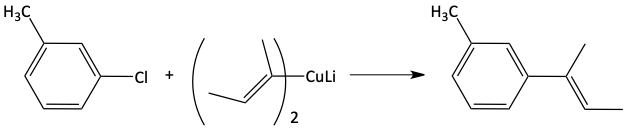
The substitution can occur on a vinyl halide.
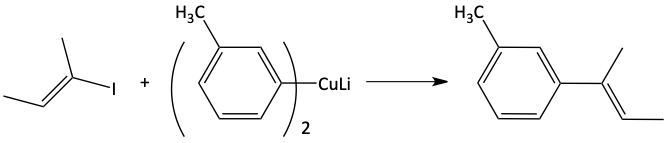
The substitution can occur on an acid chloride.

15. Give the products of the following reactions.

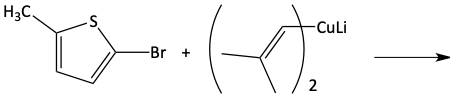
15.


16. Give the Gilman reagent used in the following reactions.
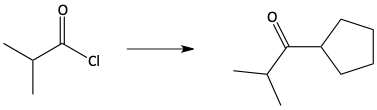

16.

