21.2 Electrophilic Aromatic Substitution
Aromatic rings usually do not react unless they are in the presence of a very positively charged species, an electrophile. But, if an electrophile has a strong enough positive charge, it can coax the negatively charged pi electrons of the aromatic ring to attack it. When the pi bond attacks the electrophile, the electrophile attaches to the benzene ring, and the ring loses its conjugation. It forms a non-aromatic species called a sigma complex. A base cleans up the reaction by pulling off a proton with the electrons in its bond reforming the pi bond of the aromatic ring. Overall, a hydrogen atom is replaced with an electrophile.
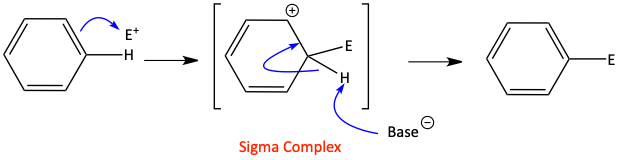
Let’s look at a few of these reactions. You should immediately memorize these next few reactions. We will use them often.
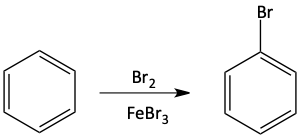
21.2.1 Bromination of Benzene
We learned previously that pi bonds can be brominated using Br2 to make anti-dibrominated compounds. But, we find that benzene cannot be brominated the same way. The stability of the aromatic benzene ring precludes that.
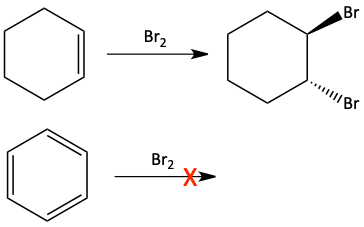
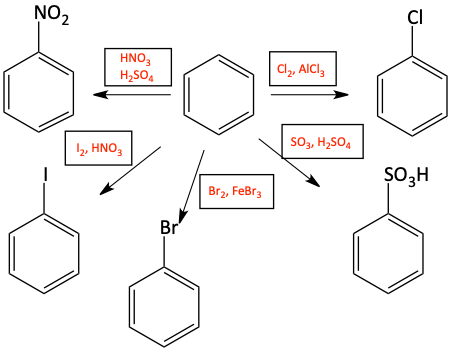
A stronger electrophile is needed in order to brominate benzene or other aromatic compounds. This is done by adding the Lewis acid, ferric bromide (FeBr3), to bromine, Br2. Br2 donates a lone pair of electrons to the FeBr3 Lewis acid. This makes the bromine positively charged and an electrophile.

This is a strong enough electrophile that the aromatic benzene ring will now donate electrons from a pi bond to it. We will not worry about the mechanism of this reaction, but you should memorize it.
21.2.2 Chlorination of Benzene
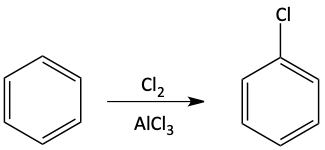
The chlorination of benzene is similar to the bromination of benzene. On its own, chlorine is not a strong enough electrophile to react with an aromatic ring. A Lewis acid is needed. For the chlorination reaction, the Lewis acid is usually aluminum trichloride, AlCl3. Memorize this reaction.
21.2.3 Iodination of Benzene
The iodination of benzene occurs in the presence of iodine and nitric acid.
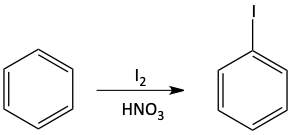
Iodine, I2, is also not a strong enough electrophile on its own. Typically, nitric acid, HNO3, is added to iodine to make the electrophilic iodonium ion.
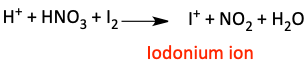
Once iodonium is produced, the iodination of an aromatic compound can occur. Memorize this reaction.
21.2.4 Nitration of Benzene
Benzene is nitrated in the presence of nitric and sulfuric acid.
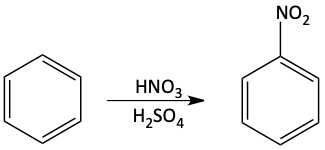
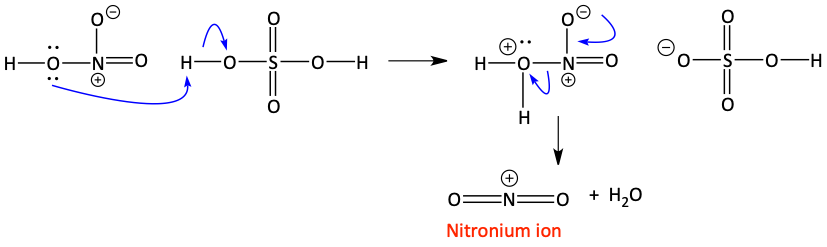
The mechanism to produce the electrophile in this reaction is interesting. When nitric acid and sulfuric acid react with each other, sulfuric acid acts like an acid and donated a proton while nitric acid acts like a base. Once the nitric acid is protonated, water leaves giving a nitronium ion. This nitronium ion is an excellent electrophile and can act with benzene producing a nitrobenzene.
21.2.5 Sulfonation and Desulfonation of Benzene
This reaction is fun because it uses fuming sulfuric acid which just sounds menacing. Fuming sulfuric acid is sulfuric acid with sulfur trioxide gas dissolved in it. In the presence of fuming sulfuric acid, benzene can be sulfonated.
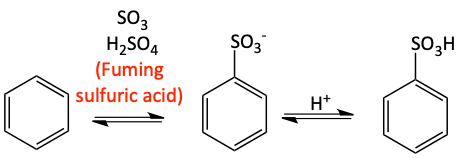
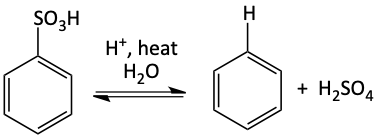
Sulfonated benzene can be desulfonated when it is heated with water and acid.
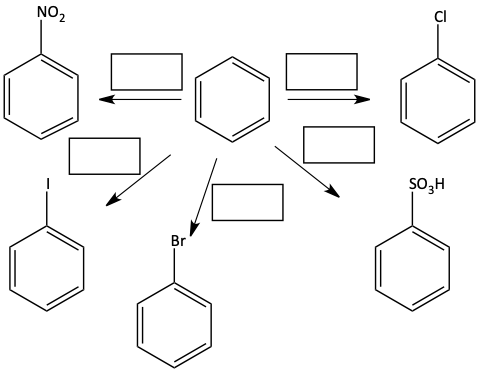
1. Write the reagents used to perform the following transformations.