21.6 Disubstituted benzenes
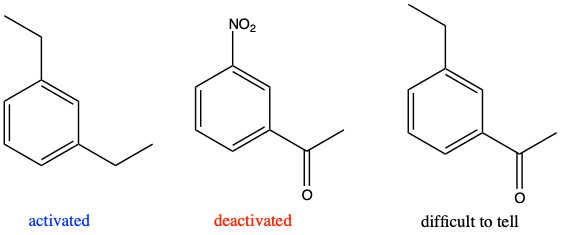
A disubstituted benzene is when two groups are on a benzene. When both groups are activating, the benzene ring is activated. When both groups are deactivating, the ring is deactivated. When one group is activating and one is deactivating, it is difficult to tell.
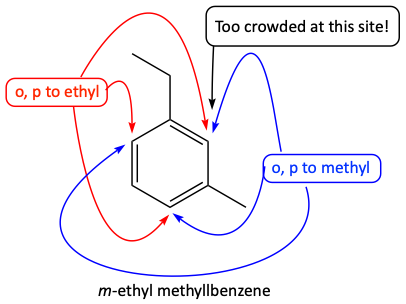
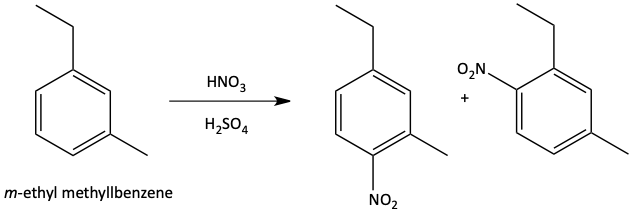
When an electrophilic aromatic reaction occurs, analyze how each group directs the substitution. If the two groups agree where the substitution should occur then the substitution occurs there. If a site is sterically hindered, the substitution may not occur at that site. For m-ethyl methylbenzene, both alkyl groups are o, p-directing. Each alkyl group directs to the same locations. The red and blue arrows point to the same sites. The site between the two alkyl groups is a little crowded, so the substitution does not happen much there.
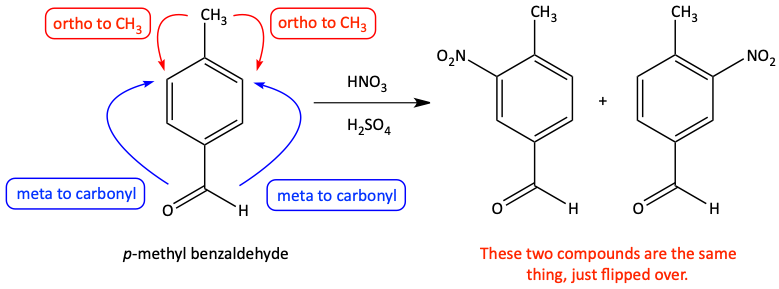
For p-methyl benzaldehyde, the methyl group is ortho directing. The carbonyl group is meta directing. These agree for the location of the substitution.
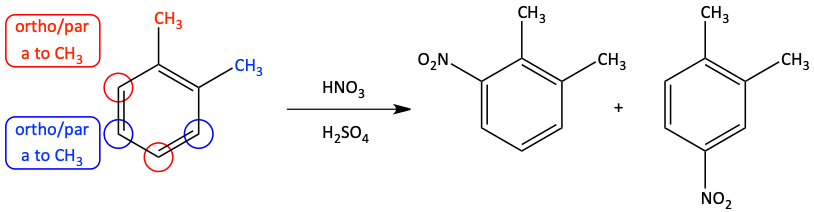
For o-xylene, each methyl group is o,p-directing, but they direct to different locations. A mixture of products is formed.
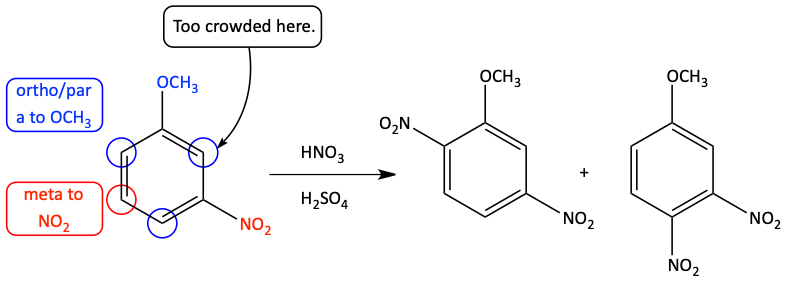
For m-nitroanisole, the methoxy is o,p-directing but the nitro is meta directing. These point to different locations. When there is a disagreement in locations, the group that is more activating wins because the reactions happen faster at those sites. In this case, methoxy (OCH3) wins. Again, the site in between the two groups is pretty crowded, so the reaction does not happen there as much.
The strength of directing groups was summarized in the previous section. Pi donors (-OH, -OR, -NR2) are more activating than sigma donors (alkyl groups). Halides are a little deactivating, but are not as deactivating as fully meta-directing deactivating groups like –NO2, -CN, and carbonyls). Go back and study the directing group summary figure in the previous section.
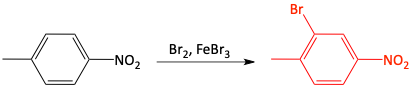
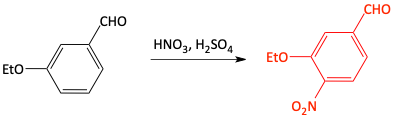
4. Draw the products of the following reactions.
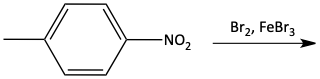
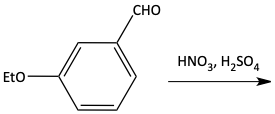
b)
4.