20.6 Aromatic or Antiaromatic Reaction Intermediates
Consider cyclopentadiene. Would we predict the protons on cyclopentadiene to be very acidic or not?
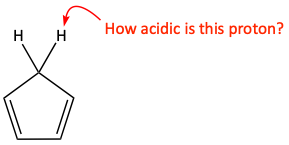
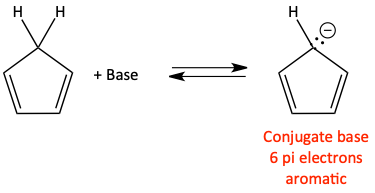
Like any time we consider the acidity of a proton, we look at the conjugate base once the proton is removed and see how stable that anion is. In this case, the cyclopentadienyl anion is a completely conjugated, flat ring system that contains six pi electrons in the pi system. This is an aromatic compound and is very stable. This is a species that would like to be made, so we know that the protons on cyclopentadiene are quite acidic. These protons have a pKa of 16.
Let’s predict the acidity of the protons of cyclopropene.
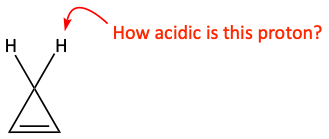
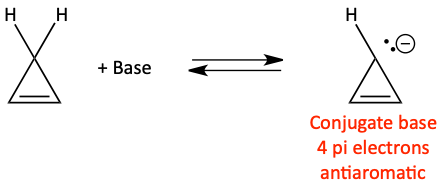
Once again, let’s consider the stability of its conjugate base. In this case, the cyclopropenyl anion is a completely conjugated, flat ring system that contains four pi electrons in the pi system. This is an antiaromatic compound and is very unstable. This is a species that would not like to be made, so we know that the protons on cyclopropene are not very acidic. They have a pKa of 61. This is 1045 times less acidic than cyclopentadiene.
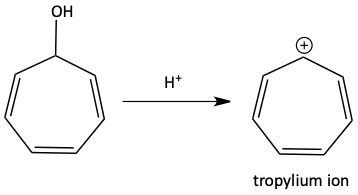
Two other reactions that give stable, aromatic species are the formation of a tropylium ion and the formation of a cyclooctatetraene dianion. A tropylium ion is a cycloheptatrienyl cation. It is a completely conjugated, flat ring system with six pi electrons in the pi system. It is aromatic. It can be formed by the acid dehydration of cycloheptatrienyl alcohol.
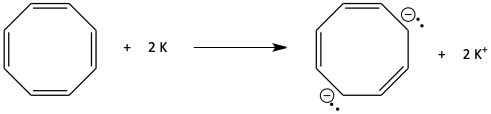
When cyclooctatetraene reacts with potassium metal, it can form a dianion. The cyclooctatetraenyl dianion is a fully conjugated, flat ring with ten pi electrons in the pi-system. This is a stable, aromatic compound.
The general rule is if we make a stable, aromatic compound as a product, this is good and the reaction will proceed easily. If we make an unstable, antiaromatic compound as a product, this is bad and the reaction will not proceed very well.
6. Predict whether or not the following reactions would proceed well.
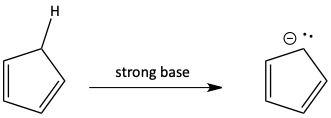
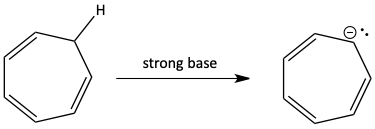

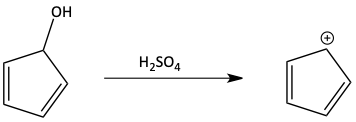
6. a) yes b) no c) no d) no