20.3 Molecular orbital diagrams of annulenes
Benzene is extra stable in its ring form. It is aromatic. The benzene pi system contains six sp2 hybridized carbon atoms. Each carbon atom has an unhybridized p-orbital. These six p-orbitals can overlap. When they overlap, they can overlap constructively to make bonding sites or destructively to make antibonding sites.
The lowest energy is when all of the p-orbitals are in phase with each other. This totally overlapping set of orbitals has zero nodes. This makes a pi-bonding molecular orbital, 𝜋1. There are two ways to overlap the p-orbitals to make one node, 𝜋2 and 𝜋3. There are two ways to overlap the p-orbitals to make two nodes, 𝜋4* and 𝜋5*. In these, there is more destructive overlap than constructive overlap, so these are antibonding molecular orbitals. We indicate they are antibonding by using *. Finally, there is one way to overlap p-orbitals where each p-orbital is out of phase with the next. This makes a totally anti-bonding pi orbital, 𝜋6*.
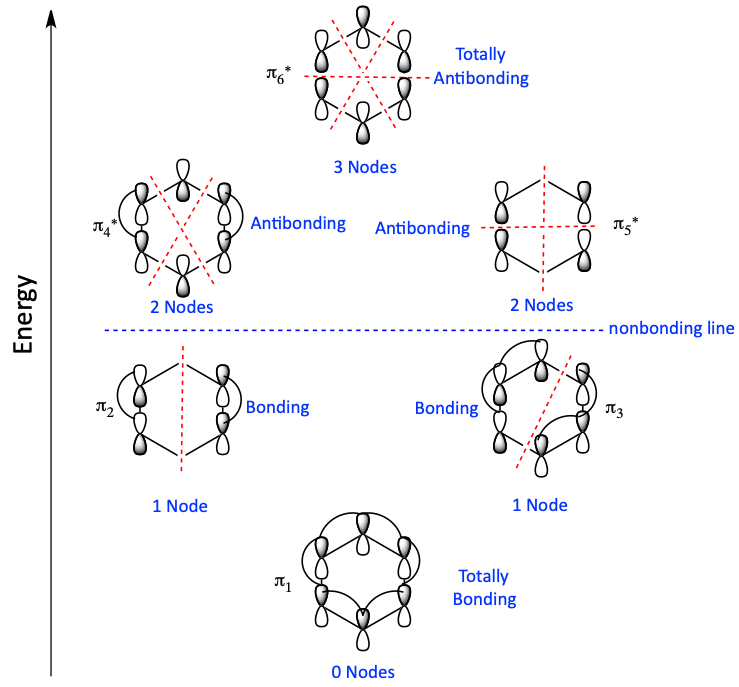
Once we know the ways the p-orbitals can overlap to form the various molecular orbitals, we can begin to draw a molecular orbital energy diagram. Benzene, with its three pi bonds, has six pi-system electrons. The molecular orbitals are filled in from the lowest energy up. This fills up 𝜋1, 𝜋2, and 𝜋3 with a pair of electrons in each. Each of these molecular orbitals is a bonding molecular orbital. By sharing the pi electrons over more than two atoms in these molecular orbitals, we get even lower energy electrons. The amount of energy we save by dropping below the nonbonding line is all saved energy giving us extra stability for benzene.
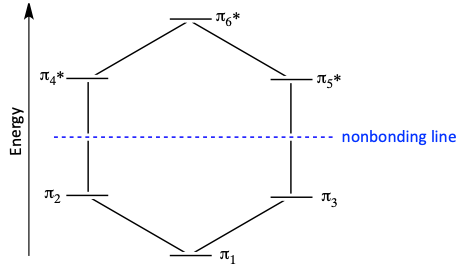
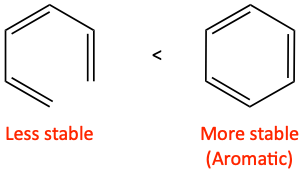
Overall, because benzene is more stable in its ring form than it is in its non-ring form, we say that benzene is aromatic.
20.3.2 MO diagram of cyclobutadiene
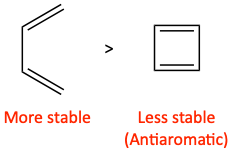
Cyclobutadiene is especially unstable. We call it antiaromatic. Its molecular orbital diagram will help us understand why it is so reactive.
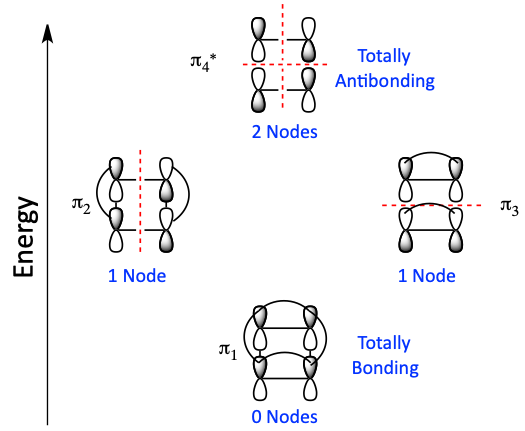
For cyclobutadiene, there are four sp2 hybridized carbon atoms with an unhybridized p-orbital on each carbon atom. The lowest energy form for the overlapping p-orbitals is if they all overlap and make a totally bonding molecular orbital with zero nodes in it, 𝜋1. There are two ways to overlap to make one node, 𝜋2 and 𝜋3. There is one way where the p-orbitals are all out of phase with each other to make two nodes and a totally antibonding molecular orbital, 𝜋4*.
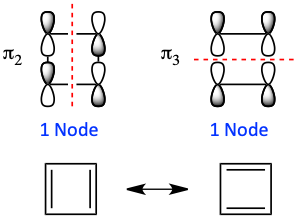
Notice that the molecular orbitalsππ2 and π3 are the same as the two resonance forms of the Lewis structures we draw for cyclobutadiene.
Once we know the ways the p-orbitals can overlap to form the various molecular orbitals, we can begin to draw a molecular orbital energy diagram. Cyclobutadiene, with its two pi bonds, has four pi-system electrons. The molecular orbitals are filled in from the lowest energy up. The molecular orbital 𝜋1 is filled with a pair of electrons. Then, following Hund’s rule where each orbital of the same energy is filled with one electron before the electrons are paired together, we get two electrons that are in separate orbitals, 𝜋2 and 𝜋3. This diradical (two unpaired electrons) is very reactive.
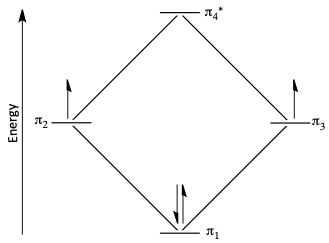
The molecule is unstable. Therefore, we say that cyclobutadiene is antiaromatic. Cyclobutadiene is less stable than its open ring counterpart.
20.3.3 Counting Pi-System electrons
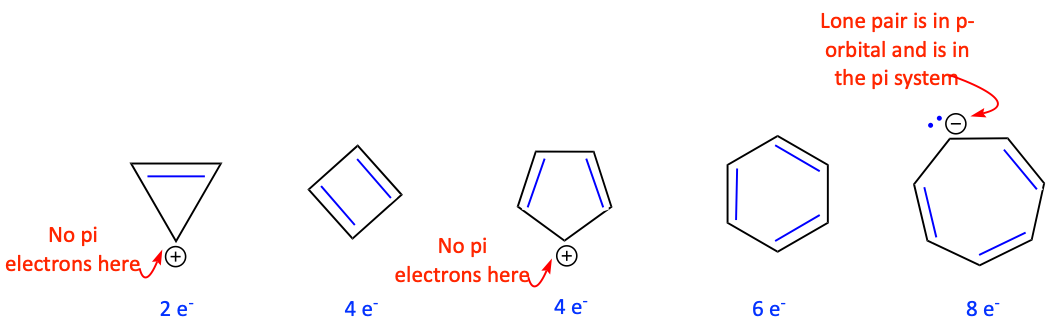
Let’s practice counting pi electrons that are in the pi-system of these conjugated cyclic compounds. Each pi bond of the double bonds is obviously part of the pi system. There are two electrons for each of these pi bonds. If there is a carbocation in the system, there is an empty p-orbital there. This extends the conjugation of the system because this empty p-orbital can overlap with the other p-orbitals, but it donates zero electrons to the pi-system. Each carbanion is sp2 hybridized with two electrons in the p-orbital adding to the electron count of the pi-system.
20.3.4 Polygon rule
The MO diagram of the pi system of a planar, totally conjugated ring system has the same polygon shape as the molecule does with the vertex (point) at the bottom of the diagram. We can remember the vertex is at the bottom because there is always only one lowest energy molecular orbital, the one where all of the p-orbitals overlap. There is always only one way to do this and have zero nodes.
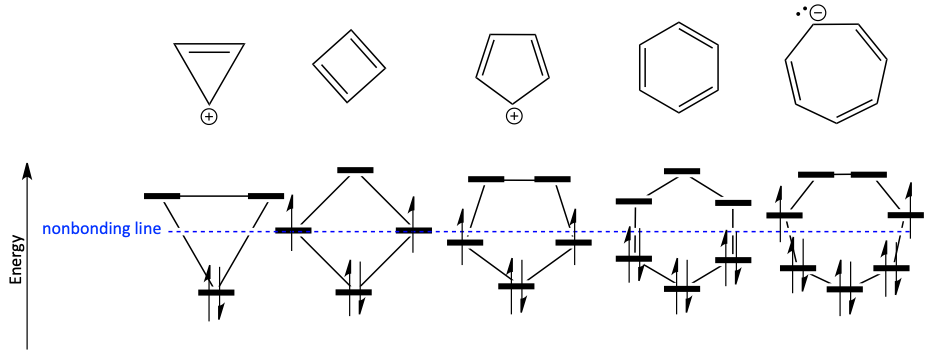
1. For the following MO diagrams of the compounds above, circle the word “aromatic” or “antiaromatic” to indicate whether the MO diagram represents an aromatic or an antiaromatic compound. Hint: Look at whether all of the electrons are paired up or if there are two unpaired electrons.
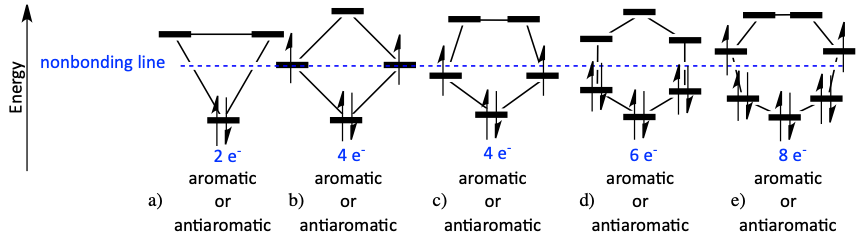
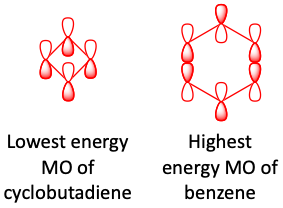
1. a) aromatic b) antiaromatic c) antiaromatic d) aromatic e) antiaromatic
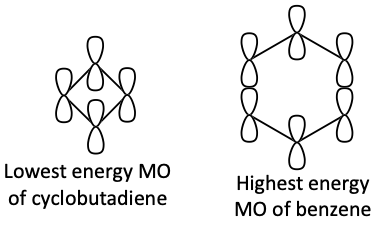
2. Shade in the atomic p-orbitals to represent what would overlap to make the following molecular orbitals.