20.11 Allotropes of Carbon
Imagine a fused ring system that is not only four or five benzenes fused together, but an infinite number of benzene rings fused together into an infinite place. Then, imagine several of these infinite planes stacked on top of each other. These planes would be made out of only carbon since it has no edges where the hydrogens can be. This stacked group of infinite planes of fused benzenes is called graphite.
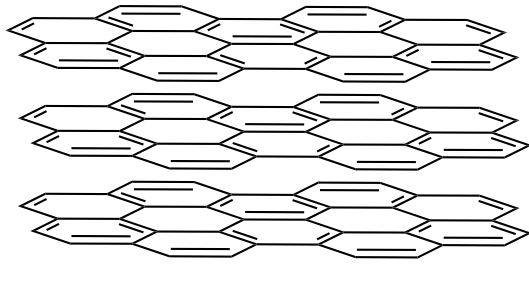
Each carbon atom of this infinite plane has an unhybridized p-orbital on it that can overlap with the others. Electrons are shared in the molecular orbitals formed by these p-orbitals giving a plane where electrons can freely move around. These p-orbitals cause the layers to loosely stack on each other. Here is a set of three benzenes stacked on top of each other.
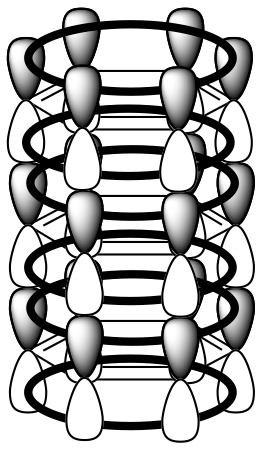
Because of this loose stacking, graphite us used as pencil “lead”. It is called pencil lead because long ago, lead metal was used to make the dark marks on paper. But, since lead is toxic, the nontoxic compound graphite is used. As the graphite is rubbed on paper, the bottom layer of graphite easily shaves off. The graphite is deposited one layer at a time onto the paper.
Graphite is one of the several orderly forms of pure carbon. These are called allotropes of carbon.
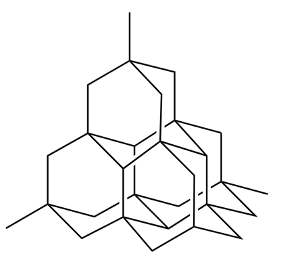
Another allotrope of carbon is diamond. The carbon atoms in diamond are all sp3 hybridized. A diamond structure is a series of cyclohexane chairs stacked on top of each other. Because each carbon atom in diamond is a perfect tetrahedral, diamond has tremendous strength. Of course, it is one of the hardest materials.
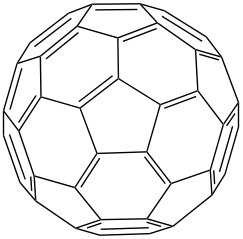
For many years, these were thought to be the only allotropes of carbon. But, in the 1980s, scientists discovered another allotrope of carbon. These are the fullerenes. Fullerenes are 5- and 6- membered aromatic rings arranged to form a “soccer ball” structure. The most common fullerene is C60. This is a molecule that contains 60 carbon atoms and zero hydrogen atoms. It was named the Molecule of the Year in 1990 by the journal “Science”. Yes, believe it, there is such a thing as the Molecule of the Year
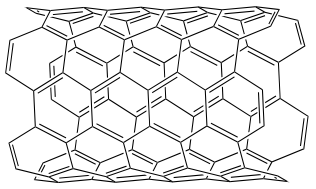
Even more recently, another form of all carbon is being developed, the nanotubes. You can think of carbon nanotubes as one layer of graphite wrapped into a cylinder. Nanotubes are incredibly strong. Nanotubes are nearly 120 times stronger than steel. One hope is to eventually make extremely strong, lightweight cables out of carbon nanotubes.