6.6 Cyclohexane Chair
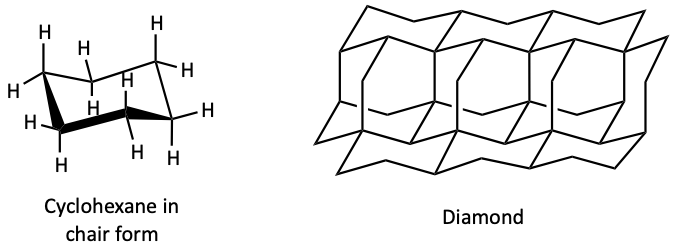
Cyclohexane is the most stable of the cycloalkanes. It is a very, very common ring structure in organic chemistry. Many organic molecules have this ring structure. Therefore, it is incumbent upon us to investigate and have a very good understanding it. Cyclohexane is not flat. It has what is called a chair conformation. This chair conformation has no angle strain. Each carbon atom is a perfect 109.5°. The C-H bonds are also all in a staggered conformation. In fact, the chair form of cyclohexane rings is so stable, they are found as repeating units in the carbon structure of diamond. Look carefully at the piece of diamond structure. Can you see some chairs in it?
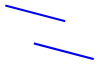
Let’s practice drawing this chair conformation. First, draw two parallel lines at an angle.
At the top of the two lines, draw a V down connecting the two lines. At the bottom of the two lines, draw a v up connecting the two lines. This makes the base form of the cyclohexane chair.
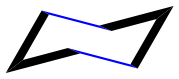
At the top of the two lines, draw a V down connecting the two lines. At the bottom of the two lines, draw a v up connecting the two lines. This makes the base form of the cyclohexane chair.
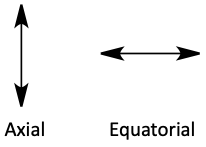
First, on each corner, draw a line straight up on carbon atoms that point up, and draw a straight line down on carbon atoms that point down. These bonding positions that are straight up or straight down are called axial positions. Axial bonds point straight up on up carbons and point straight down on down carbons.
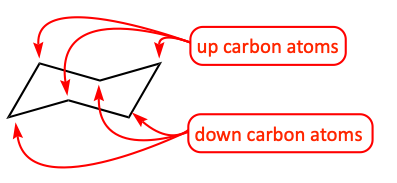
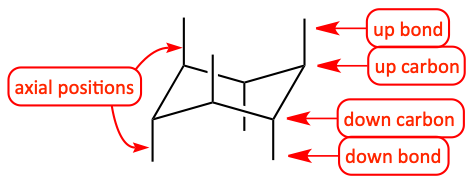
Next, let’s look at the equatorial bonds. For every up carbon, an equatorial bond is drawn down and for every down carbon, an equatorial bond is drawn up. The four equatorial bonds on the ends are easiest to draw, so draw them first.
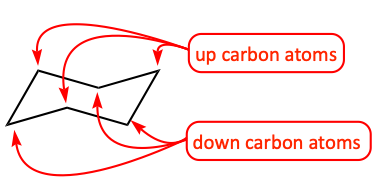
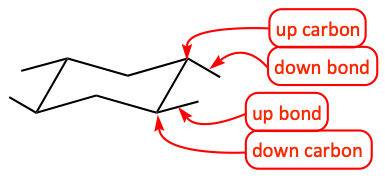
The last two equatorial bonds are sometimes confusing for students at first. For the up carbon atom, we know the equatorial bonds needs to point down, but do we angle it down to the left or the right? As a beginner, both may look OK to you.
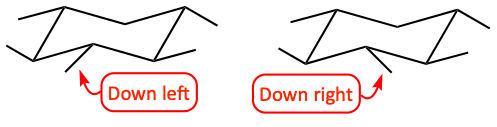
This is the correct way.
This is the wrong way.
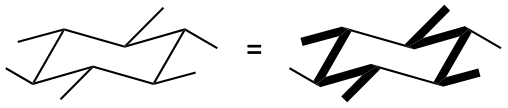
The way to remember which way to point these last two equatorial bonds is to look for the “M” and “W”. Below is the correct way to draw in the equatorial bonds.
17. Practice drawing a chair. Draw the chair five times without the axial and equatorial bonds on it.

18. On this chair, label the axial position with an “A” and the equatorial positions with an “E”.
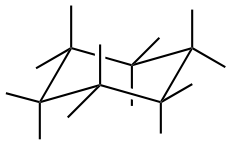
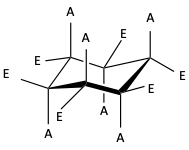
19. Draw a chair and put the six axial bonds on it.
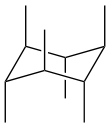
20. Draw a chair and put the six equatorial bonds on it.
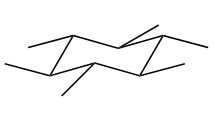
21. Draw a chair and put all axial and equatorial bonds on it.
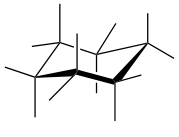
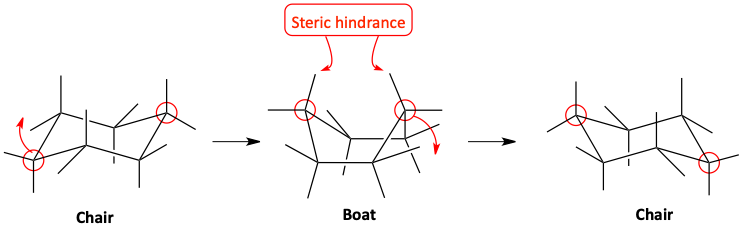
There is enough energy for a cyclohexane chair to convert to another cyclohexane chair conformation. This chair interconversion, or chair flip, goes through a boat conformation. It is called the boat conformation for its obvious similarities to a boat. This boat conformation is less stable than the chair because of steric hindrance. Two groups end up getting close to each other. But, overall, this problem is easily overcome with room temperature thermal energy.
6.6.2 Monosubstituted chair
When a chair flip occurs, all of the axial groups become equatorial groups, and all of the equatorial groups become axial groups. This can be seen in the example of methylcyclohexane.
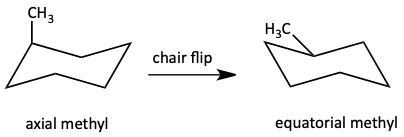
Larger groups prefer to be in the equatorial positions on a chair. Steric hindrance is a problem when a large group is in an axial position because the large axial group ends up too close to other axial groups. This particular type of steric hindrance is called 1,3-diaxial interaction because the two groups are both axial on carbon atoms 1 and 3 of a cyclohexane chair.
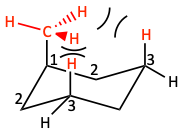
If the group is larger than a methyl, it is even more likely to be found in an equatorial position. In fact, a t-butyl group is so large, that you may never see it in an axial position. Important point: On a chair, a large group in an equatorial position is more stable than in an axial position.
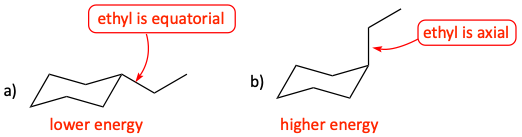
22. a) Use the following two lines to begin to draw a chair. Finish drawing an ethyl group on the chair to make the lowest energy form of ethylcyclohexane. Be very careful and particular about the direction your draw your bonds.

b) Draw the chair conformation after your ethylcyclohexane drawing from part a undergoes a chair flip. You may want to use these parallel lines to begin to draw your chair.

22. Your answer may look slightly different depending on where you chose to draw your ethyl group. Make sure it is equatorial in answer a and axial in answer b.
23. Identify the following groups on cyclohexane chairs as axial or equatorial.
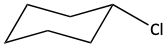
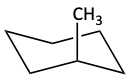
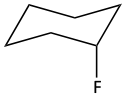
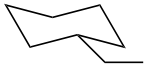

6.6.3 Disubstituted chairs
When two groups are attached to a cyclic compound, cis-trans isomers exist. This is because there are two sides to the ring. Because cyclohexane is a ring, cis-trans isomers exist when two groups are attached to it. It is easy to see if the two groups point in the same direction when the ring is drawn planar.
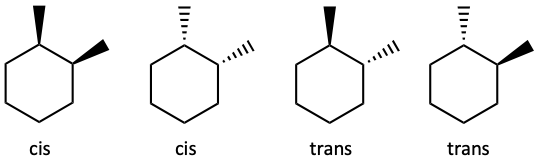
cis vs. trans disubstituted cycloalkanes
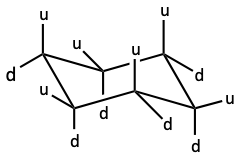
But, sometimes in a chair conformation, students have more difficulty at first when trying to determine cis or trans. It is really still pretty simple. You need to remember that if two groups both point up or both point down, it is cis. If the two groups point in opposite directions, one up and one down, then it is trans. On the following chair, all of the bonds are labeled either up (u) or down (d) based on the direction the bond points.
So, let’s look at the various possible forms of 1,2-dimethylcyclohexane.
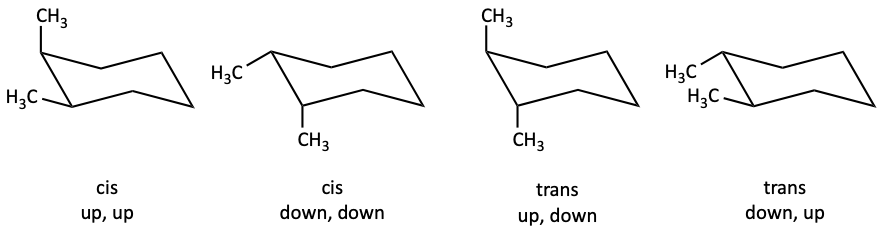
cis vs. trans on disubstituted cyclohexane chairs
Notice that the cis and trans determination of a chair is solely based on the direction (up or down) of the groups and not by axial or equatorial designations.
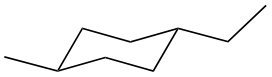
24. Name the following cyclohexanes. Remember to use cis or trans in the name.
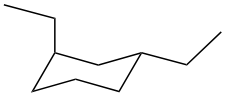
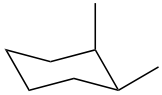

Let’s draw a structure from a name. Let’s draw trans-1,4-dimethylcyclohexane in its lowest-energy chair conformation. First, let’s draw a chair. You can draw either chair-flipped form of the chair.
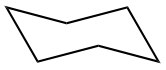
Draw a methyl group on any carbon atom. We’ll call this carbon atom #1. This methyl is in the “up” position.
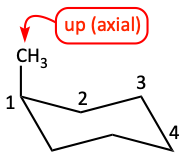
Draw in the axial and equatorial bonds on carbon atom #4. Since carbon #4 is a down carbon atom, the axial bond goes straight down and the equatorial bond must be up.
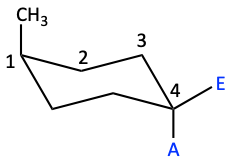
Since the methyl we have already drawn is “up” and we need trans, the second methyl group must point in the opposite direction. Therefore, we draw the methyl group down, which is the axial position on carbon #4. We can draw a hydrogen atom in the equatorial position, or we can simply delete it.
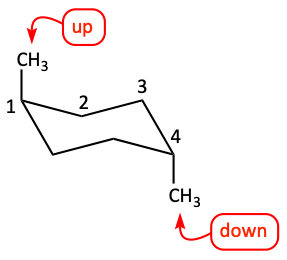
We must also consider the chair flipped version of this compound. Every axial group then moves to an equatorial position.
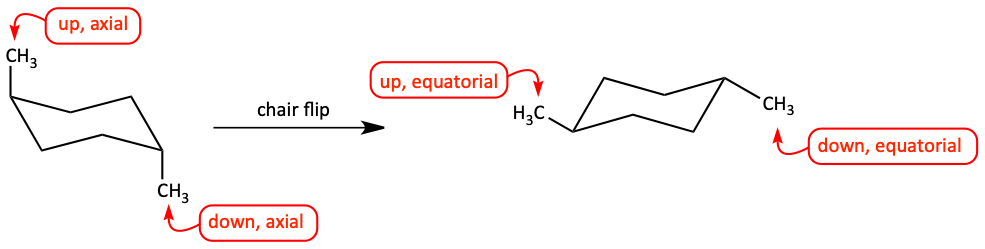
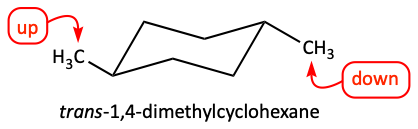
We then compare the two forms to see which one is the lowest energy form. We like the one on the right with the larger methyl groups equatorial instead of both axial like on the left. Our final answer is:
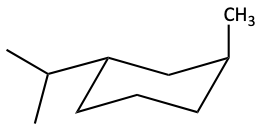
What if we have two different groups? Let’s look at the lowest energy conformation of trans-1-isopropyl-3-methylcyclohexane.

In each of these, there is one axial and one equatorial group. Which do we choose? Since larger groups prefer to be equatorial, we prefer the one with the isopropyl group in the equatorial position.
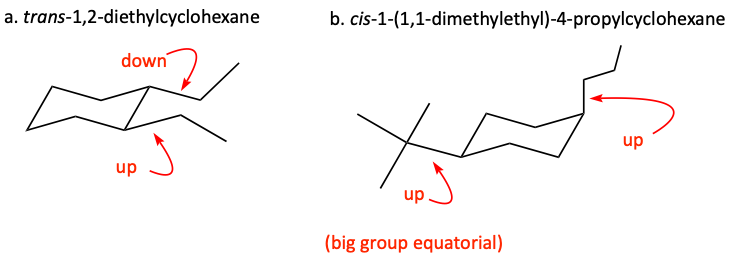
25. Draw the following cyclohexane compounds as chairs in the lowest energy, most stable configuration. Pay careful attention how you draw your axial and equatorial groups! a) trans-1,2-diethylcyclohexane b) cis-1-(1,1-dimethylethyl)-4-propylcyclohexane