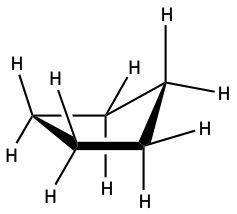
6.5 Cycloalkanes
If an alkane is in a ring, a cycloalkane, we name it by using the prefix cyclo-.
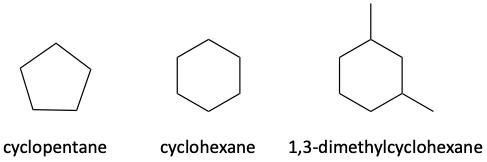
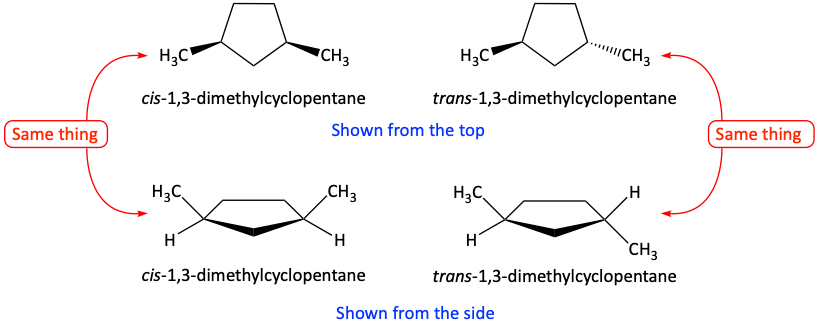
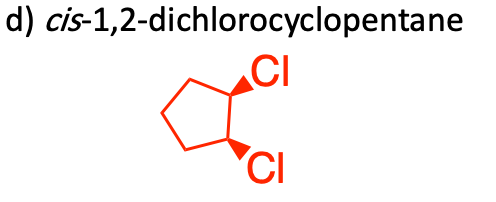
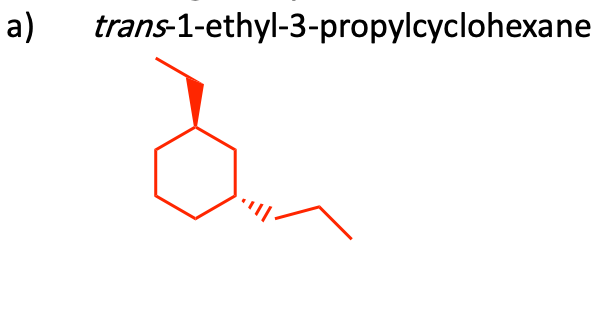
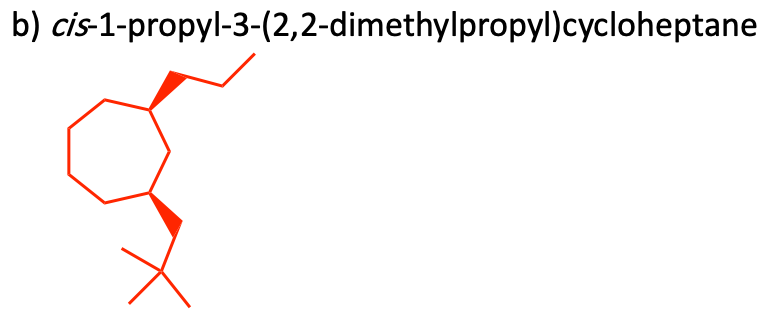
If there are two groups on a ring, we need to say whether the groups point towards the same face of the ring (cis) or opposite faces of the ring (trans).
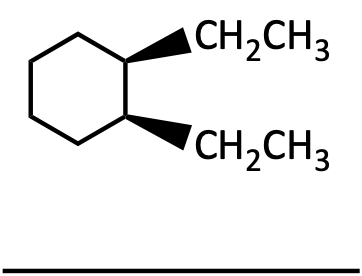
13. Name the following compounds (use cis/trans when appropriate).
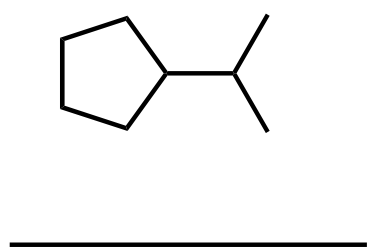
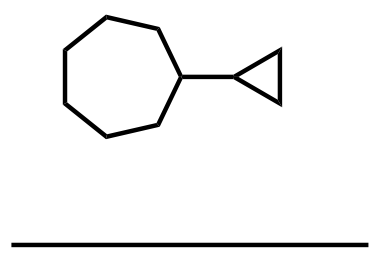
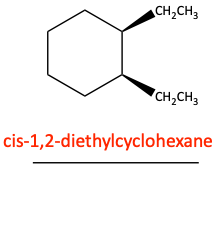
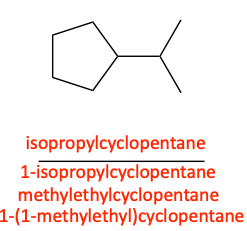
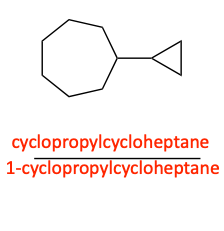
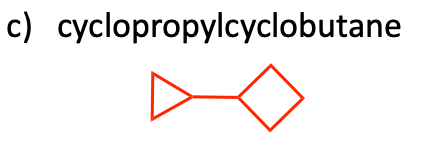
14. Draw the following compounds. a) trans-1-ethyl-3-propylcyclohexane b) cis-1-propyl-3-(2,2-dimethylpropyl)cycloheptane c) cyclopropylcyclobutane d) cis-1,3-dichlorocyclopentane
6.5.2 Bicycloalkanes
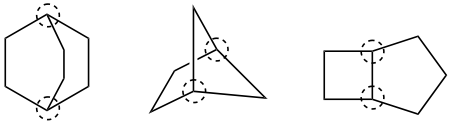
When two cycloalkanes are fused together, they are called bicycloalkanes or a bicyclic compound. These two rings always share two carbon atoms. These two shared carbon atoms are the bridgehead carbons. In the following bicyclic compounds, the bridgehead carbons are circled.
Three bridges connect these bridgehead carbon atoms. The number of carbon atoms in each of these three bridges need to be counted, but do not include the bridgehead carbon atoms in this count!
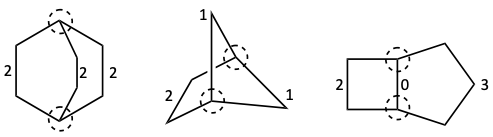
Bicycloalkanes are named by writing bicyclo, followed by brackets that contain three numbers separated by periods, followed by the alkane name for the total number of carbon atoms in the entire molecule. The three numbers are the number of carbon atoms in the three bridges arranged from highest to lowest. It takes the form bicyclo[#.#.#]alkane.
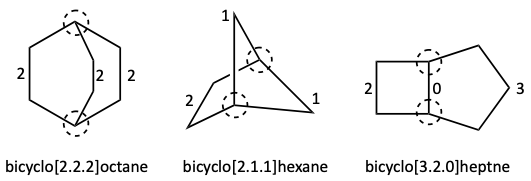
15. Name the following compounds.
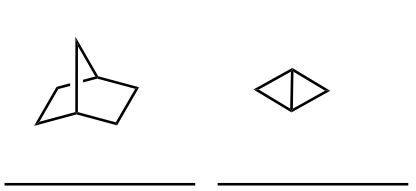
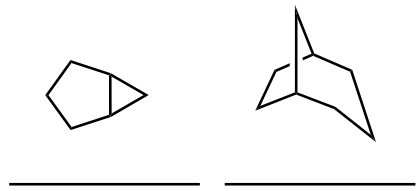
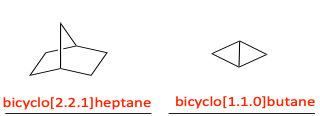
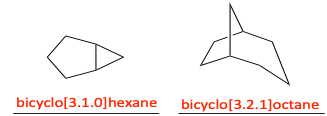
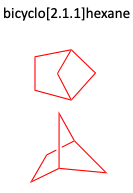
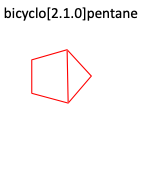
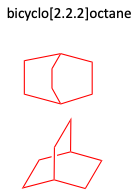
16. Draw the following compounds. a) bicyclo[2.1.1]hexane b) bicyclo[2.1.0]pentane c) bicyclo[2.2.2]octane
6.5.3 Stability of cycloalkanes
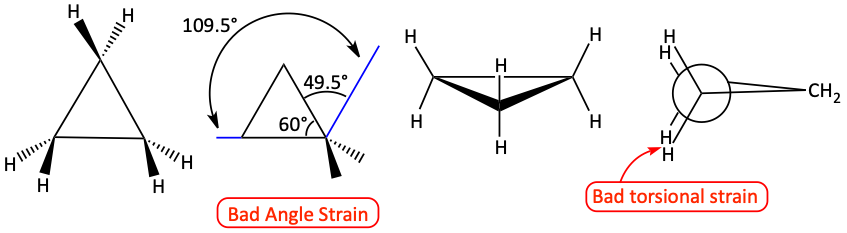
Alkane carbon atoms are sp3 hybridized which naturally produces tetrahedral bond angles of 109.5°. In order to form cycloalkanes, the bond angle must deviate from this desired 109.5. For instance, in cyclopropane, the bond angle inside the ring is 60°. This is 49.5° away from the ideal bond angle. Angle strain is the strain that comes from pulling the bonds away from the idea bond angle into this strained conformation. Also, cyclopropane has some torsional strain because it is locked into a conformation that caused the C-H bonds to overlap. The strain caused by angle and torsional strains combined is called ring strain.
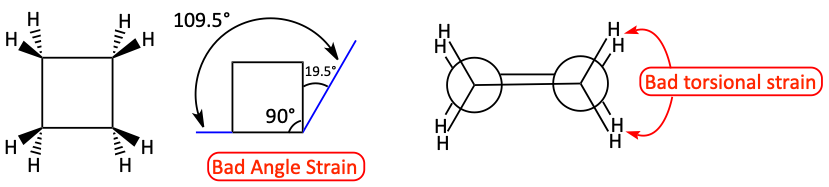
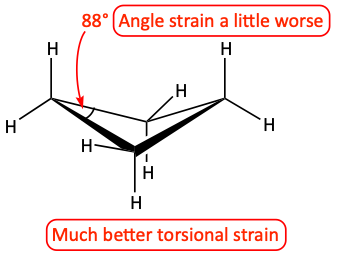
Cyclobutane also has quite a bit of ring strain. If cyclobutane was a planar, regular square, it would have high angle strain with the deviation of a 90° ring being 29.5° away from the idealized 109.5°. But, if it is planar, it has terrible torsional strain. So cyclobutane twists or folds a bit so it is not planar. It hurts the angle strain because by folding, it becomes an 88° angle in the ring. But, the torsional strain is much better. We do see cyclobutane rings at times, but they are still fairly rare because of the high ring strain.
If cyclopentane was a planer, regular pentagon, it would have bond angles of 108°. This does not deviate much from the ideal 109.5°. In order to reduce the torsional strain cyclopentane would have if it was planer, it folds a bit. Cyclopentane is quite stable with low ring strain. Cyclopentane is a fairly common cycloalkane.