10.5 Alkene Synthesis
10.5.1 Review
E2-Dehydrohalogenation to form alkenes
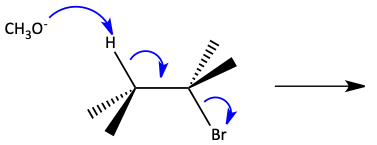
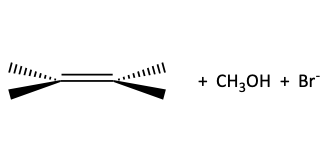
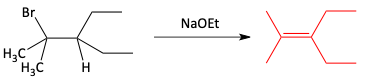
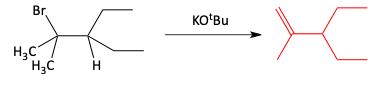
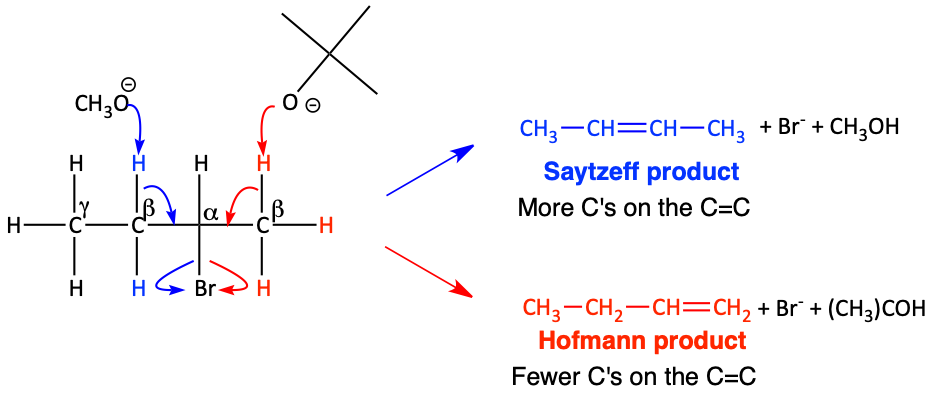
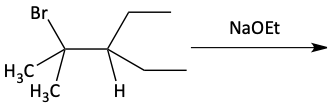
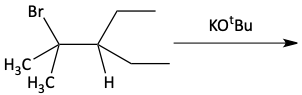
• E2 needs a strong base to attack right away. • It happens in a 1-step, coplanar arrangement. • Small, aggressive bases like NaOEt (ethoxide) make more of the Saytzeff product (if they don’t SN2). Large, bulky bases like KOtBu (t-butoxide) make more Hofmann product.
E2-Dehydrohalogenation to form alkynes
Alkynes can be synthesized by an E2 reaction as well. The elimination must happen twice to form the two pi-bonds of the alkyne. This requires two leaving groups (halides) and two hydrogen atoms on neighboring carbon atoms. This could be a vicinal dihalide, with halides on neighboring carbon atoms, or a geminal dihalide with two halides on the same carbon atom.
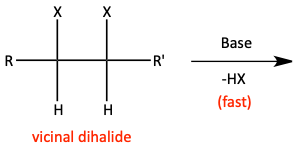
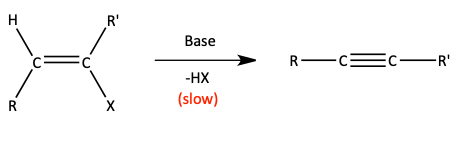
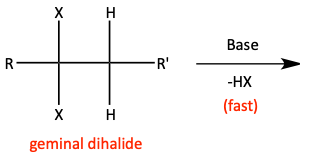
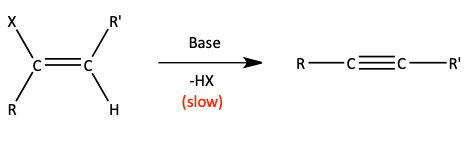
The second, slow, step of each of these dehydrohalogenations is a difficult reaction to force. It only happens under the most basic and harsh conditions. This reaction can be performed with molten KOH or KOH in alcohol heated to 200°C. Under these harsh conditions, if any other base sensitive functional groups are present, they could be destroyed.
E1 Formation of Alkenes
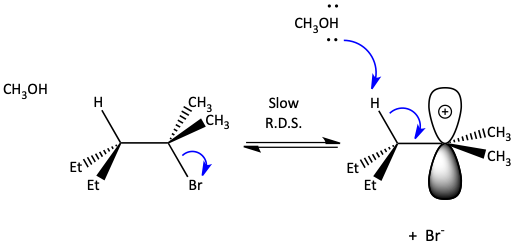
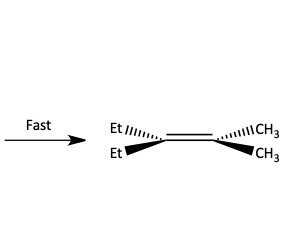
• E1 works better with a polar solvent to help with the ionization.• E1 typically involves a weak base. Stronger bases may deprotonate too quickly causing an E2 reaction.• SN1 competes with E1. The base/nucleophile can attack either the carbocation (SN1) or deprotonate a beta carbon (E1).• Because carbocations are formed in the mechanism, rearrangements are common. Rearrangements can happen in E1 and SN1 reactions.
10.5.2 New Alkene Syntheses
Dehydrohalogenation of Vicinal Dibromides
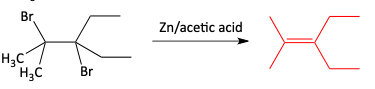
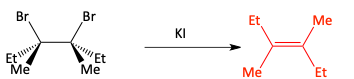
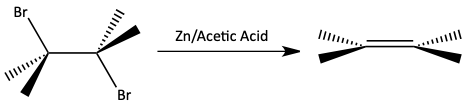
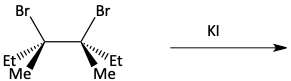
If two bromides are on neighboring carbon atoms (vicinal dibromides), they can react with I- (from a salt like NaI or KI) in an E2 style reaction to form an alkene.
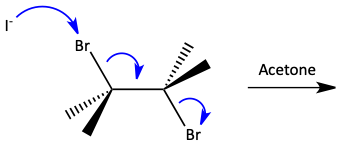
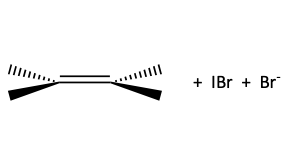
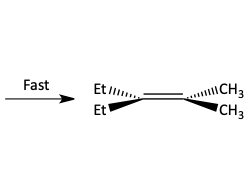
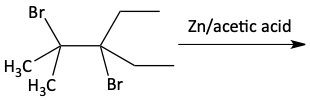
The two bromides are usually in an anti-coplanar arrangement when they react with I-.Another way to accomplish a dehalogenation of a vicinal dibromide is to use zinc and acetic acid.
Dehydration
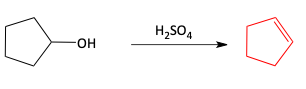
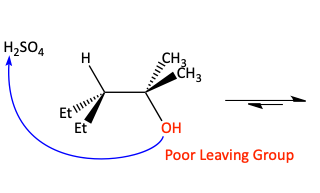
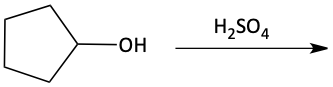
The hydroxyl group of alcohols is a poor leaving group. But, in the presence of a strong acid like sulfuric acid, H2SO4, phosphoric acid (H3PO4) or toluenesulfonic acid (TsOH) it can be turned into a good leaving group (H2O). Once this good leaving group is formed, an E1 reaction can occur to form an alkene.
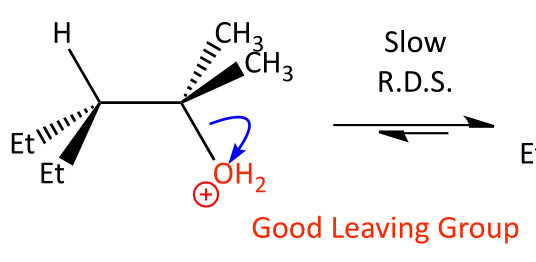
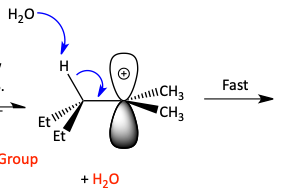
Because a carbocation is formed in this E1 reaction, rearrangements are common.
10. Draw the products of the following reactions.
10.