8.3 Finding Nucleophilic Sites
Let’s first address how we recognize the most negative spots (nucleophilic sites) in real molecules. Perhaps the most obvious situation is if an atom has a formal negative charge. Examples of this are oxides, amide ions, carbanions, and hydrides. Remember that arrows always show where the negative electrons move. In the following figure, the arrows originate at the negative, nucleophilic sites.
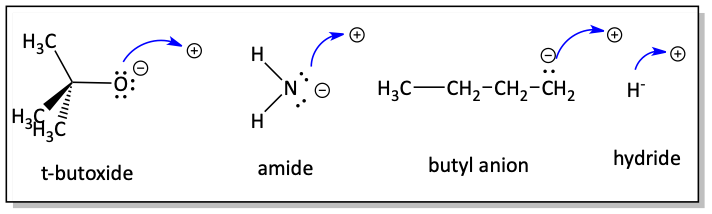
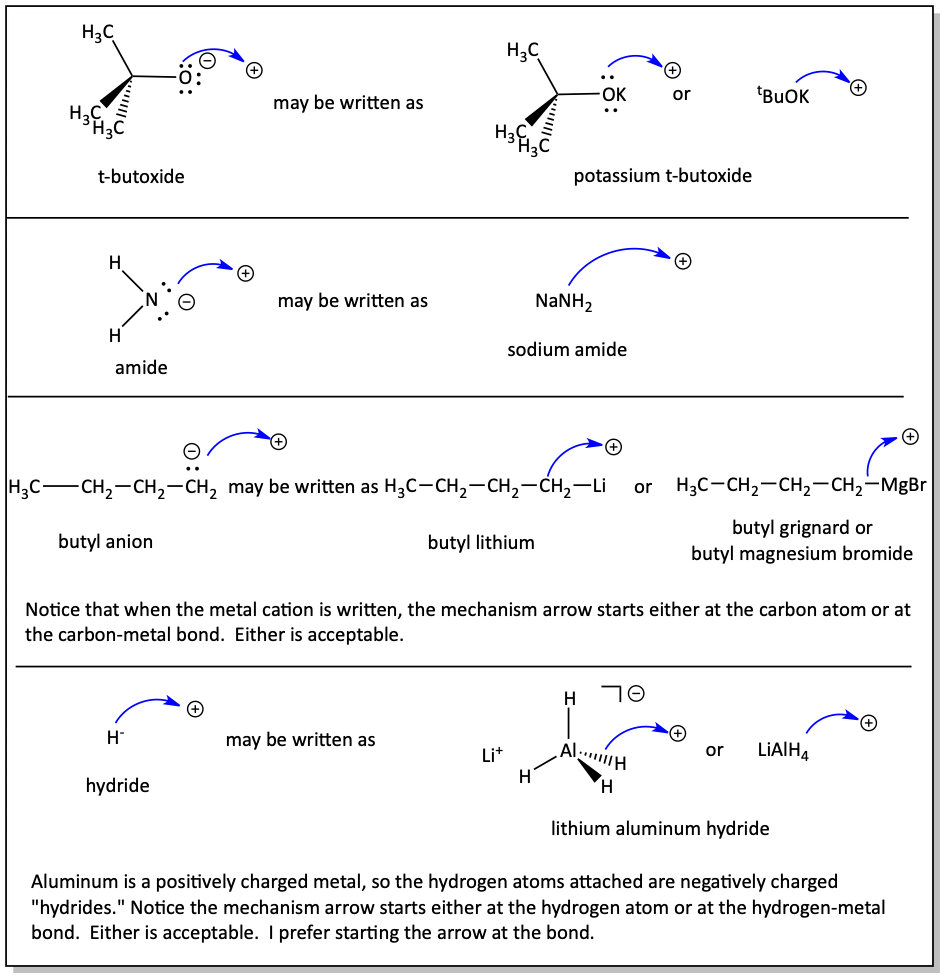
The charges are sometimes drawn on the atoms. When they are, that helps us determine where to start our arrows. But in fact, this negative charge is always balanced out by a counterion. The counterion is a positive cation, usually a metal cation. This metal cation is typically drawn attached to the most negative, nucleophilic site. This can make it a little trickier recognizing the negative atom. Remember that anytime you see a metal in a molecule, the atom attached has a negative charge. A positive metal has a negatively charged atom attached to it! It is this negative atom that will go out and attack in our mechanisms. Our arrow will start there. Here are some examples of how these compounds may be written with the metal. Remember that arrows are pointing away from the most negative, nucleophilic sites.
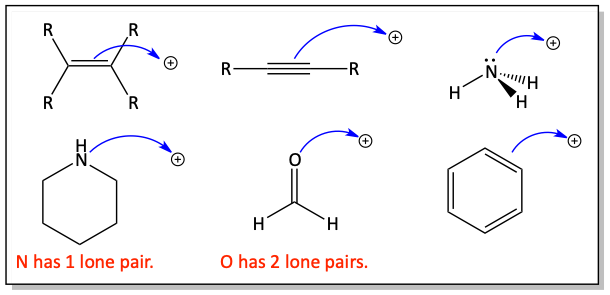
If you don’t see a formal negative charge on an atom, or if you don’t see a metal to tip you off to the location of a negative atom, look for other locations of nice, juicy negative electrons. The best place to look? Look for double or triple bonds as they contain one or two π bonds respectively. You can also look for lone pairs of electrons. This is a little tricky for beginning students because chemists are lazy when it comes to drawing structures. We quite often do not draw in all of the lone pairs of electrons. It is assumed you will know how many lone pairs there are on each atom. Remember the normal bonding patterns and you will be all right. So, if you have a nitrogen, oxygen, or sulfur atom, be sure to draw in the lone pairs of electrons.
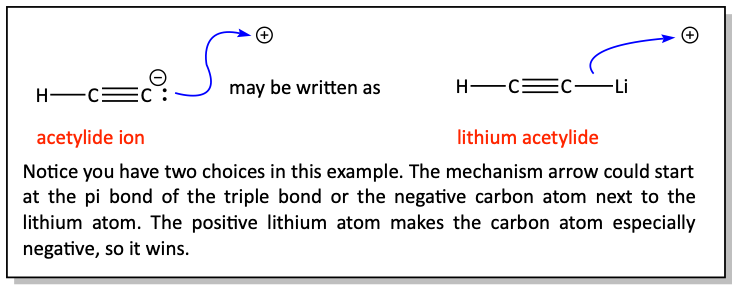
Sometimes, you’ll have two sites to choose from. Let’s consider lithium acetylide. . .

In this molecule, we see the lithium metal atom, which we remember is positively charged. This means that the carbon atom attached to the lithium has a partial negative charge. We can think of it as having a lone pair of electrons on it. But, we also notice that there is a pi bond that is also available for bonding. When you see a molecule with a metal written, our mechanism arrow will almost always start at the atoms attached to it. So, typically, carbon-metal bonds are more negative (more nucleophilic) than pi bonds.
In summary, there are four main locations to look for negatively charged sites on molecules.
How to find negative sites1. Formal negative charges2. Bonds between nonmetal and metal atoms3. Lone pairs of electrons4. Pi bonds
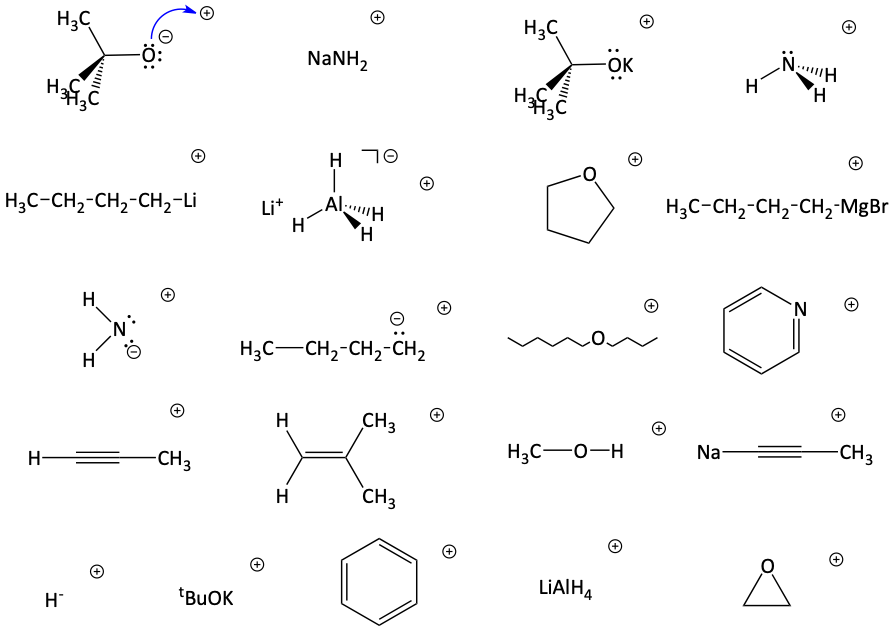
5. Draw arrows for the following molecule starting at the most negative spots (nucleophilic sites) and pointing towards the positive charges.
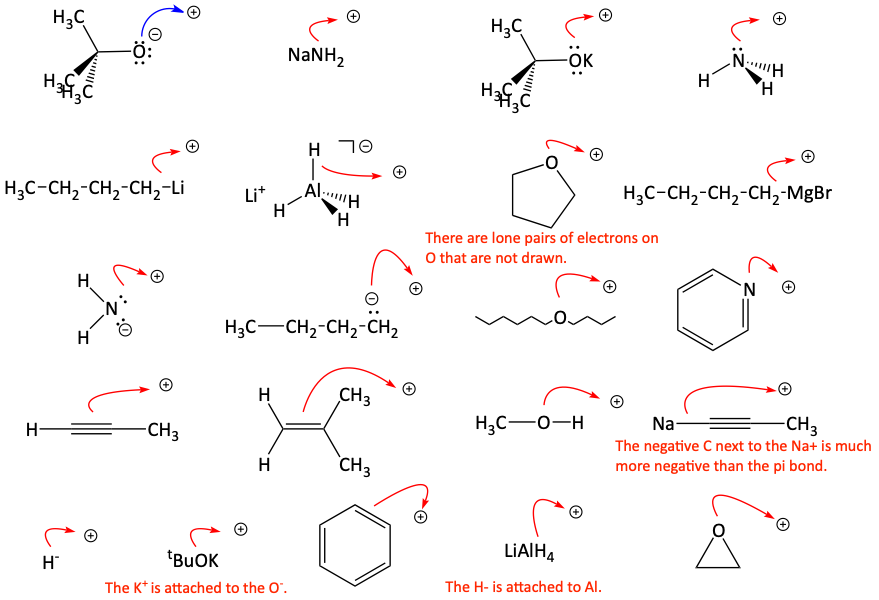
Notice in all of these, when there is a metal atom in the compound, the bond/atom next to it is the most negative site. Your arrow will start there! Pi bonds (double/triple bonds) are usually good locations for arrow beginnings, but not compared to spots next to very positive metal atoms!
If you struggled at all or missed any of the problems in the previous exercise, go back and reread the beginning of this chapter once again. You should make sure you understand what is going on before proceeding. If you were successful in the previous exercise, great! Let’s learn to recognize the positive spots (electrophilic sites) in molecules.