19.5 UV-Visible Spectroscopy
We have seen that conjugated molecules can absorb ultraviolet and visible light. The process of measuring the absorption of ultraviolet and visible light is called UV-Visible (UV-Vis) spectroscopy. A UV-Vis spectrometer is an instrument that can shine specific wavelengths of ultraviolet or visible light through a sample. The sample is usually dissolved in a solvent and placed in a cuvette. A cuvette is a 1 cm X 1 cm sample holder. Cheap ones are made out of plastic or glass. But, glass and plastic absorb ultraviolet light. So, good cuvettes are made out of quartz and can allow ultraviolet light pass through them. A detector measures the amount of each wavelength of light that passes through the sample. If the sample begins to absorb the light, less passes through to the detector, and a peak is made. It shows an absorbance.
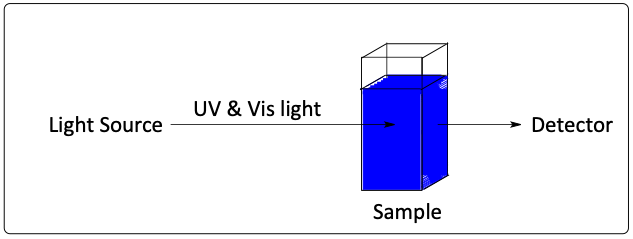
A UV-Vis spectrum usually plots absorbance vs. wavelength of light that passes through it in nm. Let’s pretend that we are analyzing blue juice. The UV-Vis instrument begins scanning from 200 nm (the ultraviolet region) to 400 nm (violet light) on up to 800 nm (red light). Below is the UV-Vis spectrum. It shows that no light is absorbed between 200-500 nm (ultraviolet through purple). Then, the sample begins absorbing light between 500-700 nm. The light around 600 nm is the greatest absorbance with the highest spot at 605 nm. 605 nm is therefore called the λmax (lambda max). This is the wavelength (λ) with the maximum absorbance. Since the juice absorbs light in the yellow-orange part of the spectrum, it looks blue.
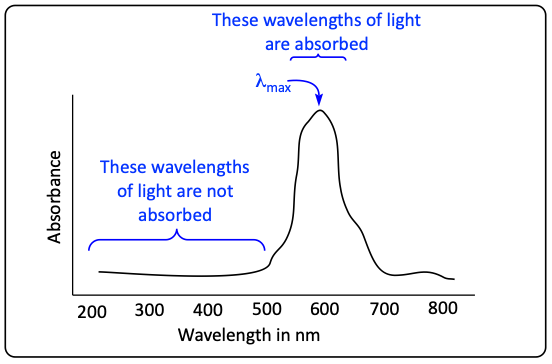
Even though a HOMO-LUMO gap is a very specific energy, UV-Vis peaks tend to be broad. This is because there are different rotational and vibrational states and energies for the molecule. This causes the energies of the HOMO and LUMO molecular orbitals to vary some.
Solved problem:
Given this UV-Vis spectrum, what is the energy of the HOMO-LUMO band gap for this blue juice?
The λmax for the blue juice is 605 nm. This wavelength corresponds to a specific energy. We know that the energy of light is proportional to its frequency.
E = hν
We therefore need to know the frequency of this light given its wavelength. We know wavelength and frequency are related by the speed of light.
c = λν
Using this equation, we solve for frequency. The units should be in m/s for the speed of light and in m for the wavelength.
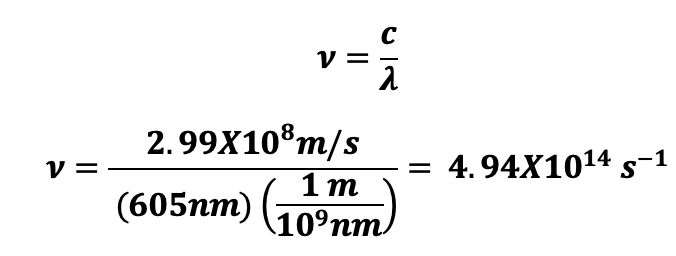
With the frequency, the energy can now be calculated. Plank’s constant, h, is 6.63×10⁻³⁴ Js.

This is the approximate energy of the HOMO-LUMO band gap.