19.4 1,3-Butadiene
Butadiene is a simple, conjugated pi system.

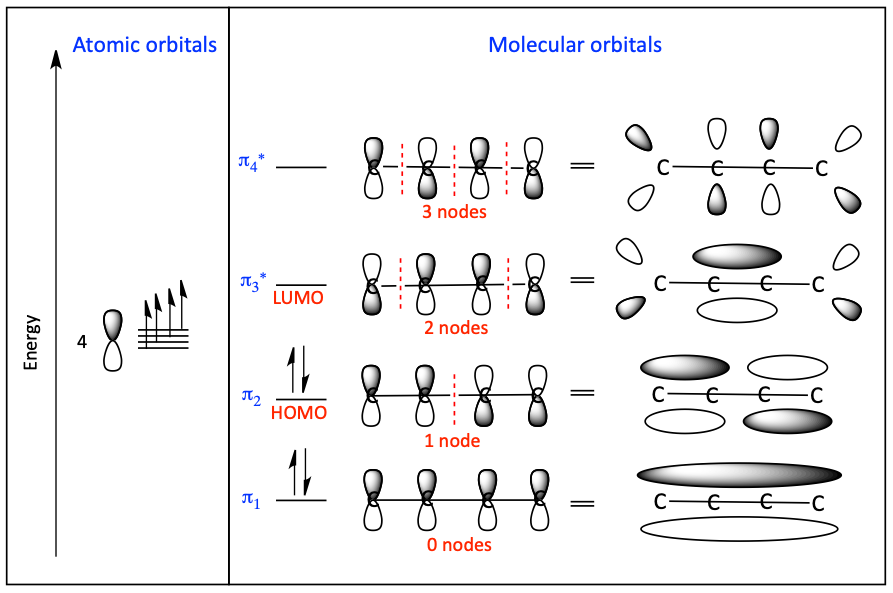
To make the two double bonds, four carbon p-orbitals overlap. Each of the p-orbitals contains one electron each. Since these four p atomic orbitals are overlapping, it makes four molecular orbitals in the MO diagram. Since there are always an equal number of bonding and antibonding molecular orbitals, butadiene has two bonding molecular orbitals and two antibonding molecular orbitals.
To determine the shapes of the molecular orbitals, we overlap the four p-orbitals. Notice that in the lowest energy molecular orbital, there are no nodes. All of the p-orbitals overlap making one pi molecular orbital that spreads over the entire four carbon atoms. This is labeled 𝜋1 in the MO diagram. There are two electrons in this orbital that are spread over the entire four carbon atoms.
The next higher energy molecular orbital, 𝜋2, has one node in it, right in the center. The electron density of 𝜋2 is located between carbon atoms C1-C2 and C3-C4. There are two electrons in this molecular orbital. This electron density is quite similar to the way we draw butadiene, with pi bonds drawn between carbons C1-C2 and C3-C4. Between carbon atoms C2-C3, there is destructive overlapping of the p-orbitals. But, overall, since there are two bonding sites and one antibonding site, the molecular orbital is bonding.
The electrons in 𝜋2 are the highest energy electrons in the molecule because they are in the highest occupied molecular orbital. This molecular orbital is given the acronym HOMO for Highest Occupied Molecular Orbital. These highest energy electrons are the most reactive electrons in butadiene.
The next higher molecular orbital is higher in energy than the four atomic p-orbitals. This molecular orbital, 𝜋3*, contains two nodes. This orbital has some overlapping p-orbitals between carbon atoms C2-C3, but it is destructively overlapping in two places, between carbon atoms C1-C2 and C3-C4. Overall, this is more antibonding than it is bonding. This molecular orbital does not have any electros in it because the four p-orbitals each only had one electron for a total of four electrons that can be used in the molecular orbitals. All four were used in 𝜋1 and 𝜋2. Since 𝜋3* is the lowest molecular orbital without electrons in it, it is labeled with the acronym LUMO for Lowest Unoccupied Molecular Orbital.
Finally, the highest molecular orbital of the conjugated pi system of butadiene is 𝜋4*. In 𝜋4*, all of the p-orbitals are out of phase with each other and destructively overlapping with each other. This gives three nodes for a totally antibonding orbital.
The energy distance between the HOMO and LUMO molecular orbitals is of particular importance. This energy gap between the highest occupied molecular orbital and the lowest molecular orbital is called the HOMO-LUMO band gap or simply band gap. As the number of conjugated pi bonds increases in conjugated molecules, more molecular orbitals are needed to describe the conjugated system. This results in shrinking or smaller HOMO-LUMO band gaps energies.
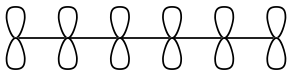
2. Shade in the atomic p-orbitals to represent what would overlap to make the following molecular orbitals.

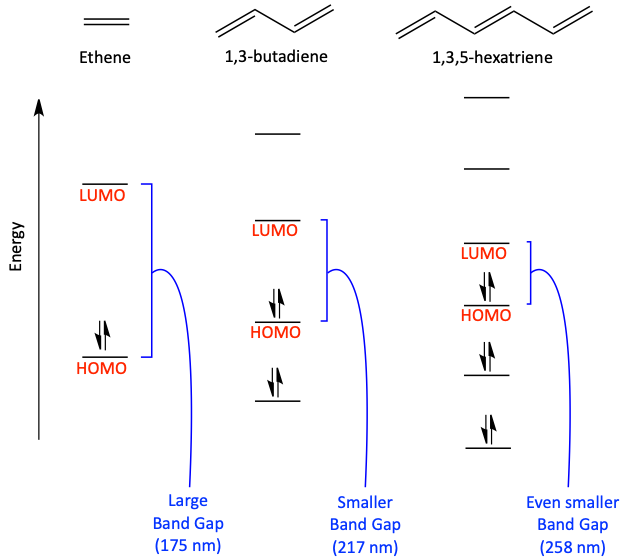
For ethane, the HOMO-LUMO band gap is fairly large. In fact, the gap is of an energy that equals 175 nm of light. This is in the ultraviolet range. This is to say, if ultraviolet light of frequency 175 nm shines on ethane, ethane will absorb that light by promoting an electron from the HOMO to the LUMO. 1,3-butadiene, with more conjugation, has a lower HOMO-LUMO band gap. Ultraviolet light of 217 nm can promote an electron from its HOMO to its LUMO energy level. 1,3,5-hexadiene has an even smaller HOMO-LUMO band gap. It will absorb ultraviolet light with a wavelength of 258 nm. Notice, longer wavelength light equals lower energy.
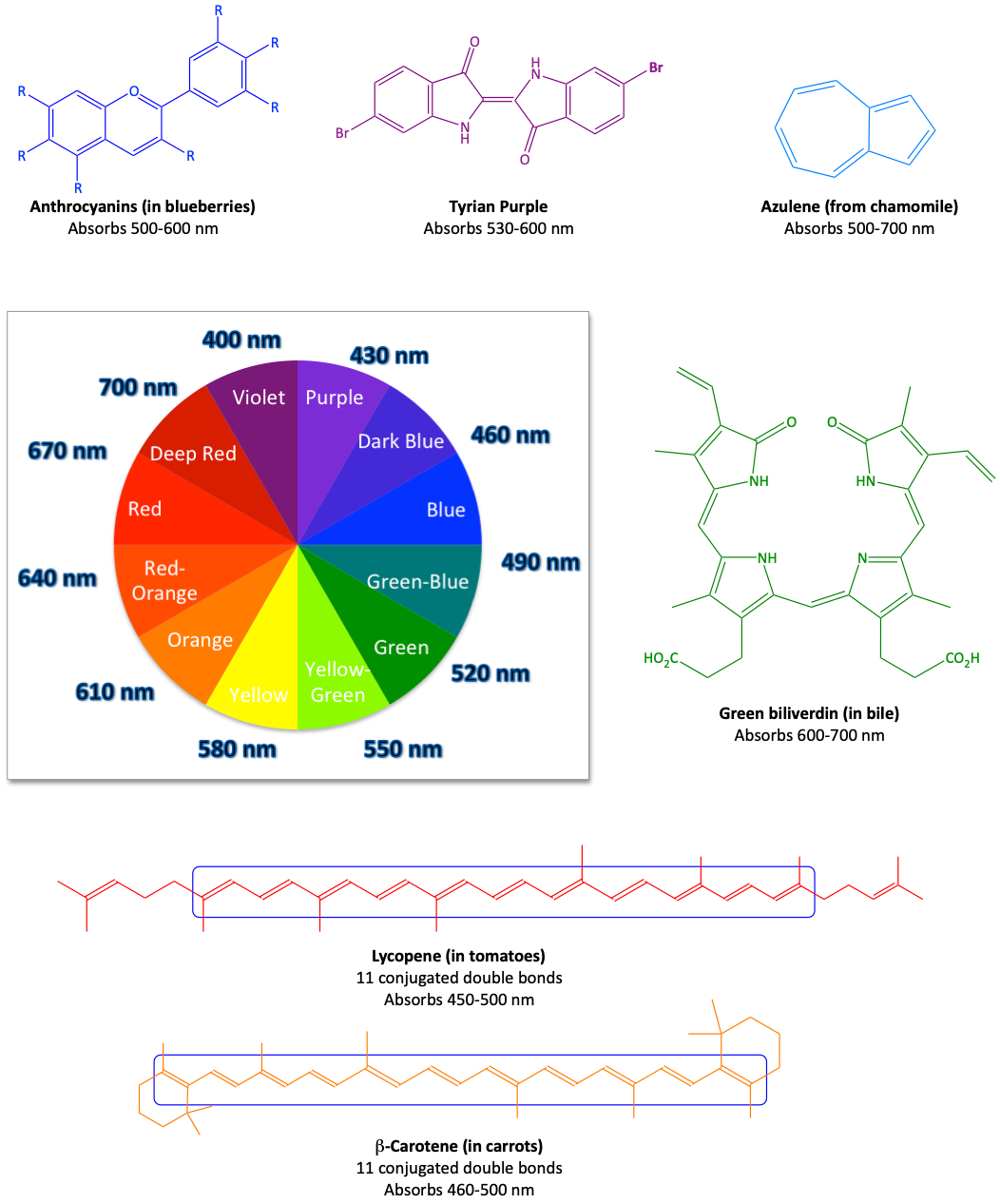
All three of these compounds, ethane, 1,3-butadiene, and 1,3,5-hexatriene, all absorb light in the invisible, ultraviolet region. Because invisible light is being absorbed, all of these compounds are colorless. In order for a compound to have a visible color, the band gap needs to be sufficiently small to absorb wavelengths in the visible spectrum, between about 400-700 nm. The way organic molecules get this small of a band gap is to be very conjugated. Here are some examples of colorful pigments with their absorptions.
3. Circle the one molecule in the following grouping that absorbs the longest wavelength of light?

