19.3 Conjugation introduction
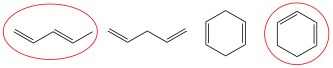
In this chapter, we are looking to deeply understand conjugated alkenes. Conjugated double bonds or conjugated alkenes are those double bonds that are separated by only one single bond. Conjugated double bonds have a double-single-double pattern of carbon bonds.
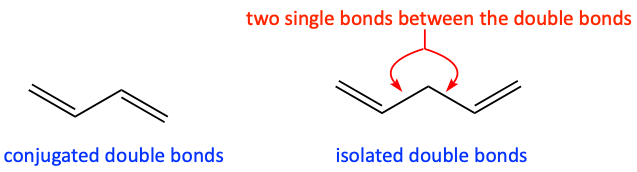
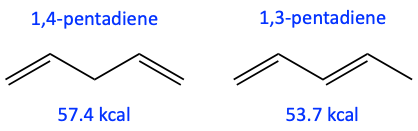
Conjugated double bonds are more stable, or lower in energy, than isolated double bonds. For example, 1,4-pentadiene, with isolated double bonds, has an energy of 57.4 kcal. The very similar, 1,3-pentadiene has an energy of 53.7 kcal. The only difference is 1,3-pentadiene has a conjugated pi system. This conjugation results in nearly 4 kcal of stability compared to the isolated double bonds.
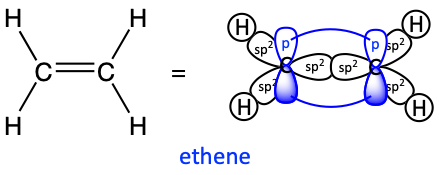
This extra stability because of conjugation can be explained by looking at the pi-system molecular orbital (MO) diagrams. Let’s begin our investigation of pi-system MO diagrams by first looking at the simplest case of pi-bonding, ethene. The double bond of ethene consists of one sigma-bond made from two overlapping sp2 orbitals and one pi-bond with two overlapping p orbitals (in blue).
Now, let’s look only at the pi bond of ethene and ignore the sigma bonds. The atomic p orbitals can overlap constructively to make a pi bond or destructively to make an antibonding 𝜋*. The 𝜋 designation is used because the electron density lies above and below the internuclear axis.
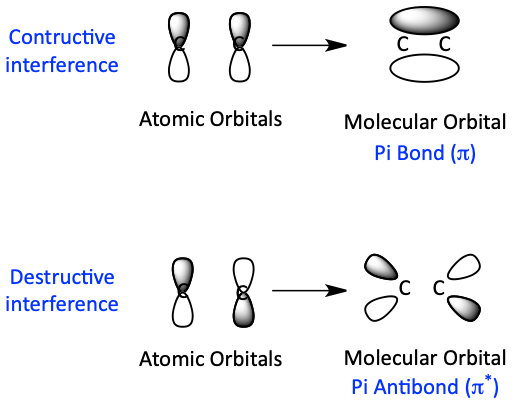
We can describe the pi bonding for ethene using the following molecular orbital diagram.
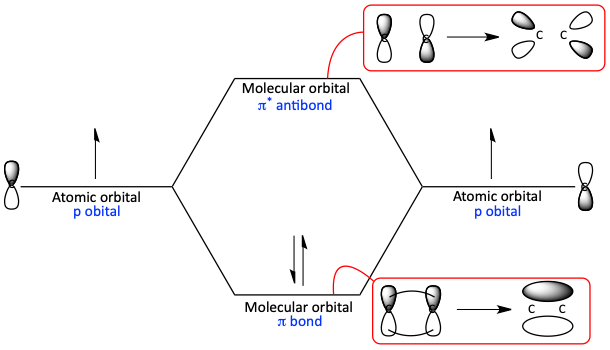
Each p atomic orbital contains one electron. When combined, the bond order is 1 for this pi system. There is only one pi bond formed.
Bond order = 1 full bond – 0 full antibonding MOs = 1
1. Circle the following molecules that are conjugated alkenes.