9.6 The SN2 Reaction - The "backside attack"
Let’s take a closer look at the substitution reactions first. There are two main mechanisms for the substitution of an alkyl halide. The first substitution mechanism we will look at is called the SN2 mechanism. Let’s walk through the SN2 mechanism by analyzing the reaction of two species, a hydroxide ion and bromomethane. In this substitution, an aggressive nucleophile attacks the carbon atom of the alkyl halide from the back side opposite the halide. If this nucleophile makes a bond with the carbon atom, that would make five bonds on the carbon atom! This cannot happen, so a group needs to leave. As the “backside attack” happens, the halide leaves. The halide is called a leaving group. The SN2 reaction all happens in one step. This is an example of a typical SN2 reaction.
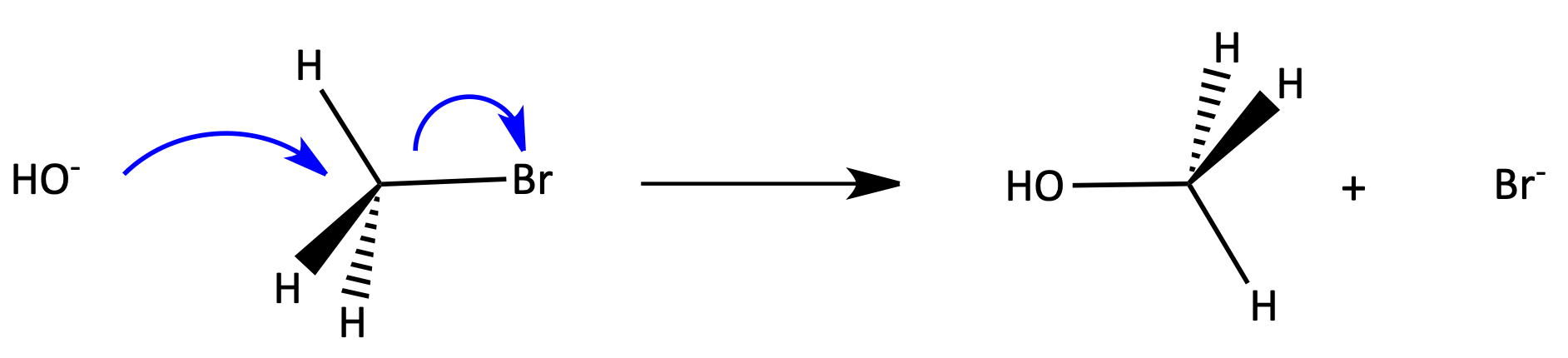
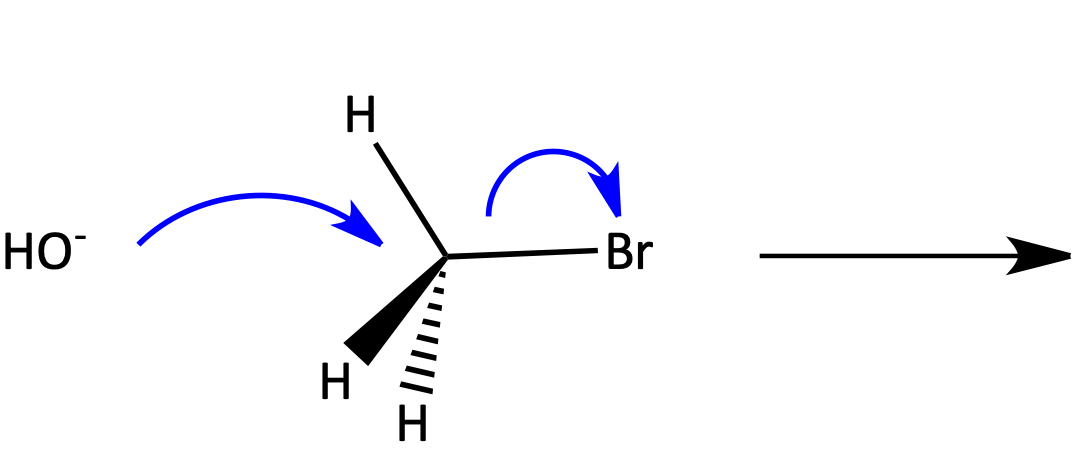
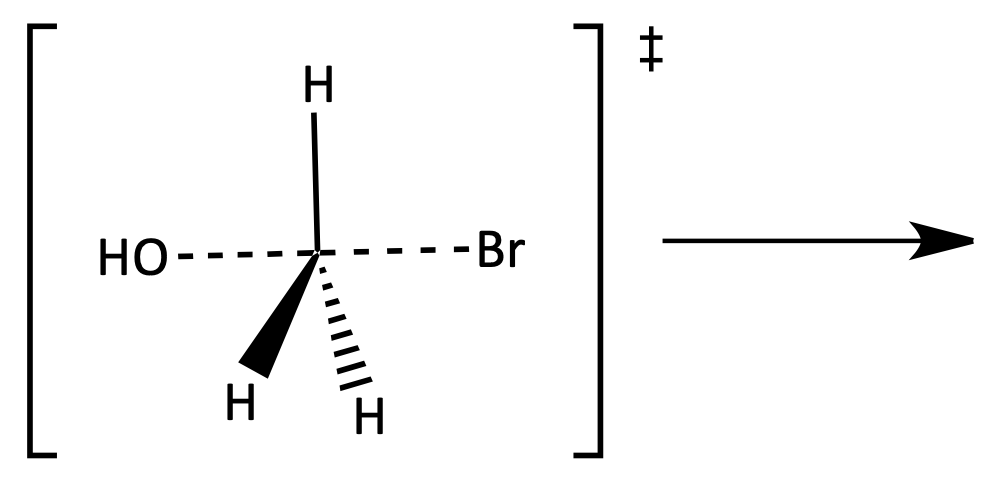
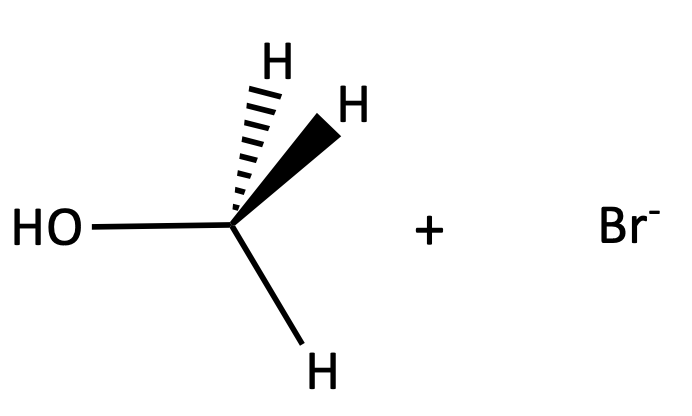
If you wanted to do a reaction with these two species, you could buy them from a chemical company. You would be able to find bromomethane in the chemical catalog, but you would not find hydroxide. That is because hydroxide does not exist by itself because of its negative charge. It exists with a positive counterion. You would need to buy sodium hydroxide (NaOH) or potassium hydroxide (KOH). But, in the reaction, the alkali metal is not involved in the reaction. It is called a spectator ion. A spectator ion is not involved in the reaction. It just floats around and acts like a spectator. It watches. Therefore, at times, the spectator ions are not explicitly drawn in our reactions. Spectator ions are sometimes ignored. So, why the weird name, SN2?S: Substitution. This is a substitution reaction.N: Nucleophilic. A nucleophile is attacking an alkyl halide.2: A Bimolecular mechanism. Two species are involved in the rate-determining step. The substitution and nucleophilic part are self-explanatory. But, what does the bimolecular part mean? The SN2 reaction mechanism is a one-step mechanism. It is a concerted mechanism, meaning the steps happen at the same time. The nucleophile attacks at the same time as the halide leaving group leaves.
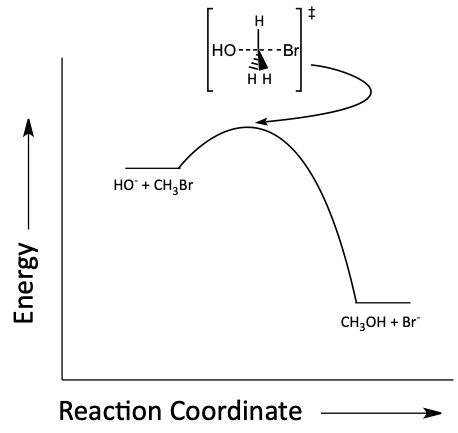
This one step is also the slowest step in the reaction because it is the only step! In this slowest step, the rate-determining step, two molecules are involved, the hydroxide and the bromomethane. For the SN2 reaction to occur, these two molecules need to meet each other. If the amount of hydroxide were doubled in the reaction, what would happen to the odds of the two colliding? It would double, or it would double the rate of the reaction. If the amount of bromomethane in the reaction were doubled, what would happen to the odds of the two colliding? It would double, so it would double the rate of the reaction. The reaction is first order with respect to each reactant and is, therefore, 2nd order overall. The rate equation for the SN2 mechanism is:Rate = kr[Nuc][Substrate]orRate = kr[OH-][CH3Br]