9.14 Extra Problems
26. Draw the following: a) isopropyl iodide b) tert-butyl chloride c) 1,2-dichlorobutane d) chloroform e) carbon tetrachloride
27. Write out the initiation, two propagation steps, and one termination step for the free-radical chlorination of methane.
28. One major monobrominated product is made when methylcyclopentane is brominated with Br2 under ultraviolet light. a) Draw that product. b) Draw the mechanism for this reaction (initiation, propagation, and termination steps).
29. a) Write the structures of both of the monobromination products of 1,1,2,2-tetramethylcyclopropane. b) Which of your monobromination products would you get more of when 1,1,2,2-tetramethylcyclopropane reacts with bromine under ultraviolet light?
30. Upon bromination with Br2 under ultraviolet light, each of the following makes one primary monobrominated product. Draw that product. a) cyclopentane
b) 2-methylbutane
c) propylbenzene
d) methylcyclobutane
e) cyclopentene
31. Show how free radical halogenation can be used to synthesize the following molecules. For each compound, explain why it is the major product formed.

32. Draw good resonance structures for the following free radicals.

33. When 4-methylpent-2-ene reacts with bromine under ultraviolet light, the following brominated products are made.

a) Draw the initiation step of the mechanism. b) Write a mechanism for the propagation steps. Your mechanism should explain how both products are formed. c) Why are these hydrogen atoms replaced with bromine compared to any of the other hydrogen atoms in the molecule? d) Show any termination step.
34. Draw the mechanism for the SN1 substitution reaction of 2-methyl-2-bromobutane to 2-methyl-2-butanol in water.
35. Provide a detailed mechanism for the SN1 reaction of ethanol (CH3CH2OH) with 1-bromo-1-methylcyclohexane.
36. Which of the following compounds will undergo an SN2 reaction most readily? (CH3)3CCH2I (CH3)3CCl (CH3)2CHBr (CH3)2CHCH2CH2CH2I (CH3)2CHCH2CH2CH2Cl
9.37 For each of the following molecules, predict which of the halogens would be more reactive in the SN2 reaction.

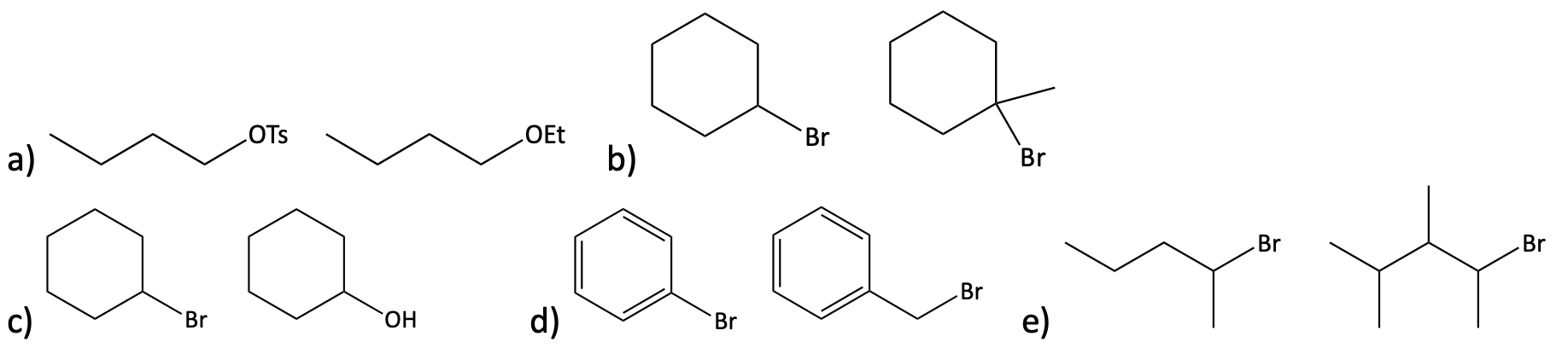
38. For each pair, circle the compound that will react the fastest as the electrophile (substrate) in an SN2 reaction.
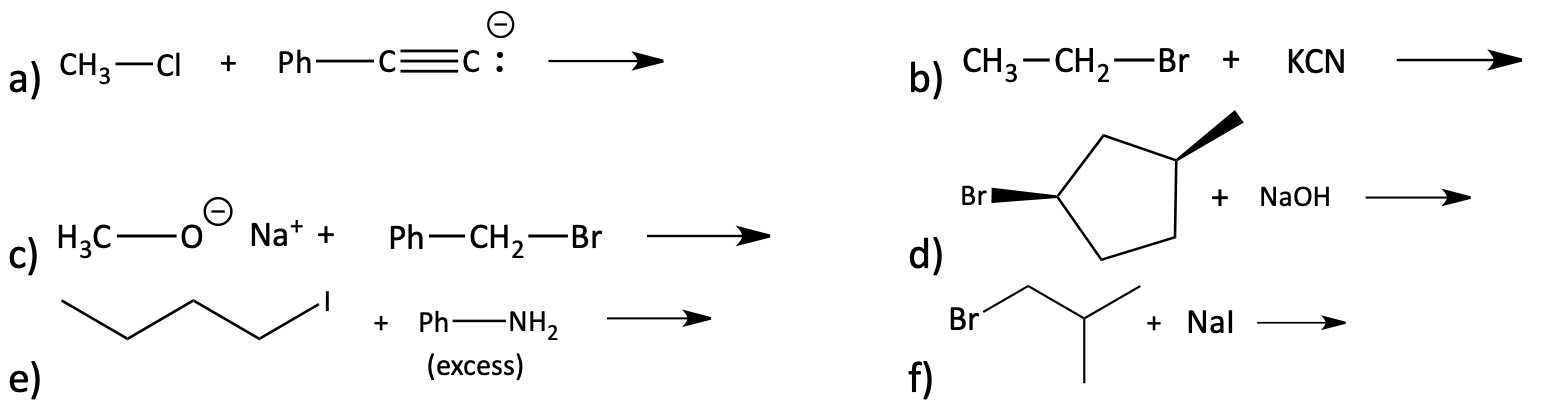
39. Show the major product for each of the following SN2 reactions.
40. Show the reagent you would use to make each of the following compounds from an SN2 reaction using benzyl bromide (Ph-CH2-Br) as your substrate.

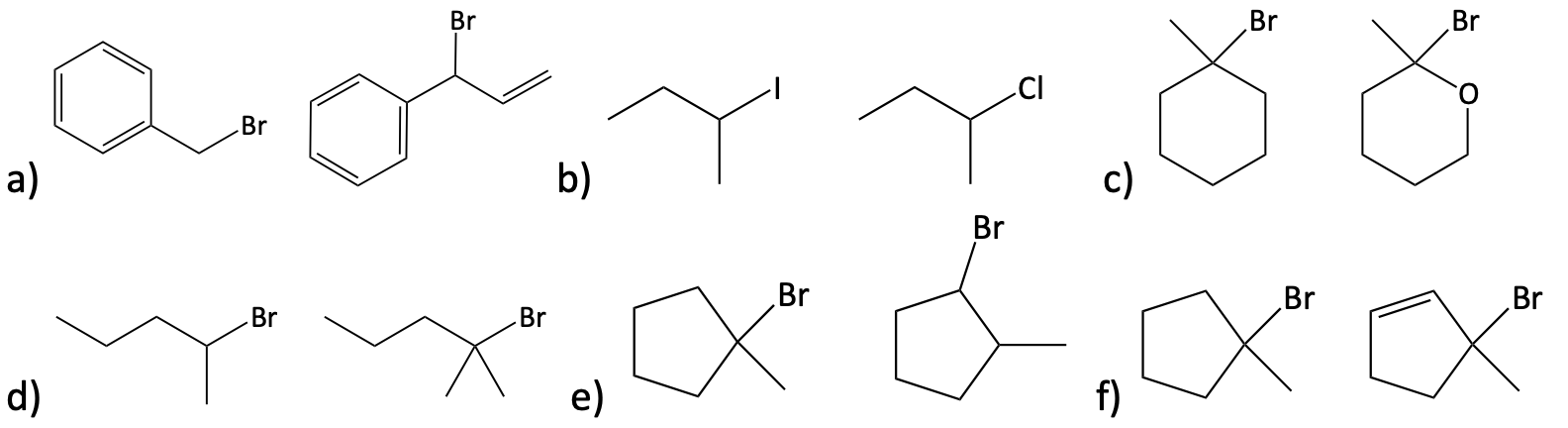
41. For each pair, circle the compound that will react the fastest as the electrophile (substrate) in an SN1 or E1 reaction.
42. List the following compounds in order of increasing reactivity in an SN1 reaction. (CH3)3CBr CH3CHBrCH3 CH3CHICH3, CH3Br CH3CH2CH2I
43. Pick the stronger nucleophile from each of the following pairs. a) HO- vs. H2O
b) I- vs. Cl-
c) CH3OH vs. CH3O-
d) Et2NH vs. Et3N
e) HO- vs. HS-
f) tBuO- vs. MeO-
44. Rank the following species in order of INCREASING nucleophilicity.

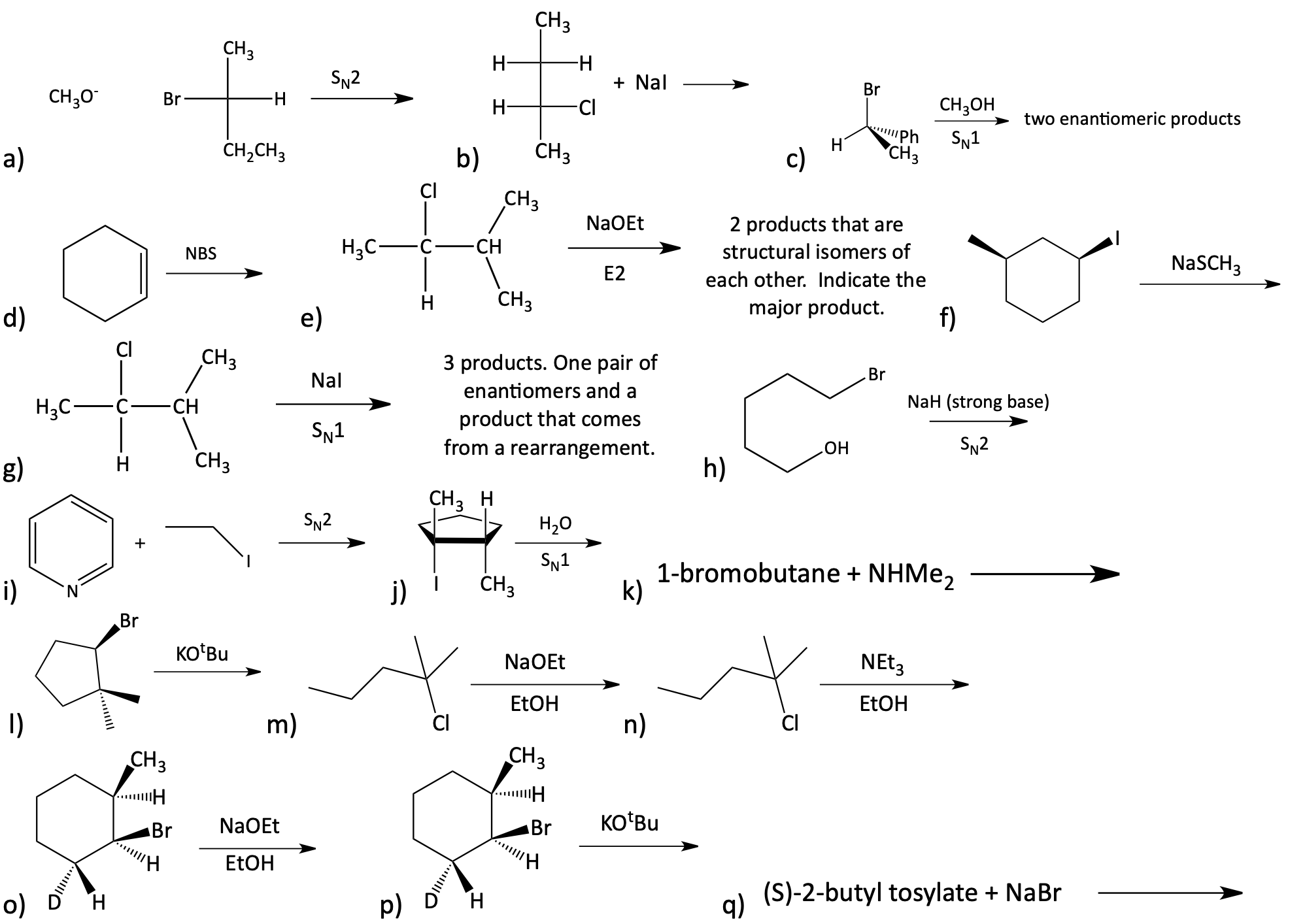
45. Draw the missing products of the following reactions:
46. Give suitable reactants/reagents for the following reactions.

47. Draw good resonance forms for the following carbocations.

48. Show the mechanism for the solvolysis (SN1) reaction of tert-butyl chloride in water.
49. Predict the E1 products of the following substrates. If more than one alkene can be formed, predict the major product. a) 1-bromo-2-methylcyclopentane b) 2-bromohexane c) chlorocyclohexane d) 3-iodo-3-ethylpentane
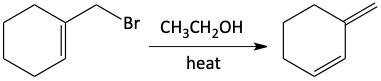
50. When 1-bromomethylcyclohexene undergoes a reaction in ethanol, the compound shown below is one of the products formed. Give a detailed mechanism for its formation.
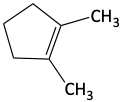
51. When 1-bromo-2,2-dimethylcyclopentane is heated in methanol (CH3OH), one of the products which results is 1,2-dimethylcyclopenene. Provide a detailed, stepwise mechanism for the production of this compound, and give the name of the mechanism by which it is produced.
52. a) What two elimination products could be formed from the reaction of a base with 2-bromo-3-methylbutane? b) Label these two elimination products with the appropriate term of Saytzeff product or Hofmann product. c) What base would you use in the experiment to make more of the Saytzeff product? d) What base would you use in the experiment to make more of the Hoffman product?
53. Determine whether the following substitution reactions would be first order (SN1) or second order (SN2).
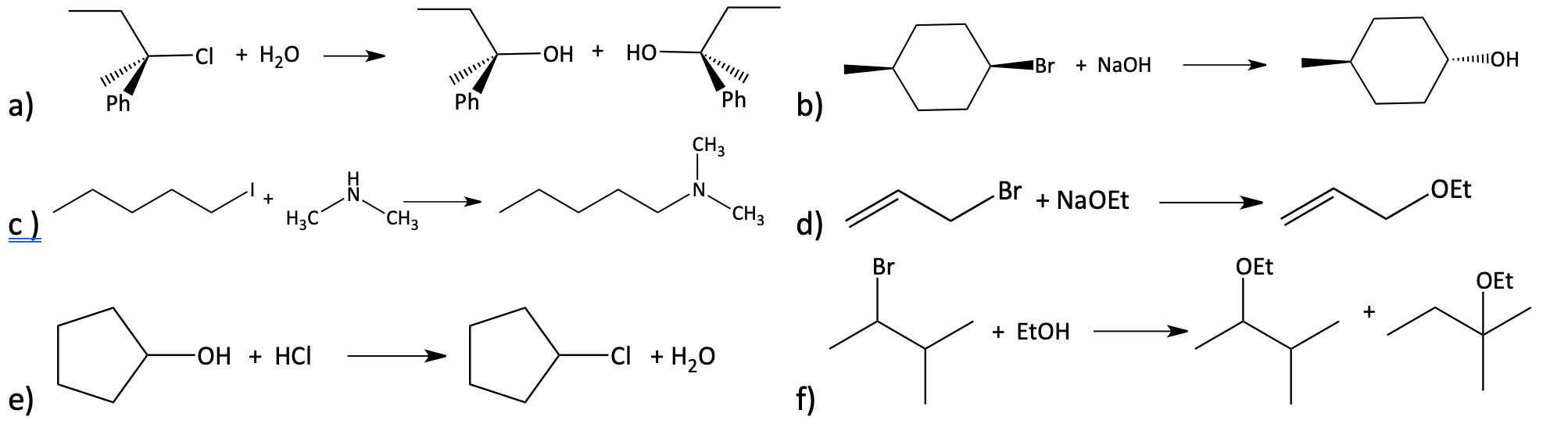
54. Looking only at the reagents, predict whether the following substitution reactions would be first order (SN1) or second order (SN2). a) 2-iodo-2-methylbutane + methanol b) bromopropane + sodium hydroxide c) iodopentane + ethylamine d) 2-chloro-2-methylpentane + water e) 1-bromo-1-methylcyclopentane + ethanol
55. The following structure is formed when 1,4-dibromobutane reacts with sodium sulfide, Na2S. Show the mechanism for this reaction.

56. For the following reactions, determine the substitution and elimination products that would be formed. For the elimination products, if more than one alkene is formed, predict which one is formed in a greater amount. a) iodocyclohexane + AgNO3 in H2O
b) 1-bromo-1-methylcyclobutane heated in EtOH c) 3-chloro-3-methylpentane heated in CH3OH
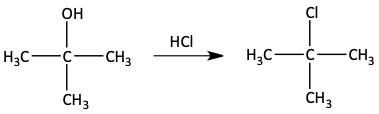
57. We have learned in this chapter that tertiary alcohols can be converted to tertiary chlorides by reacting an alcohol with Lucas Reagent or HCl. a) Show the mechanism for the reaction of t-butanol with HCl. b) Is the mechanism for this reaction SN1, SN2, E1, or E1?
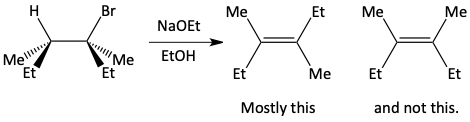
58. When the following alkyl bromide reacts with a base, only the trans isomer is made, not the cis isomer. Explain why.
59. A student performed the following E2 elimination reaction of an alkyl halide with potassium t-butoxide expecting two cyclohexenes to form. But, only one of them formed.
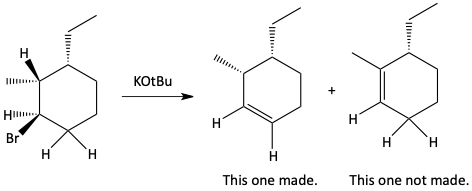
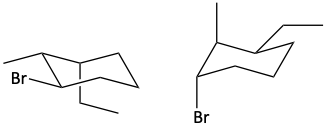
To try to understand this why, the student drew out the two chair forms of the reactant. Only one chair form can do an E2 elimination. Draw in the hydrogen atom(s) on that conformer that can be removed and then show the mechanism of the elimination forming the only alkene that is made.
60. When 1-chloro-2-methylcyclohexane undergoes solvolysis in methanol, two substitution products are formed. One is the “normal” product and the other is a product that follows a rearrangement. a) Draw out the mechanism for the formation of both products. One of the hydrogen atoms (the one that shifts) is labeled in red.
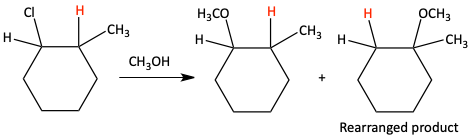
b) Why does the rearrangement happen? What is its driving force?
61. One trick to help pull off a halide to form a carbocation is to use AgNO3. Ag+ pulls I- off of this alkyl iodide to form silver iodide precipitate and a carbocation. a) Show the mechanism for the formation of cyclohexanol and 1-methylcyclopentanol. (Hint: look for rearrangements). b) Is this reaction first or second order?

62. Why does CH2=CHCHBrCH3 undergo an SN1 reaction much more rapidly than 2-bromobutane?
63. Which diastereomer of 1-bromo-4-tert-butylcyclohexane, the cis or trans, undergoes elimination more rapidly when treated with sodium ethoxide? Explain your answer. (Hint: pull up a chair and think about this one.)
64. Show the best way to prepare CH3OCH(CH3)2 by an SN2 reaction.
65. Predict the two most likely mechanisms for the reaction of 2-bromoheptane with sodium methoxide from SN1, SN2, E1 and E2.
66. For each of the following pairs of alkyl halides, choose the one that is more likely to undergo a rearrangement during an SN1 or E1 reaction? a) 3-bromohexane vs. 1-chloro-3,3-dimethylpentane b) 1-bromo-1-methylcyclopentane vs. 1-bromo-2-methylcyclopentane c) 1-chloropropane vs. 2-chloropropane
67. One ether and one alkene are the major product that results when t-butyl chloride is heated in ethanol. a) Draw the ether. b) This reaction proceeds via which mechanism, SN1, SN2, E1, or E2? c) Draw the alkene. d) This reaction proceeds via which mechanism, SN1, SN2, E1, or E2? e) When t-butyl chloride is treated with sodium methoxide in methanol, the major organic product is:f) The reaction in part e proceeds via which mechanism, SN1, SN2, E1, or E2?
68. Using Saytzeff’s rule, choose the most stable alkene among the following.1-methylcycloheptene vs. 3-methylcycloheptene vs. 3,4-dimethylcycloheptene
69. Draw all likely alkene products in the following reaction and circle the product you expect to predominate.
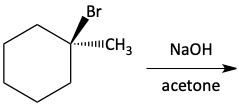
70. Propose a detailed, step-by-step mechanism for the reaction pathway shown below.
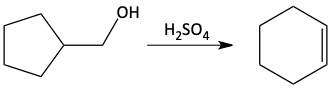
71. What alkyl bromide undergoes dehydrohalogenation in the presence of a strong base to give 2-pentene as the only alkene product?
72. Provide the reagents you would use to carry out the transformation of cyclohexane to cyclohexene.
73. Provide the reagents you would use to carry out the transformation of 2-methylpentane to 2-methylpent-1-ene.
9.74 a) Explain why the molecule shown below does not react with an SN2 mechanism.
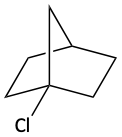
b) Explain why this same molecule does not react by an E2 mechanism.
75. Label the following reactions by their mechanism, E1, SN1, E2, or SN2.
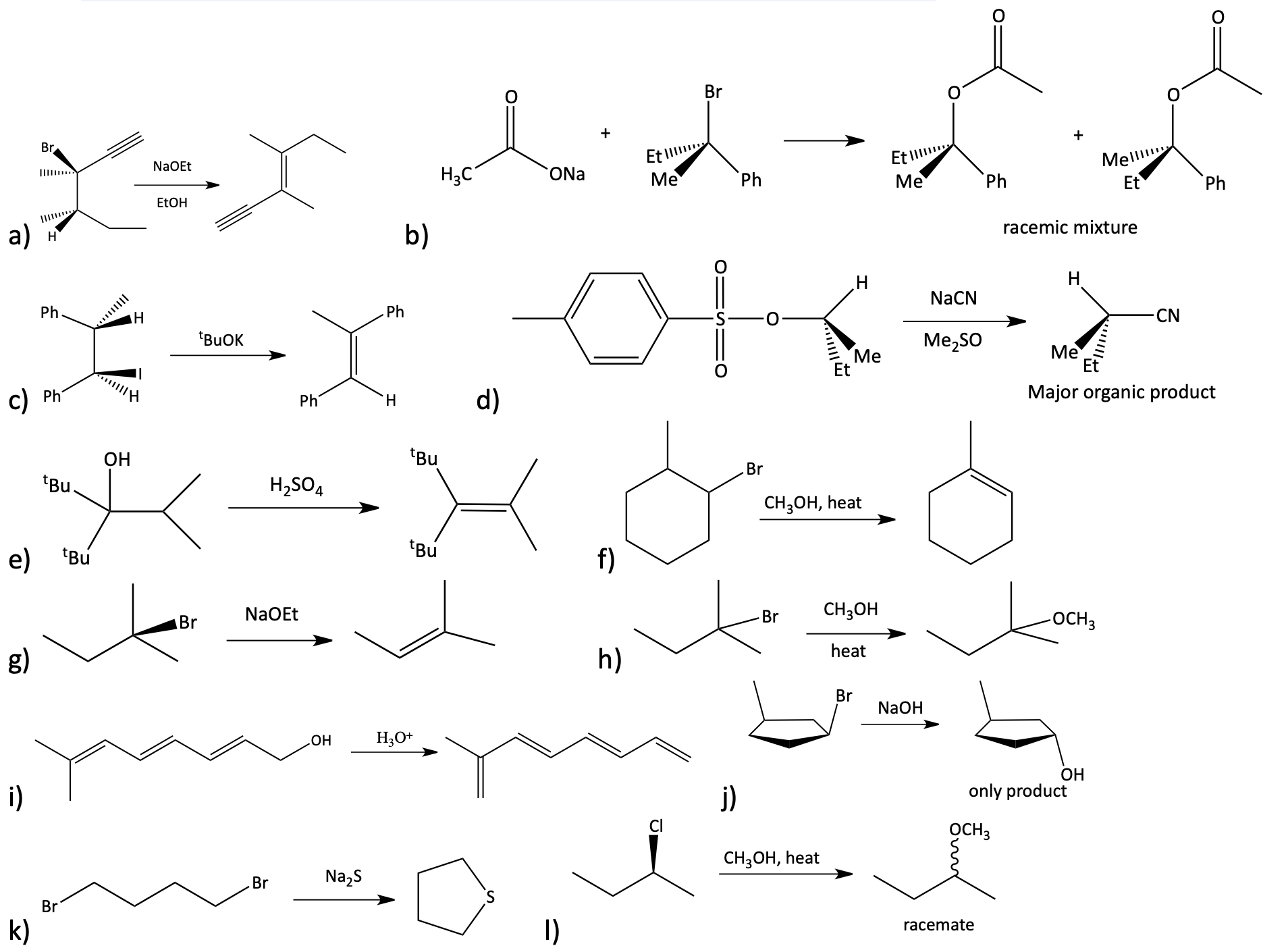
76. This alcohol undergoes an SN1 reaction with methanol and acid. It produces three different products. Show the mechanism for the formation of these three compounds.
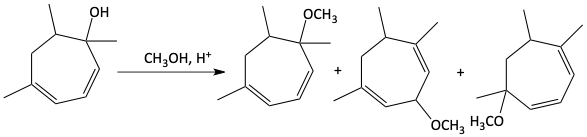
77. The following elimination does not work. Pull up a chair, think about it, and explain why.
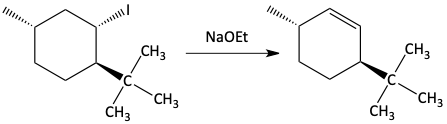
78. Show the mechanism for the following reactions. Be sure to show how each product is made.
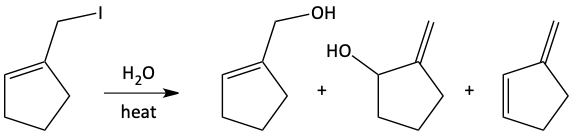
79. Show the mechanism for the following reactions. Be sure to show how each product is made.

80. Show the mechanism for the following reactions. Be sure to show how each product is made.

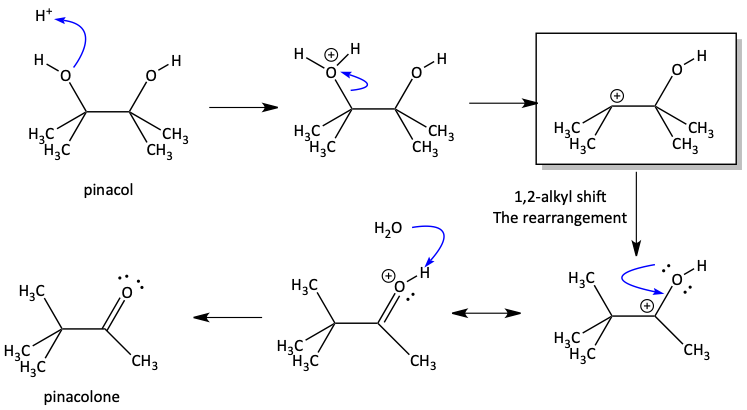
81. The pinacol rearrangement is a reaction that we will study later. The mechanism is, mostly, shown below. a) Complete the mechanism by drawing an arrow on the intermediate in the box to show the methyl shift. b) Explain the driving force for this rearrangement. Why does it happen?