12.3 The Proton NMR Spectrum
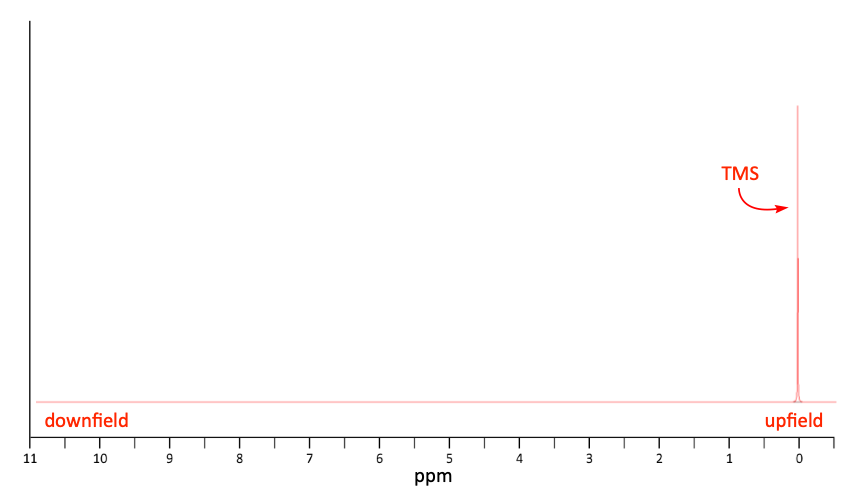
The right side of the NMR spectrum, is where more shielded protons appear. These protons correspond to lower frequency radio waves. Higher frequency radio waves are located on the left side of the spectrum where peaks for deshielded (less electron density) protons appear. In older, CW NMR, the right side corresponded to higher magnetic fields and the left side with lower magnetic fields. Even though most NMRs are now FT-NMR, some of the older CW-NMR language still exists. The right side of the NMR spectrum is called the upfield side and the left side of the NMR spectrum is called the downfield side.
All peaks in an NMR spectrum are compared to those made by the protons of a compound called tetramethylsilane (TMS). TMS is the standard. The peak on the NMR spectrum generated by TMS is given a value of zero (0 ppm).
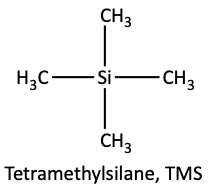
TMS was chosen as the standard because the protons in it are very shielded because silicon is less electronegative than carbon. Therefore, the TMS peak is to the right of most organic compounds.
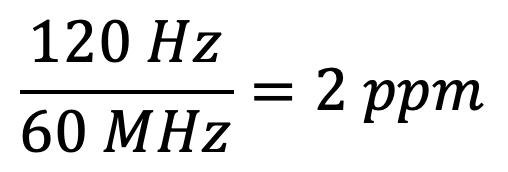
NMR instruments come in different magnet strengths. In a very weak magnet instrument, it is easier to flip the nuclear magnet from alpha to beta. In a very strong magnet instrument, it is more difficult to flip the same nuclear magnet from alpha to beta. If the NMR spectrum scale reported absolute values of radio frequency or magnetic strength, all reported values for a compound would be instrument dependent. In order to keep reported values consistent between any strength of instrument, the scale is reported in ppm (parts per million). The chemical shift is determined by looking at the difference in the chemical shift in Hz compared to TMS divided by the frequency of the magnet used. Let’s look at how this works for a peak that would appear at 2 ppm. On a weak, 60 MHz (60 million hertz) magnet, a peak that shows up at 2 ppm resonates at a frequency that is 120 Hz greater than that for TMS. 120 hertz divided by 60 million hertz is 2 parts per million (ppm).
On a stronger 200 MHz magnet, that same proton has a resonance frequency of 400 Hz.
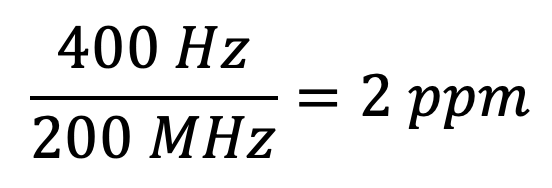
This way, no matter what strength of NMR instrument is used, the same chemical shift can be reported for a particular proton. This makes things much simpler.