
12.2 The Theory
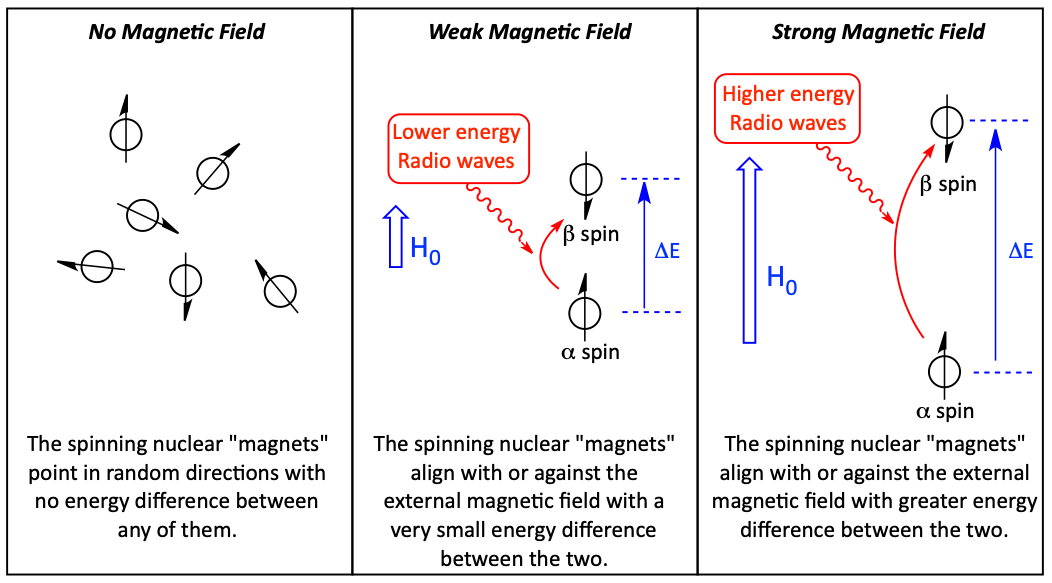
A negative electron has a spin state of either +1/2 or -1/2. Some positively charged nuclei of atoms (1H, 13C, 15N, 19F, and 31P) have a +1/2 or -1/2 spin state associated with them as well. When these positively charged nuclei spin, they create a magnetic moment and become very similar to tiny bar magnets. Presently, we will focus on the nuclei of the hydrogen atoms (1H or protons) in organic molecules. The NMR analysis of 1H in organic molecules is called 1H NMR or proton NMR.In the absence of an external magnetic field, H0, these spinning nuclear magnets point in random directions. All of these spinning nuclear magnets have the same energy. In the presence of a magnetic field, the spinning nuclear magnets align with or against the external magnetic field, H0. The nuclei magnets that align with H0 are called alpha spin and those that align against it are called beta spin. It takes a small amount of energy to flip an alpha spin nuclear magnet aligned with the external magnetic field to a beta spin magnet aligned against the external magnetic field. This low amount of energy matches the energy of low-energy, long wavelength radio frequency (Rf) waves. In a weak external magnetic field, it is fairly easy to flip a nuclear magnet from an alpha to a beta spin. Low-energy radio waves can do this. When the Rf energy matches the “flip” energy, the nuclei are said to be in resonance. In a stronger magnetic field, the energy difference between the alpha and beta spins is greater because it is more difficult to flip the small alpha-spin magnet into a beta spin that would oppose the strong external magnetic field.
12.2.1 Shielding
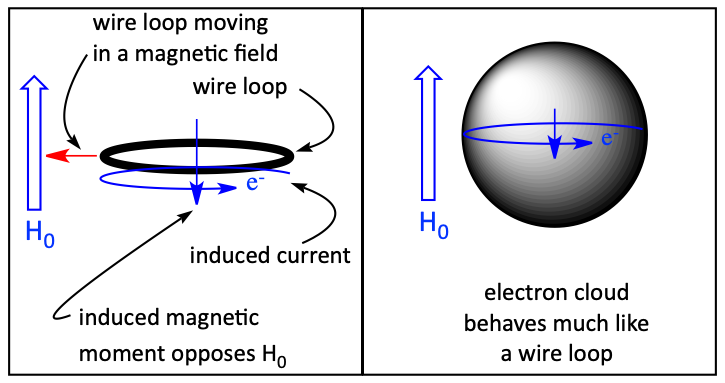
When a loop of wire enters a magnetic field, a current is induced in the wire. This induced current of electrons then induces a magnetic field that opposes the external magnetic field, H0. A similar effect happens with the electrons that surround the positive nuclear magnet. When an atom enters a magnetic field, H0, the negative electrons begin moving in a circular pattern and induces a current. This induces a magnetic field that opposes the external magnetic field, H0. This makes sense, right? If the positive nucleus is a magnet that aligns with H0, the negative electrons create a magnetic moment that opposes H0.
In the first pane of the figure below, a naked nucleus, without its electrons, is in its alpha spin aligned with H0. It absorbs a certain radio frequency and flips to beta spin. In pane two, negative electrons surround the positive nucleus. We say that the nucleus is shielded. With the opposing negative electron magnetic moment subtracted from the positive nucleus’ magnetic moment, the overall nuclear magnetic moment is smaller than it was with the naked nucleus. The nucleus no longer absorbs the same radio frequency. In pane three, the external magnetic field is increased by H0’. This causes the nuclear magnetic moment to grow to the same size as in pane one and the same radio frequency is once again absorbed. Different hydrogen atoms in a molecule have different electron densities around them. Therefore, they have different nuclear magnetic moments. The more electron density around a nucleus, the greater the electron induced opposing magnetic moment, the smaller the net magnetic moment will be at the nucleus. This is great news. Because the proton magnets are different, we can get information about them to help us determine the structure of the organic compound.
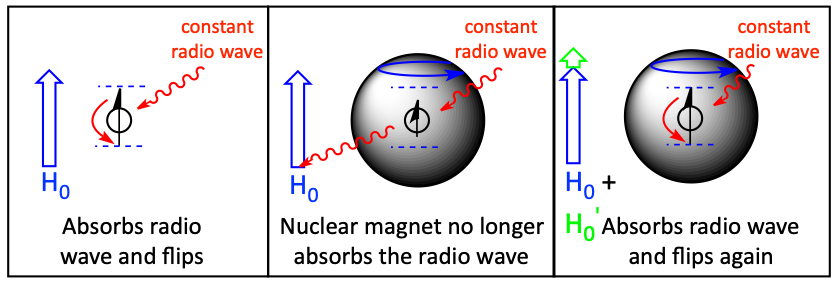
Early, continuous wave, CW, NMR experiments worked this way. A constant radio frequency was directed at the organic sample while the magnetic field strength was changed. When the correct magnetic field strength was reached to cause the net molecular moment at the nucleus to absorb a certain radio frequency, the radio frequency was absorbed. The detector noticed that less radio wave light was reaching it, and a peak was made on the spectrum. The modern method of performing NMR uses Fourier transform. This is called FT-NMR. It keeps the magnetic field strength constant while the radio frequency is varied. Small nuclear magnetic moments are easier to flip and require a lower frequency radio wave. Larger nuclear magnetic moments are more difficult to flip and require a higher frequency radio wave.