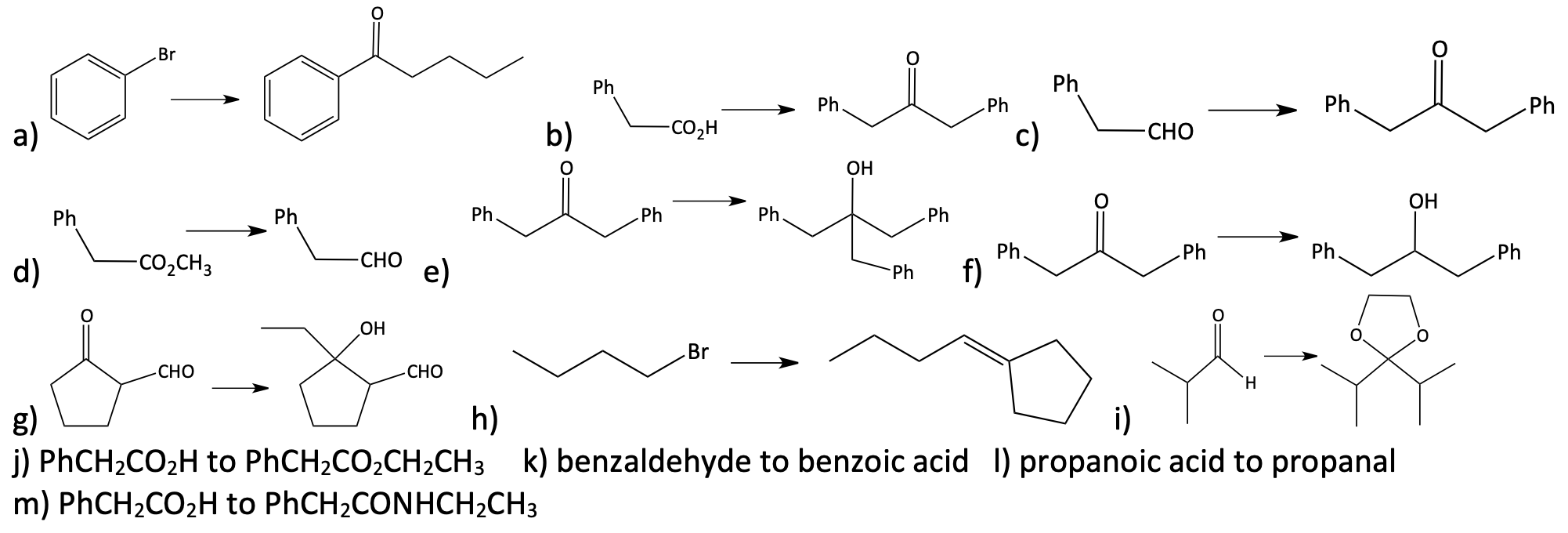
17.6 Extra Problems
4. Show how the following compounds can be synthesized from an appropriate carboxylic acid. For the aldehydes, provide two syntheses, one with an ester intermediate and one with an acid chloride intermediate.

5. Provide the major organic product that results when benzaldehyde, PhCHO, is treated with the following sequence of reagents: 1. CH3MgBr; 2. H3O+; 3. Na2Cr2O7, H2SO4.
6. Identify the carbonyl compound and amine that would be used to synthesize the following imines.

7. When 2-methylcyclopentanone reacts with ethylamine in acidic conditions, two different compounds are formed. These are geometric isomers of each other. Draw them.
8. Show how you would synthesize the following alkenes from an alkyl halide and aldehyde or ketone.

9. D-glucose is a familiar monosaccharide. Its Fischer projection is shown below.
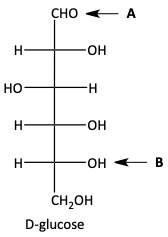
The aldehyde at position A reacts with the hydroxyl group at position B to give the ring structure shown here.
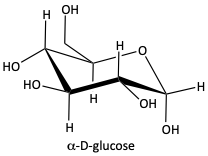
a) Circle the hemiacetal portion of the D-glucose ring shown above. b) When a small amount of acid is present, the hemiacetal portion of the above molecule reacts with another alcohol to form what biochemists call a glycoside. Quite often this alcohol is one of the alcohol groups on another monosaccharide to form di-, tri-, or polysaccharides. In fact, glycosides formed by adding several glucose rings together make either starch or cellulose. But let’s keep your task simple. Show the glycoside formed from the reaction of α-D-glucose with methanol.
10. Identify the carbonyl compound and the alcohol(s) needed to make the following acetals or hemiacetals.

11. Identify the products of the hydrolysis of the following compounds.

12. Identify a ketone or aldehyde and a Grignard reagent that would make the following compounds. a) 2-methyl-3-heptanol
b) 1-phenylpropanol
c) 1-ethylcyclohexanol
d) 2-methyl-2-pentanol
13. Show how to make the following compounds by using an excess of appropriate Grignard reagent and an acid chloride. Then show how to make it from a Grignard reagent and an ester. a) 1,1-diphenylpropanol
b) 1,1-dicyclohexylethanol
c) 3-ethyl-2,2-dimethylpentan-3-ol
d) 2-methyl-2-pentanol
14. Fill in the reagents or products (A-M) of the following reactions.
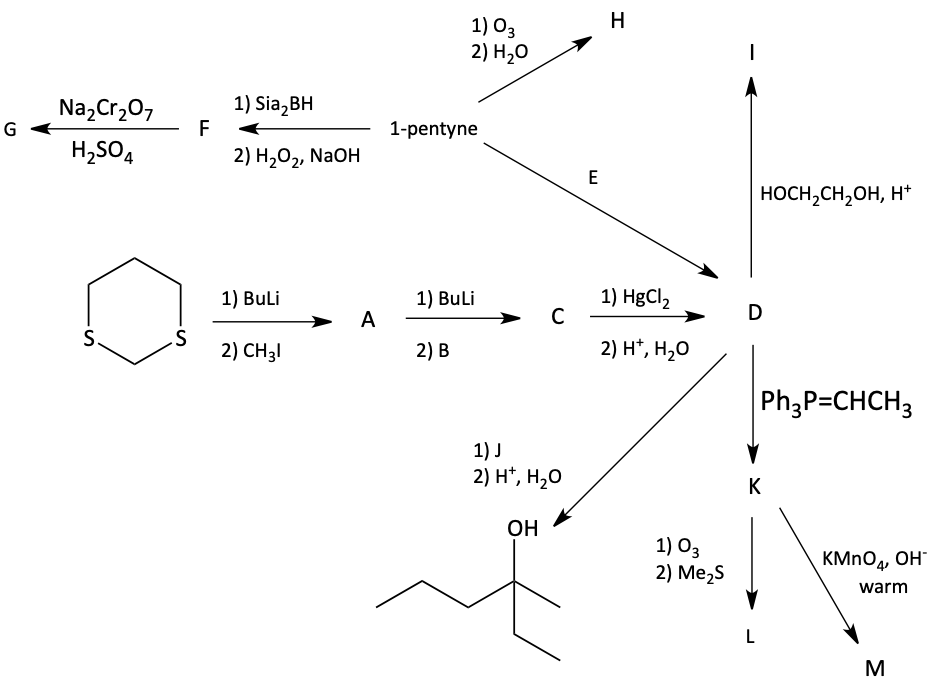
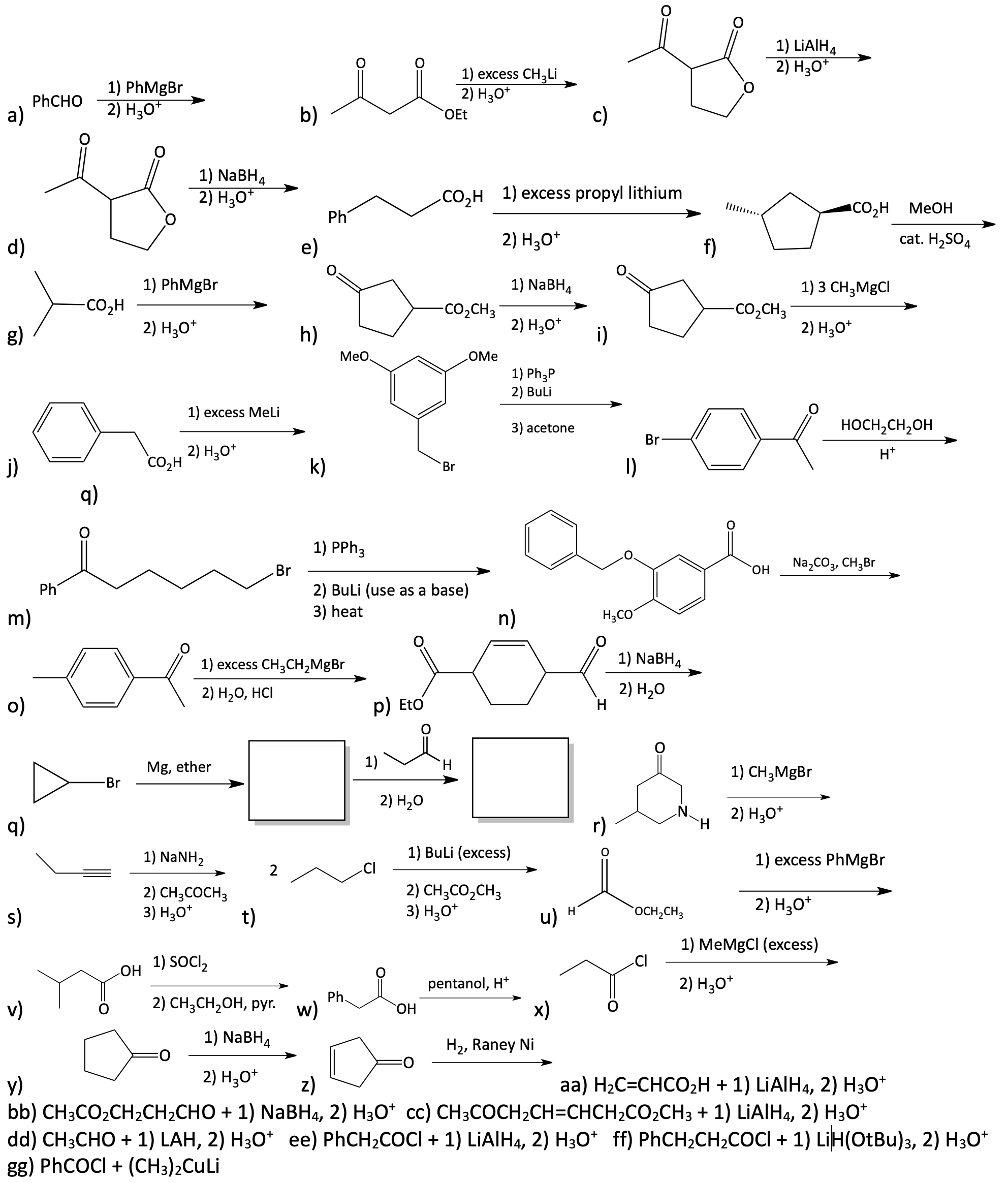
15. Provide the major organic products for the following reactions.
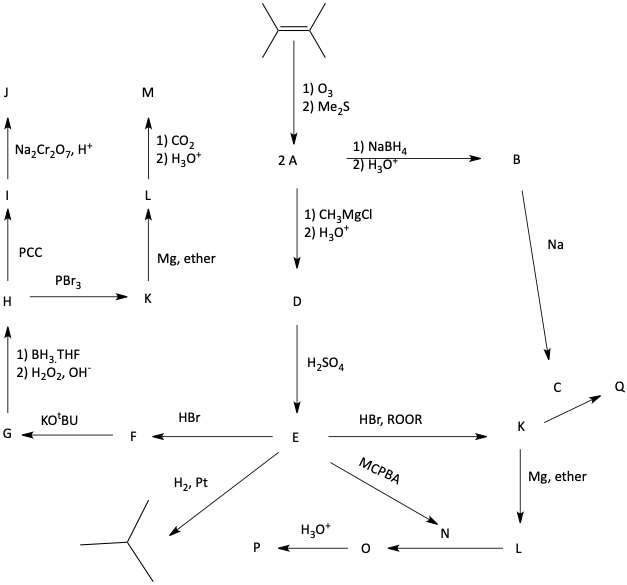
16. Draw the structures of A-P.
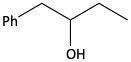
17. Show how you would make the following alcohol starting with bromobenzene and 1-butene. More than one reaction is needed.
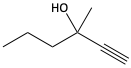
18. Show how you would make the following alcohol starting with 2-pentanol and acetylene (H-C≡C-H). More than one reaction is needed.
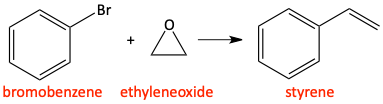
19. Show how you would make styrene starting with bromobenzene and ethyleneoxide. More than one reaction is needed.
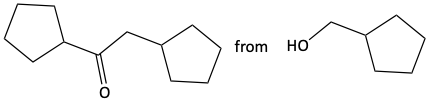
20. Show how you would make the following ketone starting with cyclopentylmethanol as your only organic reagent. More than one reaction is needed. You can use as more than one equivalent of cyclopentylmethanol if necessary.
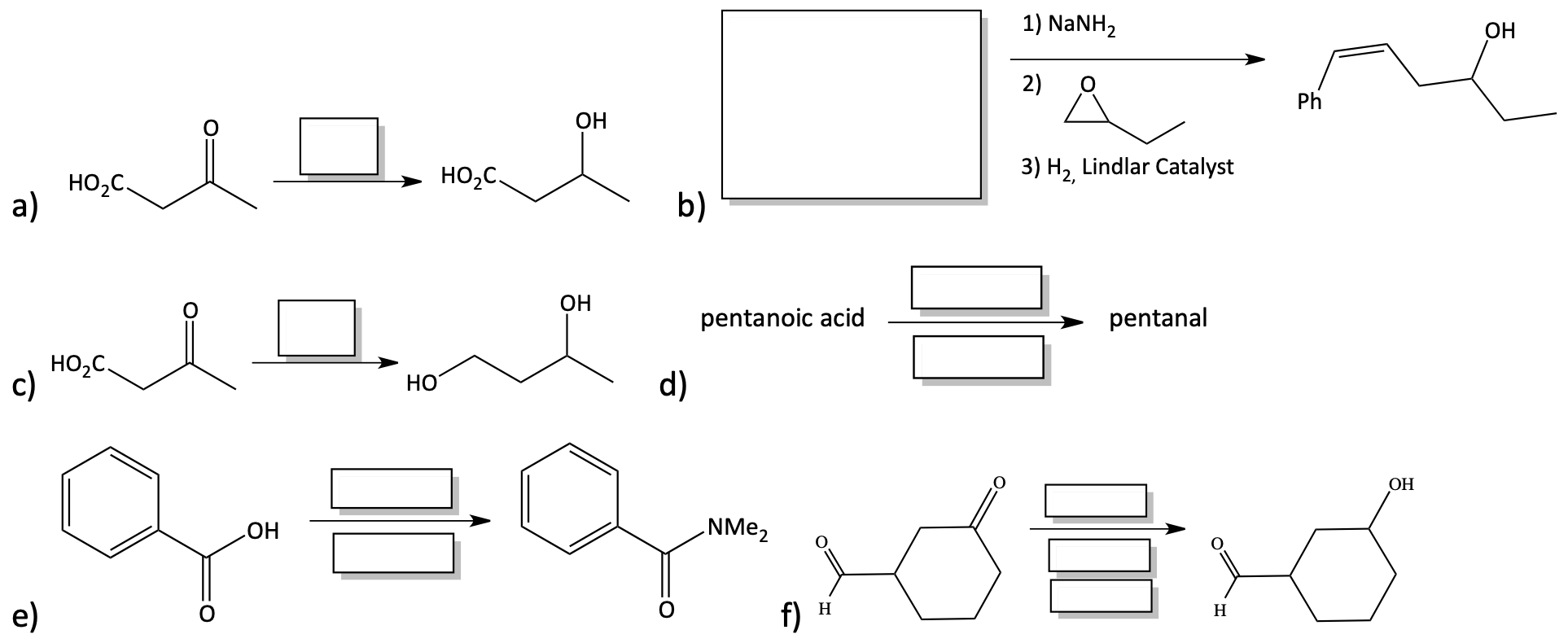
21. Fill in the blanks in the following reactions.
22. The mechanism for the reaction below begins the same way we have seen Grignard reagents attacking esters. Then, in an interesting twist, an ether is formed because of the bromide leaving group. Show the full mechanism for this reaction.

23. Why doesn’t the following reaction work as written?

24. Describe the reagents that could be used to perform the following reactions. Sometimes, more than one reaction may be required.