16.4.6 Ozonolysis of alkenes
Ozonolysis is very similar to oxidation by KMnO4 in warm, concentrated solution. The difference is that if an aldehyde is formed, it is not further oxidized to a carboxylic acid. Notice that in this oxidation, two carbon- carbon bonds of the alkene turn into two carbon-oxygen bonds of the carbonyl.
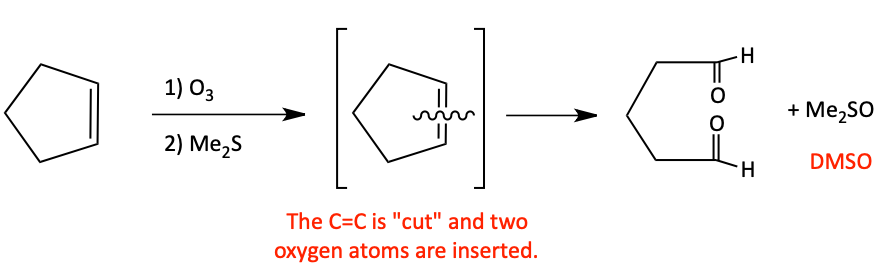
The mechanism for this reaction does not really help us learn the reaction. If you are interested in it, you can look it up elsewhere. Ozone is a compound with three oxygen atoms (O3). Two of the three oxygen atoms are in the final product. The third oxygen atom ends up on the Me2S to make Me2SO.
16.4.7 Periodic acid cleavage of glycols
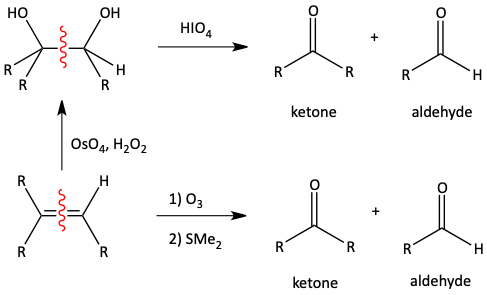
The C-C bond of a vicinal diol, a glycol, can be oxidatively cleaved with periodic acid (pronounced purr-eye-oh-dik-acid), HIO4 to make two carbonyl compounds. This is very similar to how alkenes are oxidatively cleaved in an ozonolysis reaction.
16.4.8 KMnO4 oxidation of alkynes
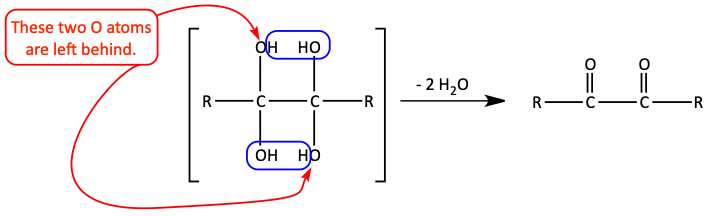
The same reaction can happen with the two pi-bonds of an alkyne. Since there are two pi-bonds, the dihydroxylation can happen twice, resulting in a species with four hydroxyl groups on it. This is unstable. Two water molecules are eliminated resulting in an α-diketone (alpha-diketone). Under neutral KMnO4 conditions, the α-diketone is the product.
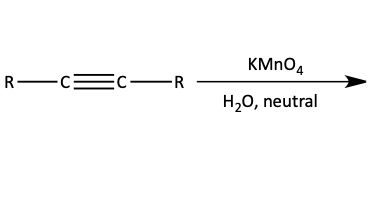
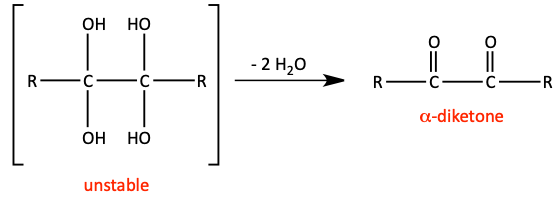
The double dihydroxylation of the alkyne makes sense. Look closely how the two molecules of water are lost leaving only two oxygen atoms behind on neighboring carbon atoms.
The KMnO4 video on 16.5.1–16.5.3 also covers these reactions.