
15.6.1 Sulfide Synthesis
Sulfides, or thioethers, are the sulfur analogues of ethers. They can be synthesized by using a reaction similar to the Williamson Ether synthesis. Thiols, the sulfur analogue of alcohols, can be deprotonated making nucleophilic thiolate anions. The thiolate anions can then perform an SN2 reaction on an alkyl halide resulting in a sulfide or thioether.
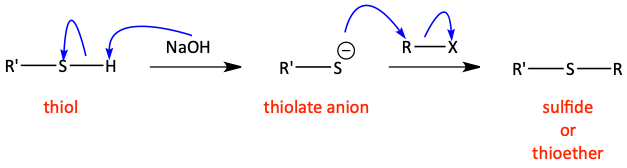
Remember that sulfur is directly below oxygen in the periodic table. Therefore, sulfur atoms are larger than oxygen atoms. Thiols are easier to deprotonate than alcohols, because the negative charge produced in a thiolate anion is spread out over a larger sulfur atom compared to the negative charge on an oxygen atom of an oxide. A base like sodium hydroxide can be used to deprotonate the thiol. The deprotonation of alcohols took a stronger base, like sodium or sodium hydride.
Thiolate anions are also very good nucleophiles because the negative sulfur atom is large and polarizable. The fluffy electron cloud of the thiolate anion can easily reach out its electrons to start the SN2 attack of the alky halide. They are such good nucleophiles; they will even attack secondary alkyl halides.