2.1 Electron waves
The world really is strange. It is stranger than most people realize. Back in your Junior High Science class, you were probably told about the duality of light, where light is both a particle and a wave. This wave/particle duality is not only true about light, but it is true about most of nature. This is the strangeness that we explore in a field called quantum mechanics. For now, I want us to focus on the wave/particle duality of electrons. One way to think about electrons is that they are little particles orbiting the nucleus. This is a fairly good model that many of us have in our minds, the Bohr planetary model. But, the interesting thing is that electrons are also waves! Let’s focus on two very simple waves. Think of a guitar string. If I pluck a guitar string, it vibrates up and down.

If I combine these, the string vibrates so fast that it looks something like this.
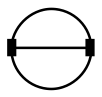
This simple vibrational shape is spherical in nature and leads us to the shape of the simplest electron orbital, the s orbital.

If I put my finger down in the middle of the guitar string and pluck it, I get a wave where when one side is up, the other side is down. A moment later, it switches which side is up and which is down.

When the string vibrates fast, it looks something like this.
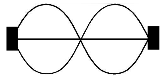
There is one spot in the center where there is no wave. We say that it has one node in the center. This vibrational shape has two lobes of equal size. It leads us to the shape of another electron orbital, the p orbital.
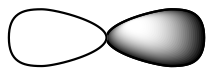
These orbital waves can be described with mathematical functions—just like all waves can. We call this mathematical function for the wave the wavefunction which is often represented by the greek letter psi (Ψ). These mathematical functions can be added together or subtracted. Intuitively, you understand this about waves. For example, a child on a swing set moves forward and backward. This motion is a wave-like motion. When children are learning to swing on a swing set, they are taught to kick their legs out when they are moving forward and bend at the knees and put their feet down when they are moving backward. This motion of their feet is also a wave. They are taught to do this so that their feet wavefunction can be added to the wavefunction of the swing. Constructive interference is when two waves overlap to make a larger wave. When done correctly, the child’s feet motion and the swinging motion constructively interfere to increase the amplitude of the wave, and their swinging, so they go higher and higher.
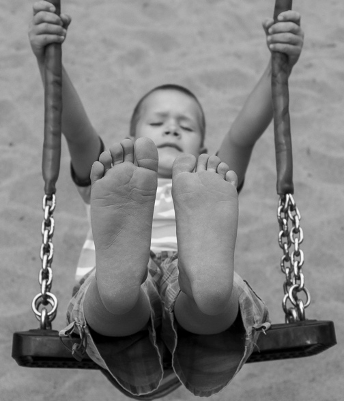
Photo by GaborfromHungary at Morguefile.com
Many children get confused when learning this, though. If instead, they kicked their feet straight out when they were going backward and bent their knees putting their feet down when they were going forward, their feet wave would be opposite the swing’s wave. Destructive interference is when two waves are out of phase with each other making smaller waves. Children who swing this way will not be swinging for long. When the wavefunctions destructively interfere, they are subtracted from each other and get canceled out. Two electron orbitals can add constructively or destructively because they are waves. This can happen when orbitals overlap on the same atom (to make hybrid orbitals) or when orbitals on two different atoms overlap when the atoms come close together (to make molecular orbitals or bonds).