2.9 Dipole Moment
Once we know the geometry of a molecule, we can use that information, along with what we know about electronegativity to determine if a molecule is polar or nonpolar. If a molecule is polar, it has one side of the molecule that is more positive and one side that is more negative. The charges are lopsided. Having a positive and negative side means we have two poles, or a dipole. The strength of this positive-negative separation is called the dipole moment of the molecule. The positive and negative sites are balanced and symmetrical if a molecule is nonpolar. To determine if a molecule is polar or nonpolar, we look at the molecule’s shape and the electronegativity of the atoms at each bond. We also remember that lone pairs of electrons are very negative spots. Let’s look at some nonpolar molecules first. They all have a dipole moment of zero. There are some more positive and some more negative spots in the molecules, but overall nonpolar molecules have a symmetrical distribution of charge. Notice the symmetry of the following nonpolar molecules. They all have a mirror plane of symmetry or an inversion point of symmetry.

Let’s look at some polar molecules. These all have a dipole moment. The dipole moment of each bond is shown with the red dipole arrows. The overall dipole moment for the molecule is shown with the blue arrow. The vector sum of the individual bond dipole moments is the overall molecular dipole moment. Another way to think about that is if you pulled or pushed individually in the direction of all of the little red arrows, how would the molecule move? This direction, the blue arrow, is the overall molecular dipole moment.

19. Click whether each of the following compounds is polar (has a dipole moment) or nonpolar.
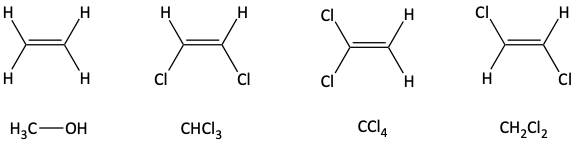
- Ethene:
- cis-1,2-dichloroethylene:
- 1,1-dichloroethylene:
- trans-1,2-dichloroethylene:
- Methanol:
- Chloroform, CHCl3:
- Carbon tetrachloride, CCl4:
- Dichloromethane, CH2Cl2:
20. Click whether each of the following molecules contains polar bonds, and whether the molecule is polar overall.
- a) Cl2 — Polar bonds? Molecule overall?
- b) HCl — Polar bonds? Molecule overall?
- c) H2O — Polar bonds? Molecule overall?
- d) CH4 — Polar bonds? Molecule overall?
- e) CHBr3 — Polar bonds? Molecule overall?
- f) CH3OCH3 — Polar bonds? Molecule overall? (because it is bent)