14.11 Extra Problems
10. Rank phenol, 4-nitrophenol, and cyclohexanol from weakest to strongest acid? Explain why.
11. Draw the ethers produced in the following reactions involving alkoxides.

12. Determine appropriate reagents to make the following ethers from these alcohols.

13. Draw the major organic product for each of the following dehydration reactions.

14. Draw the products of the following reactions.
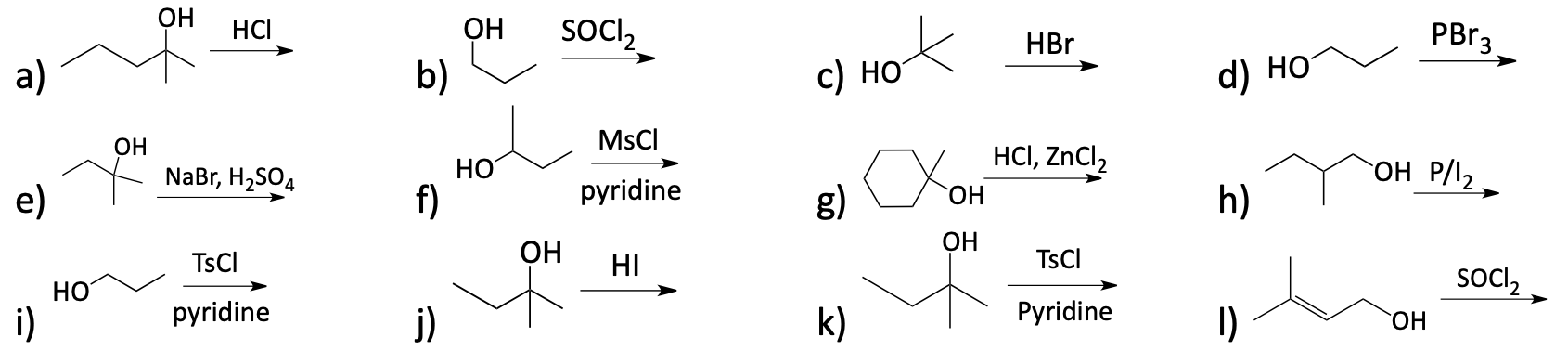
15. Determine appropriate reagents to make the following alkyl halides/tosylates from these alcohols.

16. A few years ago, a graduate student was synthesizing some thiophene derivatives (A-D).
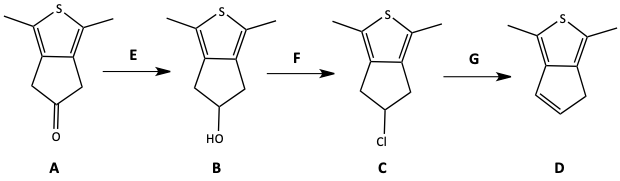
a) What reagents (E-G) would you use to perform these reactions? b) If the chloride leaving group of compound C was not good enough, what reagent would you use to turn the hydroxyl group of B into a better leaving group like a bromide? How about an iodide? c) It is also possible to synthesize D from the dehydration of the alcohol, B. What reagent could do this?
17. Draw the products of the following oxidation reactions.
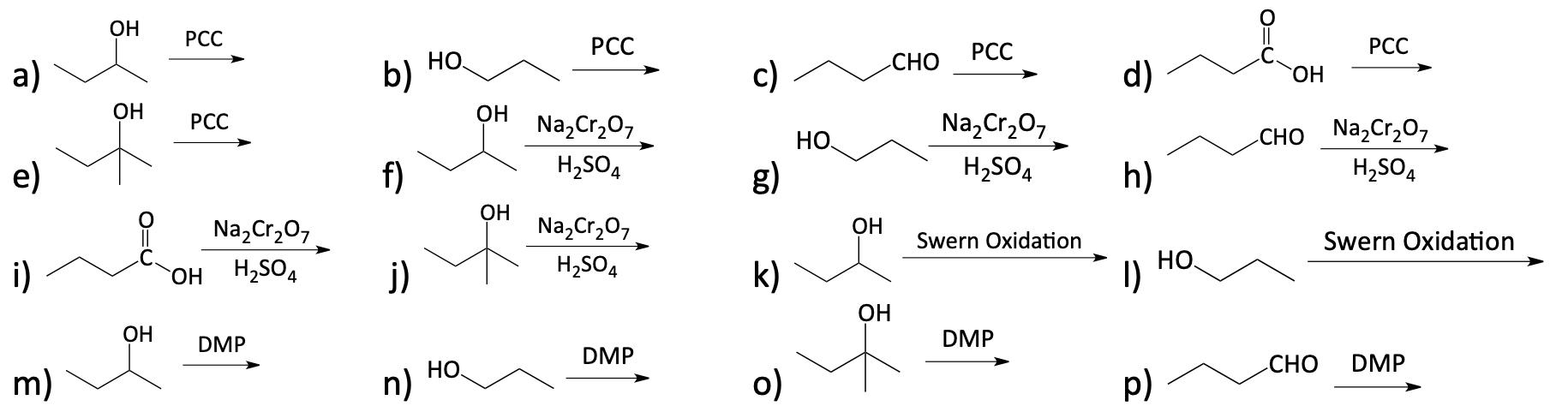
18. Identify an appropriate oxidizing agent to perform the following transformations.

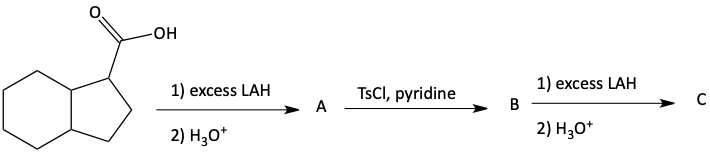
19. What are the products (A-C) of the following reaction sequence?
20. Draw the products of the reaction of periodic acid with the following diols.

21. Identify the alcohol and carboxylic acid that, when catalyzed with H2SO4, can be used to make the following esters.

22. Draw the esters formed in the following reactions.

23. Draw the products of the following reactions.
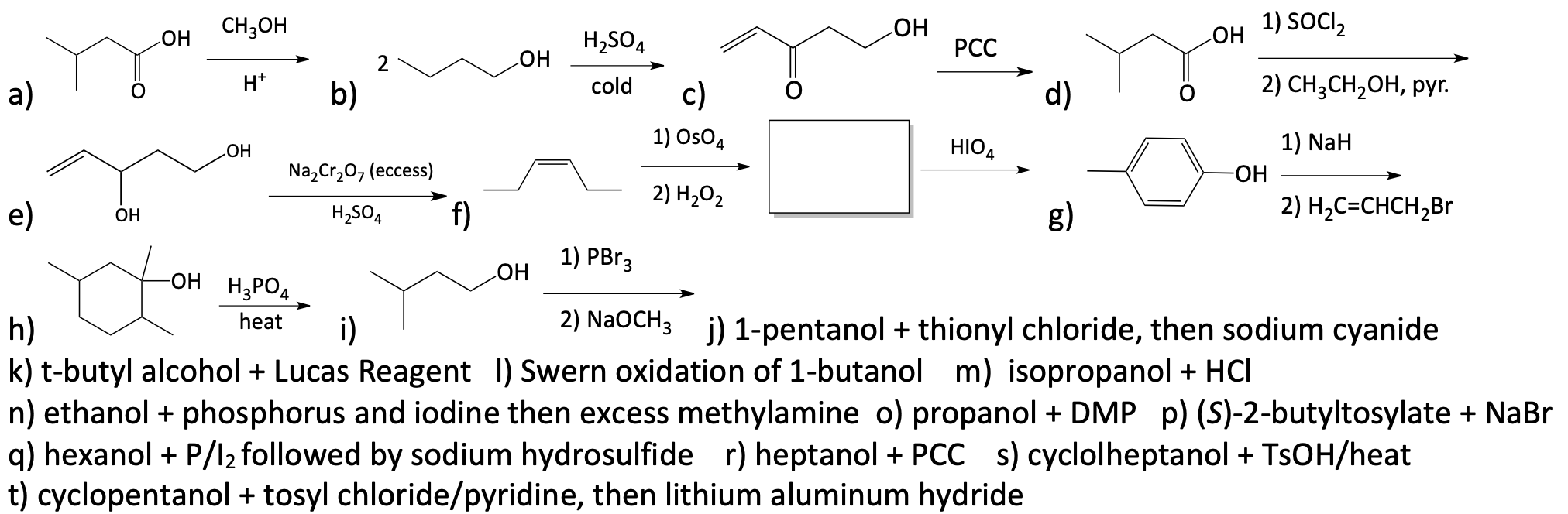
24. Draw the appropriate reactants of the following reactions.

25. How would you convert 1-butanol to a tosylate and then to the following compounds? a) 1-iodobutane b) dibutylamine c) CH3CH2CH2CH2OPh d) CH3CH2CH2CH2CN e) butylamine
26. Draw the mechanism of 2-methyl-2-butanol with HBr. Hint: It is an SN1 mechanism.
27. Draw the mechanism of the following reaction.
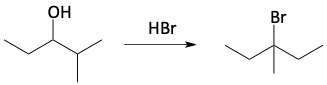
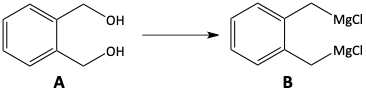
28. a) What reagents would turn phthalyl alcohol, A, to a Grignard reagent, B?
Esters, C, can react with B, quenched with acid and water, then dehydrated with p-toluenesulfonic acid to make D.
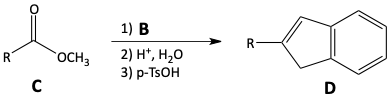
b) Draw the structure of p-TsOH. c) What does p stand for in p-TsOH? d) Show the step by step mechanism for the formation of D from C.
29. In an organic chemistry lab, a student tries to identify which of the following alcohols they have. They have narrowed the list to propanol, isopropanol, t-butyl alcohol. They run a Lucas test where they add Lucas reagent to the alcohol and time how long it would take to react. The solution in the test tube became cloudy almost immediately, indicating the reaction proceeded very quickly. Think about the mechanism of an alcohol with HCl or Lucas reagent. Now, determine which alcohol the student most likely has.
30. Draw the mechanism for the following reaction. Clearly show how each product is made.

31. Explain how you would make the following compounds from an alcohol.

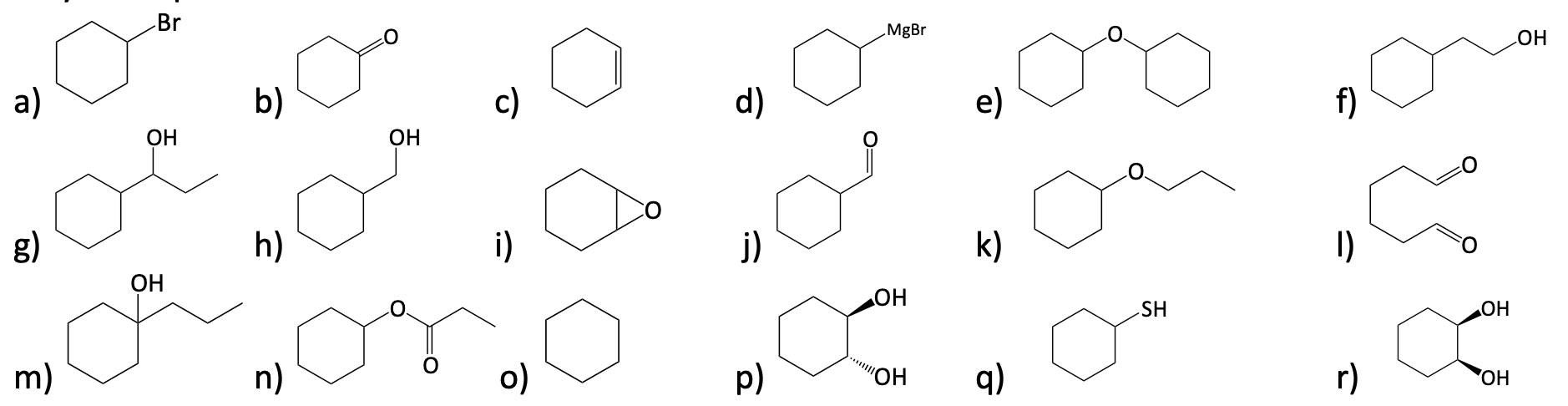
32. Show how you would make the following compounds starting with cyclohexanol. More than one reaction may be required.
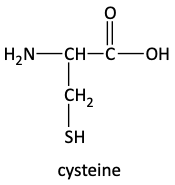
33. Draw the disulfide that is synthesized from the oxidation of two cysteine amino acids.
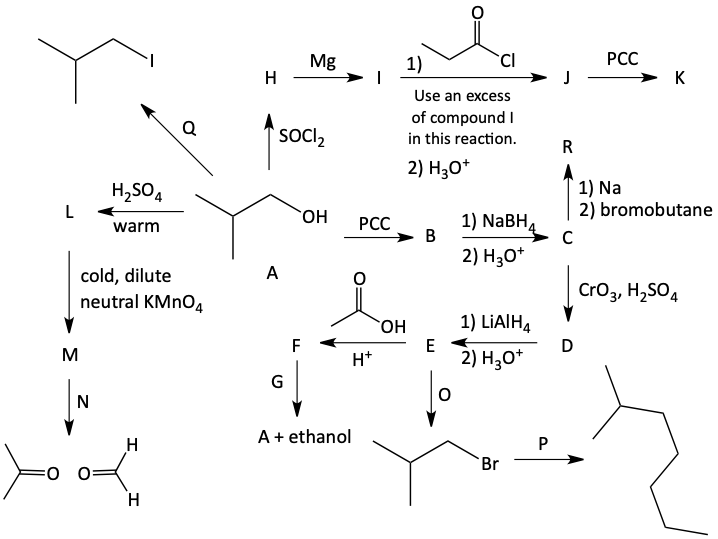
34. Identify compounds/reagents B through R in the following reaction scheme.
35. Show how you would make the following compounds starting with 1-butanol as your only organic reagent. You can use more than one equivalent of 1-butanol if necessary. a) 1-bromobutane
b) CH3CH2CH2CH2CN
c) 1-butoxybutane
d) 1-butene
e) 1,2-epoxybutane
f) 3-octanol
g) 3-octanone (CH3CH2COCH2CH2CH2CH2CH3)
h) butyraldehyde (CH3CH2CH2CHO)
i) 4-octanol j) 4-octanone (CH3CH2CH2COCH2CH2CH2CH3)
k) 2-butoxybutane
l) propionaldehyde (CH3CH2CHO) m) 1,2-butanediol
n) 2-butanol
o) 2-bromobutane