18.5 Acetoacetic ester synthesis
An aceto- (pronounced uh-seat-oh) group is a methyl next to a carbonyl. Acetic acid is a methyl on a carboxylic acid. Acetoacetic acid is the combination of the two. Acetoacetic ester is the ester made from acetoacetic acid.
Let’s look more closely at the β-dicarbonyl compound, acetoacetic ester. There are two different types of acidic alpha hydrogen atoms. Which are the most acidic?
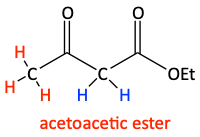
If a red hydrogen atom from the methyl group is removed, the enolate conjugate base can be stabilized with one resonance form. But, the blue hydrogen atoms on the carbon atom between the two carbonyls are even more acidic since two resonance forms can be drawn for its enolate conjugate base.
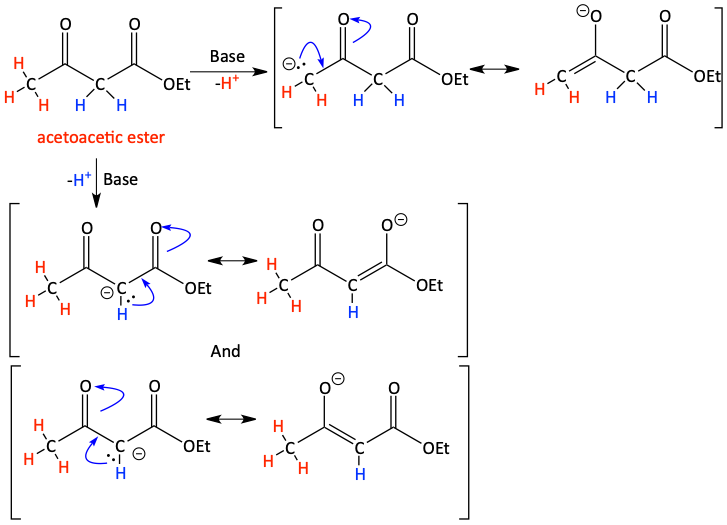
Whenever you encounter a choice of which protons to deprotonate, if you see these especially acidic protons between two carbonyl groups, deprotonate there.
In the acetoacetic ester synthesis, acetoacetic ester is first deprotonated between the carbonyl groups. The resulting enolate reacts with an alkyl halide via an SN2 reaction to alkylate it. Once the ester is hydrolyzed with acid and heat, the esters turn into a carboxylic acid.

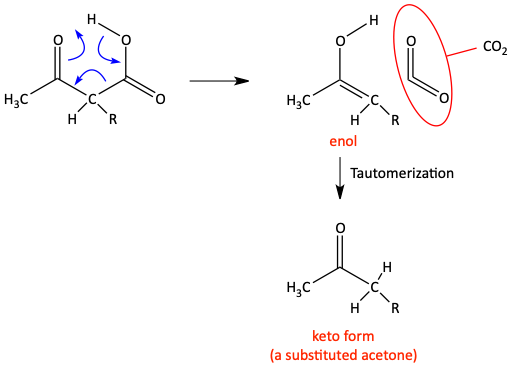
A carboxylic acid that is beta to a carbonyl is interesting. It decarboxylates, or loses carbon dioxide.
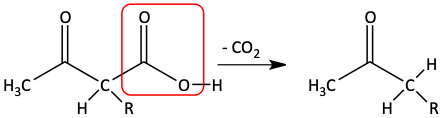
Let’s redraw the carboxylic acid beta to a carbonyl in such a way as to show the mechanism of the decarboxylation. As the carbon dioxide is eliminated, an enol is formed. It tautomerizes under acidic conditions to a keto form. This ketone is a substituted acetone.