7.8 Extra Problems
14. Identify each set of compounds as conformational isomers (conformers), constitutional isomers (structural isomers), stereoisomers, or identical.
a) cis-1,3-dibromocyclohexane vs. trans-1,4-dibromocyclohexane b) CH2=CH-CH3 vs. CH3-CH=CH2
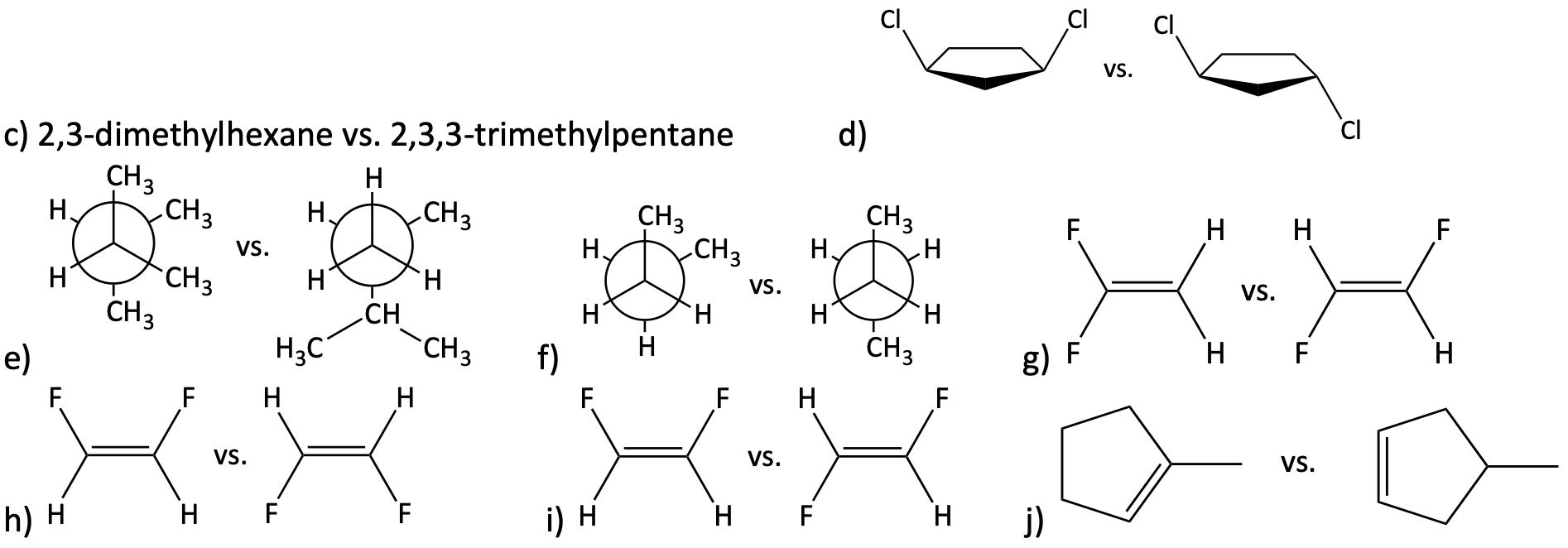
15. This molecule is a form of D-glucose. In each box, indicate if the arrow points to a carbon that is R, S, or NA. Use NA for not applicable for non-stereogenic carbon atoms.
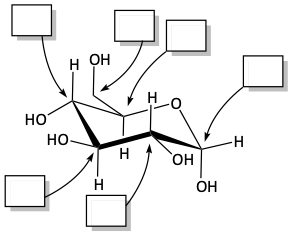
16. For each of the following compounds, identify whether the stereogenic atom is R or S.

17. Draw the following compounds and identify the molecules as chiral or achiral. a) (R)-2-chloropentane
b) (2R,3S)-2-chloro-3-methylpentane
c) (2R,3R)-2,3-dichlorobutane d) (2R,3S)-2,3-dichlorobutane
e) meso-1,2-dibromo-1,2-dichlorocyclobutane
f) (S)-1-bromo-1-chloroethane
g) (1R,3S)-1,3-dibromo-1,3-dichloropropane
h) (S)-1-bromo-1-chloro-1-fluoro-1-iodomethane
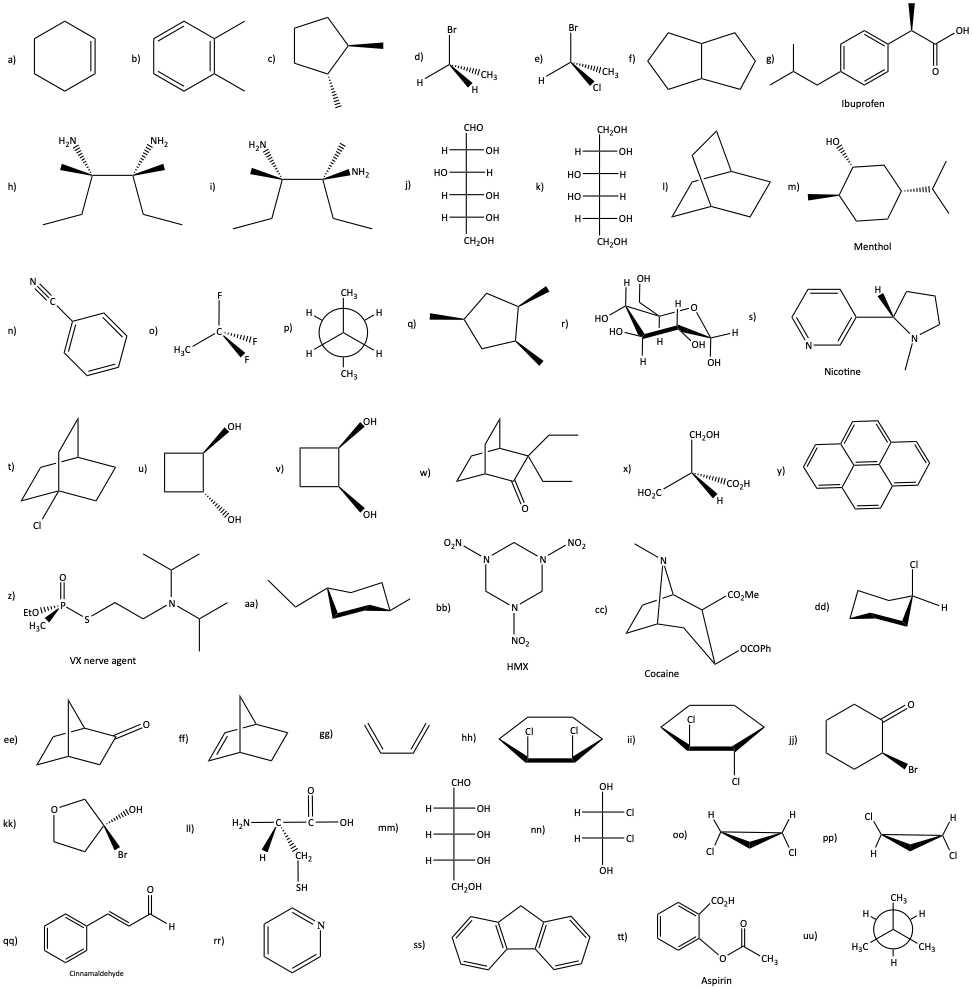
18. Circle each of the following compounds that is a meso compound.

19. Identify each of the following molecules as chiral or achiral.
20. A reaction was performed giving the S-enantiomer in 97% e.e. Which of the following is true? a) 97% of the S- enantiomer and 3% of the R- enantiomer were formed. b) 97% of the R- enantiomer and 3% of the S- enantiomer were formed. c) 98.5% of the S- enantiomer and 1.5% of the R- enantiomer were formed. d) None of these is correct.
21. Draw the enantiomer (if one exists) for the following compounds.

22. (R)-glyceraldehyde has a specific rotation of +8.7º, a) What is the specific rotation of (S)-glyceraldehyde? b) A mixture of 75% of (S)-glyceraldehyde and 25% of (R)-glyceraldehyde was made. What is the e.e. of this mixture? c) What is the specific rotation of the mixture in part (b)? d) Because (R)-glyceraldehyde rotates plane polarized light to the right, +8.7º, it can also be called what two names? (Use (d)-, (l)-, (+)-, or (-)-.) e) A mixture of 6.0 grams of (R)-glyceraldehyde and 4.0 grams of (S) glyceraldehyde has an e.e. of _____% and a specific rotation of _____º. f) A mixture of equal amounts of (R)-glyceraldehyde and (S)-glyceraldehyde has an e.e. of _____%. This type of mixture is called a _______________. g) If a mixture of glyceraldehyde enantiomers has a specific rotation of -6.96º. What is its e.e.?
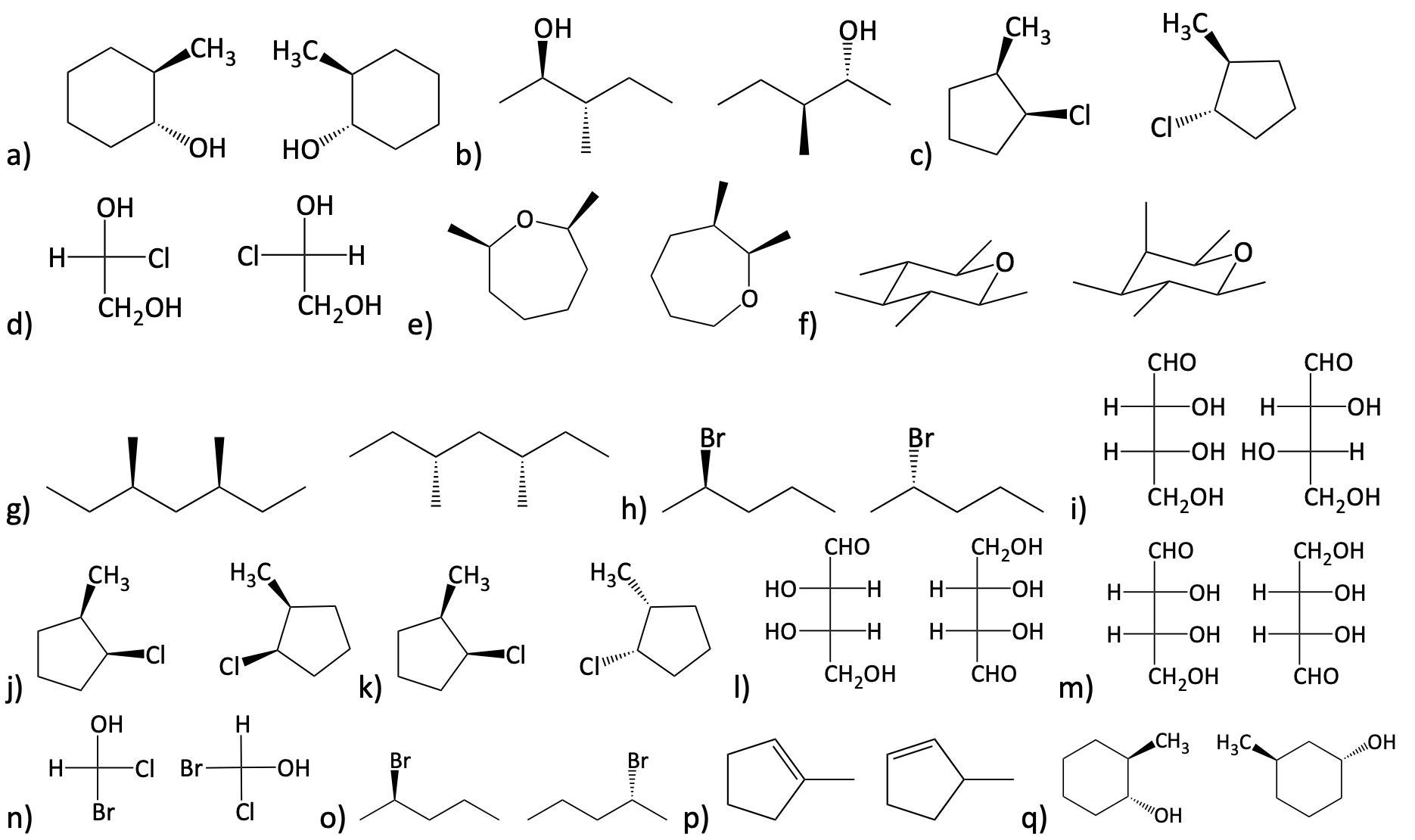
23. Give the following pairs of compounds the appropriate label from the following: enantiomers, diastereomers, structural isomers, or the same compound.
24. Name the following compounds. Their Fischer projections are shown. Use R and S as appropriate.

25. The following is a synthesis of a compound that has been proven to be highly inhibitive to HIV-1 protease. The reaction sequence involved the following:
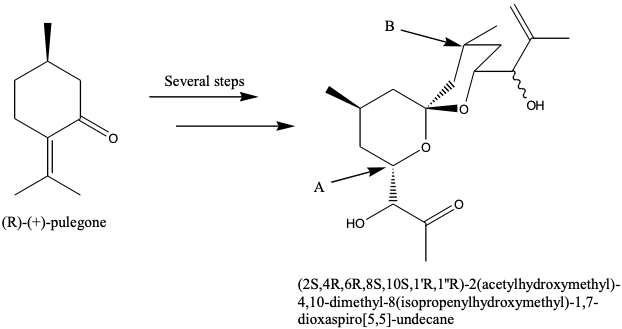
a) Why is the starting material labeled (R)? b) What does the (+) mean for the pulegone starting material? c) Do (R) and (+) always go together or can some compounds have (S) and (+)? d) Draw and name the enantiomer of (R)-(+)-pulegone. e) The carbon marked A in the product is either carbon #2 or carbon #4. Which is it? Explain your reasoning. f) Is the methyl group on the carbon atom marked B in the product axial or equatorial? Let’s identify some other parts on the product above. . .
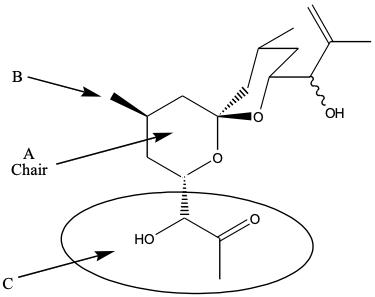
The 6-membered ring marked with an arrow is really a chair. We are looking straight down on the molecule.
g) Are the two groups (B and C) cis or trans to each other? h) For B and C, state if you think B is axial or equatorial and if you think C is axial or equatorial. Explain your reasoning. (Hint: It may help to draw out a chair to answer this question.)