Which is the better base?
A base is a compound that grabs a proton, H+. If we are asked the question, “Which of two compounds is the better base?” we are really being asked, “How likely is the compound to go and grab a proton, H+? If the compound is very happy, it will stay the way it is and not grab a proton. It would be a poor base. If it is not happy, it is more likely to go grab an H+ and be a good base. Another way to think about it is a good base has the most concentrated negative charge and is most likely to go grab an H+.For the following, the strongest base of each pair is circled.

Rule 1 explains this. Oxygen and nitrogen are on the same row of the periodic table. Oxygen is more electronegative than nitrogen, so is more stable with the negative charge. Being more stable, negative oxygen is less likely to go grab H+ compared to negative nitrogen.

Rule 1 explains this. I and Cl are in the same column of the periodic table—both halogens. I‑ is a larger anion than is Cl‑. The negative charge can spread out more on I-, so it is happier, or more stable than Cl-. Since Cl‑ has a more localized negative charge and it is less happy, it will be more likely to go grab an H+. It is a better base.

Rule 2 explains this. The negative charge of the acetate molecule on the left can be shared over two oxygen atoms through resonance. The negative charge on the right cannot be shared, so it is a localized negative charge. This is unhappy and more likely to go grab an H+, making it a better base.

Rule 3 explains this. They both have a juicy lone pair of negative electrons on a nitrogen atom. Since they are both nitrogen atoms, it is a tie. The difference is that one nitrogen atom has one methyl group attached while the other has two methyl groups attached. The methyl groups are electron donating. Therefore, the molecule on the right has a greater negative electron density on its nitrogen atom, making it more likely to grab an H+. It is a better base.

Rule 4 explains this. The negative charge on the triple bond is in an sp hybrid orbital. The negative charge on the single bond is in an sp3 hybrid orbital. The lone pair of electrons in the sp hybrid orbital is held closer to its positive carbon nucleus and is more stable. Being more stable, it is less likely to go grab an H+, so it is a worse base.

Rule 3 explains this. The molecule on the left has electronegative chlorine atoms which help pull the negative charge through the sigma bond framework by induction. This makes the negative charge more spread out and the molecule happier. The anion on the right has the negative charge stuck on one oxygen all by itself. It is unhappy. It has a localized negative charge. It is more likely to grab an H+ and is a better base.
9. In each of the following pairs, circle the one that is the stronger base.
a)
b)
c)
d)

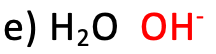
e)

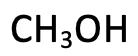
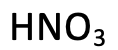
10. What is the conjugate base, if any, for the following compounds?
a)
b)
c)
d)

e)

11. The butyl anion (CH3CH2CH2CH2:-) is a much stronger base than bromide (Br-). Explain.
9.
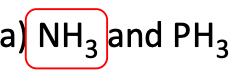
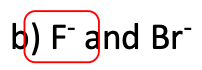
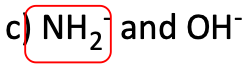
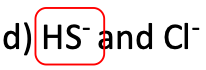

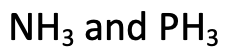
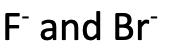
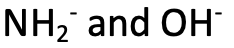
a) The lone pair of electrons are more spread out on the larger P atom than the N atom making the electron density more concentrated on the N and ready to go react.b) The negative charge is spread out more on the Br- (larger) than the F-.c) Both N and O are in the same row. O is more electronegative than N so is more stable with the negative charge making the NH2- the stronger base.d) Same row. Cl is more electronegative and more stable with the negative charge than S.e) The alkyl groups donate electron density towards the negative charge. Isopropoxide has more alkyl groups donating electron density making its negative oxygen less stable and more reactive, more basic.
10.


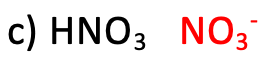
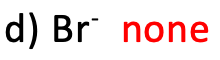
11. The butyl anion (CH3CH2CH2CH2:-) is a much stronger base than bromide (Br-). Explain. The negative charge on the carbon of the butyl anion is on a smaller, carbon atom. It is more localized. The negative charge is more spread out on the bromide ion since it is larger. This makes it more stable, happier. Therefore, the butyl anion is more likely to grab a proton, making it a stronger base.