Review
We have already learned several ways to make alcohols. We will review them here.
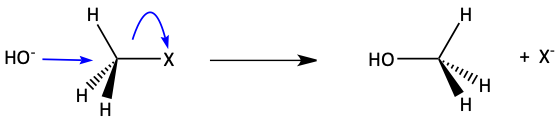
The SN2 reaction of hydroxide with an alkyl halide
Acid hydration of an alkene

Markovnikov Oxymercuration & Demercuration of an alkene in water

Anti-Markovnikov hydroboration of an alkene

Syn-dihydroxylation of an alkene using osmium tetroxide

Syn-dihydroxylation of an alkene using potassium permanganate

Epoxidation of an alkene followed by acid hydrolysis

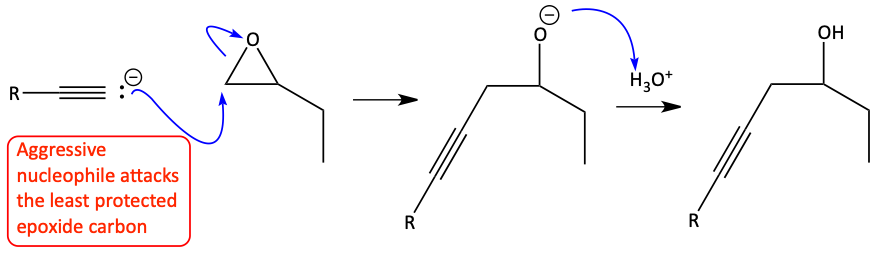
Acetylide attack of an epoxide
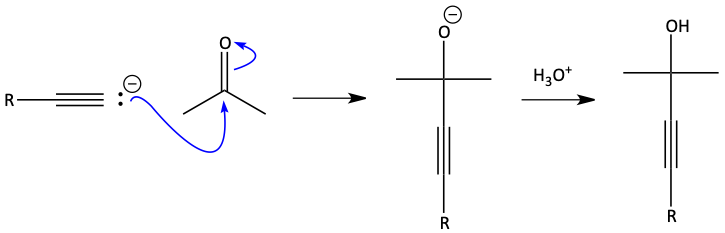
Acetylide attack of a carbonyl
2. Fill in the blank for the missing reagents in the following reactions.

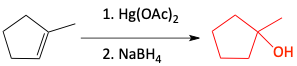
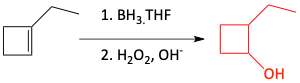
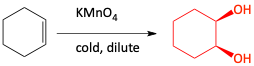
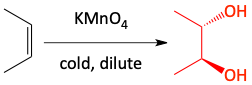
3. Draw the products of the following reactions.a) 1-methyl cyclopentene with Hg(OAc)2 followed by NaBH4b) 1-ethyl cyclobutene with BH3.THF followed by hydrogen peroxide and hydroxidec) Cyclohexene with cold, dilute KMnO4d) cis-2-butene with a peroxyacid in watere) pentyne reacted with sodium amide followed by benzaldehyde (PhCHO) and then quenched with acid and water
2.
A) 1. Hg(OAc)2 or H+, H2O (H3O+) 2. NaBH4 B) 1. BH3.THF 2. H2O2, OH- C) RCO3H in H2O D) 1. OsO4 or KMnO4, OH- (cold, dilute) 2. H2O2 E)

F)

3.
a)
b)
c)
d)
e)
